
Many businesses and homeowners believe purchasing shipping containers outright is their only path to secure storage or transport solutions. This assumption overlooks rent-to-own programs that provide flexible, budget-friendly alternatives perfectly suited for Massachusetts needs. Rent-to-own allows you to acquire containers through manageable monthly payments while building toward ownership without the hefty upfront investment. This guide explains how these programs work, what they cost locally, and practical steps to find the right container solution near you in Massachusetts.
Table of Contents
- What Is Rent-To-Own For Shipping Containers And How Does It Work?
- Costs And Local Availability Of Rent-To-Own Shipping Containers In Massachusetts
- Choosing The Right Container And Preparing Your Site: What To Consider Before Rent-To-Own
- Rent-To-Own Vs. Buying And Financing: What’s Best For Your Massachusetts Storage Needs?
- Explore Your Options With Apple Truck & Trailer In Massachusetts
Key takeaways
| Point | Details |
|---|---|
| Flexible ownership path | Rent-to-own lets you acquire containers through manageable monthly payments with purchase options after 12 to 48 months. |
| Local cost ranges | Massachusetts rates typically range from $75 to $500 monthly depending on container size and condition. |
| Affordable used options | Used cargo worthy containers start around $1,850 in the Massachusetts area, providing budget-friendly entry points. |
| No credit barriers | Most rent-to-own programs bypass credit checks and focus on payment ability, ideal for varied financial situations. |
| Site preparation matters | Strong foundations and proper soil bearing capacity ensure safe, durable container usage and prevent structural issues. |
What is rent-to-own for shipping containers and how does it work?
Rent-to-own means renting a shipping container with an eventual option to purchase it after completing a set term. Unlike traditional rentals where payments disappear into the ether, your monthly contributions actually build toward ownership. Rent-to-own agreements typically last around 36 months, though some programs offer flexibility ranging from 12 to 48 months depending on your needs and budget.
The beauty of these programs lies in their accessibility. Most bypass credit checks entirely and focus on your ability to make consistent payments, making them perfect for businesses or homeowners facing credit challenges. You get immediate access to the container for storage or transport while gradually working toward full ownership. Some providers even sweeten the deal with early payoff discounts if you decide to purchase sooner than the contract term.
During the rental period, you maintain full use of the container just as if you owned it outright. Store equipment, inventory, household items, or use it for transport needs without restrictions. The container sits on your property, accessible whenever you need it. Once you complete the agreed payment schedule, the container becomes yours with no additional purchase required in most agreements.
Pro Tip: Ask providers about early buyout options before signing. Many programs offer discounts of 10% to 20% if you pay off the remaining balance ahead of schedule, potentially saving hundreds of dollars.
Contract terms vary by provider, so read the fine print carefully. Some agreements automatically transfer ownership after the final payment, while others require a nominal purchase fee. Clarify maintenance responsibilities, delivery costs, and what happens if you need to end the agreement early. Understanding these details upfront prevents surprises and ensures the program aligns with your storage container needs.
Costs and local availability of rent-to-own shipping containers in Massachusetts
Pricing for rent-to-own containers in Massachusetts depends heavily on size, condition, and specific provider terms. Monthly rental costs range from $100 to $500 depending on whether you choose a compact 20-foot unit or a spacious 40-foot container. Smaller containers naturally cost less, making them attractive for homeowners with limited storage needs or tight budgets.
Used 40-foot containers typically start around $1,850 in the Massachusetts area when purchasing outright. Rent-to-own programs spread this cost across monthly payments, often totaling slightly more due to financing but eliminating the upfront burden. A typical rent-to-own arrangement for a used 40-foot container might run approximately $75 monthly over 36 months, though rates vary based on condition and provider markup.
| Container Size | Monthly Rent Range | Typical Purchase Price | Rent-to-Own Monthly |
|---|---|---|---|
| 20 ft Used | $100 to $200 | $1,200 to $2,500 | $50 to $125 |
| 40 ft Used | $150 to $300 | $1,850 to $3,500 | $75 to $150 |
| 20 ft New | $200 to $350 | $3,000 to $5,000 | $125 to $200 |
| 40 ft New | $300 to $500 | $4,500 to $7,000 | $175 to $275 |
Used containers dominate the Massachusetts market because they offer excellent value. Most are cargo worthy, meaning they remain structurally sound for both shipping and storage despite previous use. These containers show cosmetic wear like surface rust or dents but maintain watertight integrity and structural strength. For storage purposes, cargo worthy containers perform identically to new units at a fraction of the cost.
Local availability around Massachusetts makes finding rent-to-own options relatively straightforward. Providers throughout the state offer delivery services, bringing containers directly to your property. Urban areas like Boston, Worcester, and Springfield typically have more providers competing for business, potentially driving better rates. Rural locations may face slightly higher delivery fees due to distance.
Pro Tip: Request quotes from at least three local providers before committing. Pricing can vary significantly, and some offer promotional rates or waived delivery fees during slower seasons.
When evaluating rent versus buy decisions, consider your timeline. Renting makes sense for short-term needs under six months, while buying beats renting if you need storage beyond one year. Rent-to-own occupies the middle ground, perfect when you anticipate long-term needs but lack upfront capital. Calculate total costs across your expected usage period to determine which option delivers the best value for your specific situation. Check out Massachusetts storage container rentals and 40-foot container rates to compare local pricing.
Choosing the right container and preparing your site: what to consider before rent-to-own
Selecting the appropriate container starts with understanding the difference between new one-trip containers and used cargo worthy units. New containers arrive from overseas shipping routes after a single voyage, featuring pristine paint, minimal wear, and premium appearance. They cost significantly more but appeal to businesses prioritizing aesthetics or requiring spotless interiors. Used cargo worthy containers show their history through surface rust and minor dents but deliver identical functionality at lower prices.

Container size directly impacts both cost and utility. Standard 20-foot containers provide approximately 1,170 cubic feet of storage, suitable for household moves, seasonal inventory, or small business equipment. The 40-foot version doubles capacity to around 2,390 cubic feet, accommodating larger inventories, construction equipment, or extensive household storage. Measure your available property space carefully, accounting for delivery truck access and door swing clearance before committing to a size.
Certified containers meet international standards for protection and waterproofing, ensuring they withstand harsh weather and maintain cargo integrity. Look for cargo worthy certification when selecting used containers, as this designation confirms structural soundness and watertight seals. Avoid containers labeled as-is or for parts only, as these may have significant structural damage or leaks.
Foundation preparation proves critical for container stability and longevity. Soil bearing capacity determines how much weight your ground can support without settling or failure. A fully loaded 40-foot container can weigh 67,200 pounds, concentrating immense pressure on relatively small footprints. Exceeding soil capacity causes uneven settling, potentially warping the container frame and compromising door operation.
- Level the ground within two inches across the entire container footprint
- Remove vegetation, topsoil, and organic matter that compresses over time
- Compact the base soil thoroughly using mechanical compaction equipment
- Install concrete piers, railroad ties, or gravel pads at each corner and midpoints
- Ensure proper drainage to prevent water pooling around the foundation
Pro Tip: Invest in a professional site survey if placing containers on clay soil or in areas with high water tables. These conditions require specialized foundation solutions to prevent costly settling issues.
Foundation options range from simple gravel pads to full concrete slabs. Gravel pads offer the most cost-effective solution for temporary placements, costing $200 to $500 depending on size. Concrete pier foundations provide superior stability for permanent installations, running $800 to $2,000 but eliminating settling concerns. Full concrete slabs deliver maximum stability and level floors but cost $3,000 to $6,000 for a 40-foot container pad.
Consider local zoning regulations before finalizing your container placement. Some Massachusetts municipalities classify shipping containers as temporary structures requiring permits, while others impose setback requirements from property lines. Contact your local building department early in the planning process to understand applicable rules. Learn more about storage container basics to make informed decisions.
Rent-to-own vs. buying and financing: what’s best for your Massachusetts storage needs?
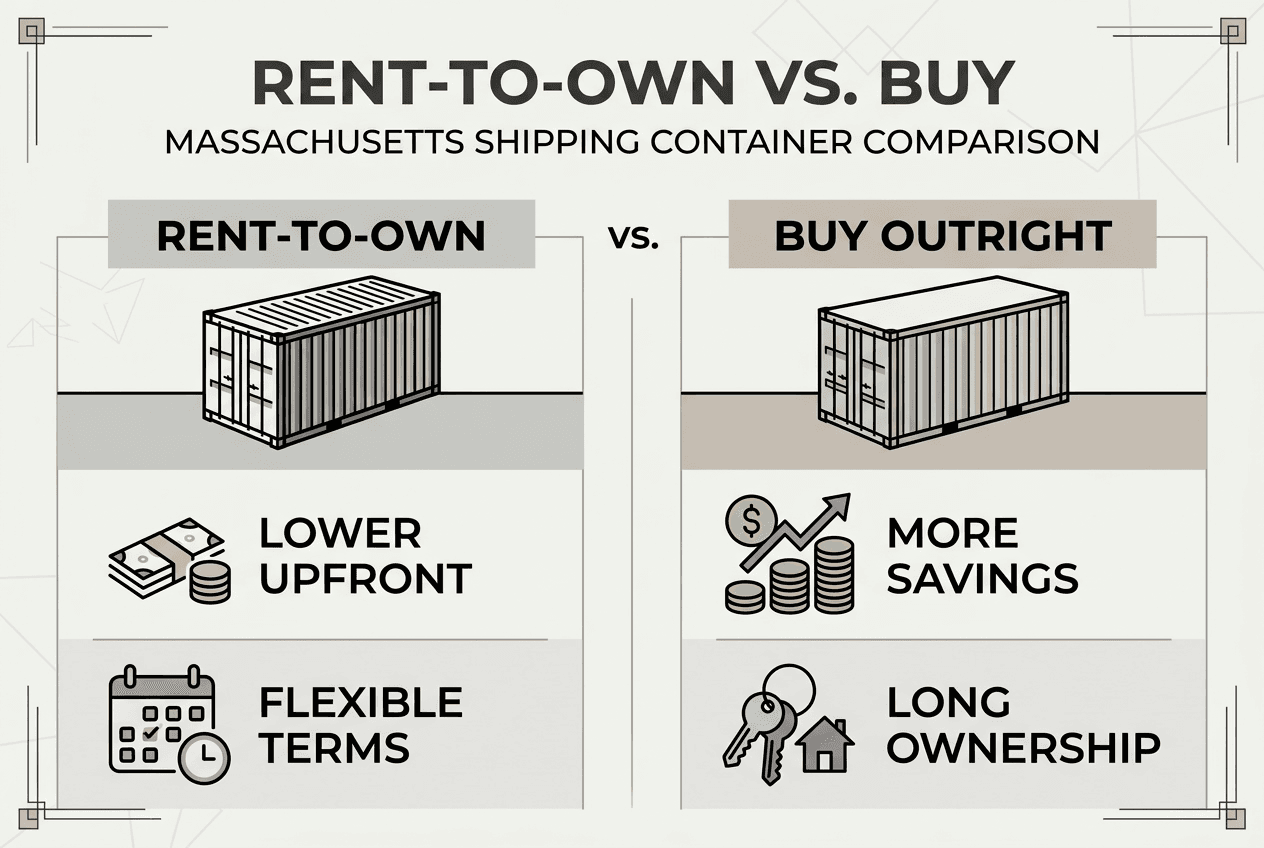
Comparing financing options requires examining total costs, flexibility, and how each aligns with your financial situation. Rent-to-own provides the lowest barrier to entry with minimal upfront costs and simple approval processes. You start using the container immediately while building toward ownership through monthly payments. However, total costs typically exceed outright purchase prices due to implicit financing charges built into the payment structure.
Buying outright delivers better long-term value if you need a container for more than one year. A used 40-foot container costing $1,850 upfront saves money compared to 24 months of $125 rent-to-own payments totaling $3,000. The break-even point typically occurs around 15 to 18 months, after which ownership costs less than continued renting or rent-to-own arrangements.
Financing options include equipment loans, business credit lines, and personal loans, each suiting different credit profiles and business structures. Equipment loans specifically designed for container purchases offer competitive rates between 6% and 12% APR with terms up to five years. Business credit lines provide flexibility for companies needing multiple containers, while personal loans work for homeowners without established business credit.
| Option | Upfront Cost | Monthly Payment | Total Cost (36 months) | Credit Required | Ownership Timeline |
|---|---|---|---|---|---|
| Rent-to-Own | $0 to $500 | $75 to $275 | $2,700 to $9,900 | None | 12 to 48 months |
| Equipment Loan | 10% to 20% down | $60 to $200 | $2,500 to $7,500 | Good to excellent | Immediate |
| Outright Purchase | Full price | $0 | $1,850 to $7,000 | None | Immediate |
| Traditional Lease | $0 to $300 | $100 to $500 | $3,600 to $18,000 | Minimal | Never |
Rent-to-own shines in specific scenarios where its unique benefits outweigh higher total costs:
- Credit challenges prevent traditional financing approval
- Cash flow constraints make large upfront payments impossible
- Uncertain long-term needs require flexibility to return the container
- Business startups need to preserve working capital for operations
- Testing container solutions before committing to permanent ownership
Traditional leasing restricts usage to storage only in many agreements, while purchasing or rent-to-own provides full control for both storage and transport. This distinction matters for businesses needing containers for job site mobility or homeowners planning future moves. Lease agreements also never build equity, with payments funding temporary access rather than eventual ownership.
Pro Tip: Calculate your break-even point by dividing the outright purchase price by monthly rent-to-own payments. If you need the container longer than this period, buying outright or financing saves money despite higher upfront costs.
Rent-to-own works best when you value flexibility and immediate access over total cost savings. The premium you pay buys financial breathing room and the option to walk away if circumstances change, which traditional financing cannot offer.
Your choice depends on weighing immediate financial capacity against long-term value. Strong credit and available capital favor equipment loans or outright purchases for maximum savings. Limited credit or tight cash flow makes rent-to-own the practical path to container ownership. Temporary needs under one year justify simple rentals, while permanent requirements exceeding two years demand ownership through purchase or financing. Explore comprehensive storage container rental guides to understand all your Massachusetts options.
Explore your options with Apple Truck & Trailer in Massachusetts
Now that you understand rent-to-own fundamentals and how to evaluate your options, connecting with a trusted local provider simplifies the next steps. Apple Truck & Trailer offers comprehensive shipping container solutions throughout Massachusetts, serving both businesses and homeowners since 1986. Their inventory includes various sizes and conditions, from budget-friendly used containers to pristine one-trip units.
Whether you need short-term rentals or flexible rent-to-own arrangements, their team provides personalized guidance matching containers to your specific requirements and budget. Competitive pricing combined with delivery throughout Massachusetts, Rhode Island, Connecticut, and New Hampshire ensures convenient access regardless of your location. Explore 40-foot storage container rentals, browse Massachusetts storage container options, or learn about rental benefits to find your ideal solution.
Frequently asked questions
What is rent to own shipping containers near me?
Rent-to-own means paying monthly rental fees that gradually build toward purchasing the shipping container outright. Unlike traditional rentals where payments only secure temporary access, rent-to-own agreements credit your payments toward eventual ownership after completing the contract term. Most programs last 12 to 36 months and allow immediate use for storage or transport during the rental period. You can find local Massachusetts providers through online searches, container dealers, and equipment rental companies serving your area.
How much does renting to own a shipping container cost in Massachusetts?
Monthly rent-to-own payments typically range from $75 to $500 depending on container size, condition, and provider terms. A used 20-foot container might cost $50 to $125 monthly, while a 40-foot unit runs $75 to $150 monthly for used cargo worthy condition. New containers command premium rates between $175 and $275 monthly for 40-foot units. Total costs over the contract period typically exceed outright purchase prices but eliminate large upfront payments.
What should I consider before renting to own a shipping container?
Evaluate total costs including any interest or fees, contract length, and whether your site foundation can support container weight before committing. Calculate whether rent-to-own costs more than buying outright or securing traditional financing over your expected usage period. Proper foundation preparation prevents soil failure under the concentrated weight of loaded containers. Review contract terms carefully, understanding maintenance responsibilities, early termination penalties, and what happens at the end of the rental period.
Can businesses and homeowners in Massachusetts use rent-to-own containers for transport or only storage?
Rent-to-own agreements typically allow both storage and transport usage since you are working toward ownership rather than simply leasing. This flexibility differentiates rent-to-own from traditional leases that often restrict containers to stationary storage only. You can move the container between job sites, use it for shipping if cargo worthy certified, or relocate it on your property as needs change. Verify usage terms with your specific provider, as some may impose restrictions based on insurance or liability concerns.
Where can I find rent-to-own shipping container providers near me in Massachusetts?
Local container dealers, equipment rental companies, and specialized storage solution providers throughout Massachusetts offer rent-to-own programs. Search online for shipping container dealers in your city or region, then contact multiple providers to compare rates and terms. Many companies deliver throughout the state, so you are not limited to providers in your immediate town. Request detailed quotes including delivery fees, contract length options, and total costs to identify the best value for your situation.