
More than 3.5 million american drivers work behind the wheel of commercial trucks, yet many are unclear about key semi-trailer terminology. Understanding this vocabulary matters because every part, from the chassis to the kingpin, plays a role in safety and efficiency on the road. Whether you are in logistics or just learning about the trucking industry, clear definitions help everyone make smarter decisions and improve everyday operations.
Table of Contents
- Defining Semi-Trailer Terminology And Concepts
- Common Types Of Semi-Trailers Explained
- Essential Parts And Components Glossary
- Industry Jargon And Abbreviations Decoded
- Regulatory And Safety Terms For Operators
Key Takeaways
| Point | Details |
|---|---|
| Understanding Semi-Trailer Usage | Semi-trailers are non-powered vehicles that couple with tractors, enabling efficient goods transport while offering flexibility in logistics. |
| Core Components of Semi-Trailers | Key elements like the chassis, landing gear, and kingpin play crucial roles in the functionality and safety of semi-trailers. |
| Types of Semi-Trailers | Various configurations such as dry vans and refrigerated units exist to meet diverse transportation needs across industries. |
| Importance of Regulatory Terms | Familiarity with safety regulations and terms like CDL and HOS is essential for effective communication and compliance in commercial trucking. |
Defining Semi-Trailer Terminology and Concepts
A semi-trailer represents a specialized non-powered transportation vehicle designed to transport goods across various distances. According to the World Road Association’s definition, these vehicles are engineered to couple with a motor vehicle, allowing part of their weight and cargo load to be supported by the towing vehicle. This unique design enables efficient goods transportation while maintaining flexibility in commercial trucking operations.
Semi-trailers differ fundamentally from standard trailers through their distinctive coupling mechanism. Unlike full trailers that require support from both their own wheels and the towing vehicle, semi-trailers transfer a significant portion of their weight onto the tractor’s rear axle. This engineering approach provides enhanced maneuverability and weight distribution, making them ideal for long-distance commercial transportation. The coupling point, typically a fifth wheel mechanism, allows for smooth connection between the tractor and trailer units.
The core components of a semi-trailer include several critical elements that define its functionality and performance. These typically encompass:
- Chassis: The fundamental structural framework supporting the entire trailer
- Landing Gear: Retractable support legs enabling independent standing when disconnected from the tractor
- Kingpin: A crucial locking mechanism that connects the trailer to the tractor’s fifth wheel
- Suspension System: Absorbs road vibrations and supports weight distribution
- Cargo Area: The primary space designed for transporting goods, available in various configurations like dry van, flatbed, or refrigerated units
Understanding these fundamental terminology and concepts provides fleet managers, logistics professionals, and commercial vehicle operators with essential insights into semi-trailer mechanics and operational characteristics. Whether you’re managing a transportation business or simply interested in commercial vehicle infrastructure, recognizing these core elements helps navigate the complex world of freight transportation more effectively.
Common Types of Semi-Trailers Explained
Semi-trailers come in diverse configurations, each engineered to meet specific transportation requirements across various industries. The Intermodal Association of North America recognizes multiple specialized trailer types that serve unique logistical purposes. Understanding these variations helps businesses select the most appropriate trailer for their specific freight transportation needs.

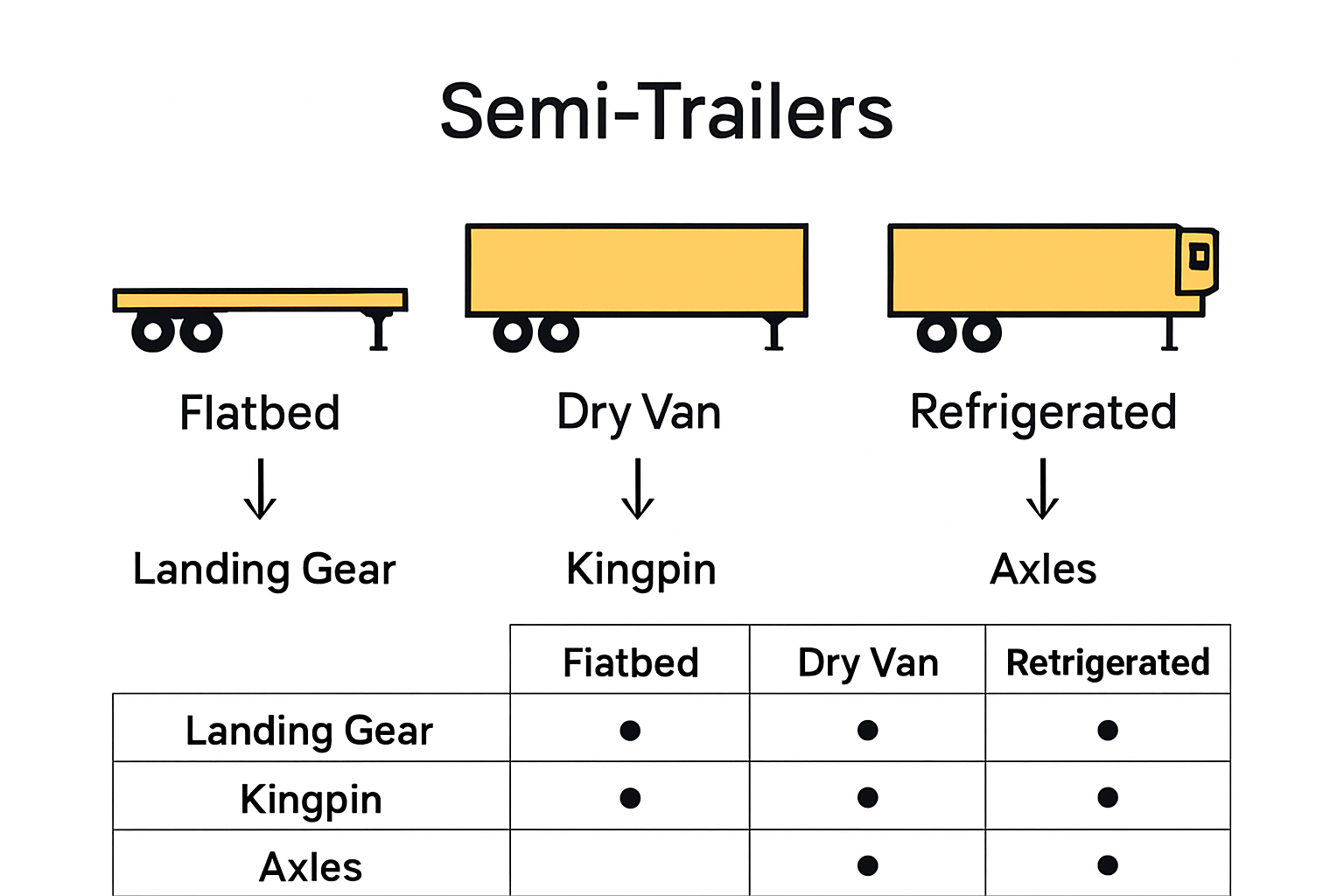
Among the most prevalent semi-trailer types are dry van trailers, which represent the standard enclosed cargo transport solution. These versatile trailers protect goods from weather and external contamination, making them ideal for non-perishable freight. Flatbed trailers offer an alternative design, featuring an open platform that allows for oversized or oddly shaped cargo like construction equipment, machinery, and large industrial components. Specialized intermodal trailers further expand transportation capabilities by supporting multiple transportation modes.
More specialized semi-trailer types include:
- Refrigerated Trailers (Reefers): Temperature-controlled units for perishable goods
- Tanker Trailers: Designed for liquid and gas transportation
- Lowboy Trailers: Ultra-low deck height for transporting tall or heavy machinery
- Conestoga Trailers: Featuring sliding fabric covers for easy side loading
- Step Deck Trailers: Two-level platforms accommodating taller cargo
The piggyback semi-trailer represents a particularly innovative design, featuring reinforced lateral beams that enable lifting by gantry or mobile crane. This design facilitates seamless intermodal transportation, allowing trailers to transition efficiently between different transport modes like trucks, trains, and ships. Such engineering innovations demonstrate the continuous evolution of semi-trailer technology to meet increasingly complex logistical challenges.
Essential Parts and Components Glossary
Understanding the intricate components of semi-trailers requires familiarity with specialized terminology that defines their complex mechanical systems. Intermodal transportation experts have developed a comprehensive vocabulary to describe these essential elements, enabling precise communication among transportation professionals and engineers.
Key structural components form the foundation of semi-trailer functionality. The kingpin, a critical connection point, allows the trailer to attach securely to the tractor’s fifth wheel. Landing gear provides independent support when the trailer is disconnected, while the chassis serves as the fundamental structural framework. Semi-truck terminology distinguishes these components with remarkable precision, reflecting the engineering complexity of modern transportation equipment.
Specialized connection and securing mechanisms play crucial roles in trailer functionality:
- Twist-locks: Securing devices inserted into corner castings
- Fifth wheel: Circular coupling mechanism on tractor connecting to trailer
- Suspension system: Complex arrangement absorbing road vibrations
- Axle assemblies: Support structures managing trailer weight distribution
- Brake system: Hydraulic or air-powered stopping mechanism
The technical terminology surrounding semi-trailers reflects the intricate engineering required for modern freight transportation. Each component represents a carefully designed element that contributes to the trailer’s overall performance, safety, and efficiency. Understanding these terms provides insights into the sophisticated world of commercial transportation infrastructure.
Industry Jargon and Abbreviations Decoded
Commercial trucking has developed a rich vocabulary of colorful terms and technical abbreviations that can perplex outsiders. Safety experts have documented numerous informal nicknames that reflect the culture and experience of professional drivers, such as calling an 18-wheel semi-truck an eighteen or a wiggle wagon when describing a truck with a trailer.
Professional trucking communication relies heavily on specialized abbreviations that streamline complex technical discussions. CDL stands for Commercial Driver’s License, while DOT represents the Department of Transportation. Commercial vehicle terminology encompasses a wide range of technical and colloquial terms that help drivers, dispatchers, and logistics professionals communicate efficiently and precisely.
Key industry abbreviations and slang terms include:
- ABS: Anti-lock Braking System
- GVW: Gross Vehicle Weight
- GVWR: Gross Vehicle Weight Rating
- PSI: Pounds per Square Inch
- BOL: Bill of Lading
- ELD: Electronic Logging Device
- Bobtail: Truck without trailer
- Deadhead: Driving without cargo
- Lot Lizard: Truck stop prostitute (derogatory term)
The comprehensive glossary of commercial motor vehicle terms reveals the intricate language that professionals use daily. This specialized vocabulary serves as a shorthand communication method, allowing quick and precise information exchange in a fast-paced industry where every second counts.
Regulatory and Safety Terms for Operators
Navigating the complex world of commercial transportation requires a deep understanding of regulatory terminology and safety standards. Federal Motor Carrier Safety Administration guidelines establish critical definitions that govern commercial vehicle operations, with the USDOT Number serving as a unique identifier for companies engaged in interstate commerce.
Safety regulations create a framework of precise operational standards for commercial vehicle operators. Truck tractors, defined as motor vehicles designed primarily to draw another vehicle, represent a specific classification with unique regulatory requirements. Commercial vehicle safety protocols encompass a wide range of technical specifications and legal obligations that drivers and fleet managers must understand and implement.
Key regulatory and safety terms include:
- CDL: Commercial Driver’s License
- HOS: Hours of Service regulations
- CSA: Compliance, Safety, Accountability program
- ELD: Electronic Logging Device mandate
- FMCSA: Federal Motor Carrier Safety Administration
- DOT: Department of Transportation
- Weight Class: Vehicle categorization based on gross vehicle weight
- Payload: Maximum allowable cargo weight
- Tare Weight: Vehicle weight without cargo
The comprehensive regulatory framework surrounding commercial transportation ensures safety, accountability, and standardization across the industry. These terms and definitions provide a critical language that helps operators, managers, and regulators communicate effectively and maintain the highest standards of road safety and operational efficiency.
Master Semi-Trailer Terminology and Find the Right Equipment for Your Fleet
Understanding the detailed terminology and components of semi-trailers is key to running an efficient and safe commercial trucking operation. Whether you are managing trailers like dry vans, flatbeds, or refrigerated units, knowing terms such as kingpin, landing gear, and chassis can help you make informed decisions about purchases, maintenance, and regulatory compliance. If your goal is to optimize your fleet with reliable and well-maintained equipment, it is essential to have access to trusted suppliers that understand these needs.

Explore a vast inventory of quality used semi trucks and trailers designed to meet varied transportation demands at Semi Truck and Trailer – Apple Truck & Trailer. Benefit from decades of expertise serving the Massachusetts and New England regions, where you can find tailored solutions to improve your fleet’s performance and compliance. Don’t wait to enhance your operation with equipment that matches your understanding of industry terms. Visit https://appletruckandtrailer.com now to request a quote or schedule a consultation and take control of your fleet’s future.
For added support on tractor-trailer options, visit Semi-Truck and Tractor-Trailer – Apple Truck & Trailer. Our team is ready to help you transform knowledge into action.
Frequently Asked Questions
What is a semi-trailer?
A semi-trailer is a non-powered transportation vehicle designed to transport goods, which couples with a motor vehicle, allowing part of its weight and cargo to be supported by the towing vehicle.
How do semi-trailers differ from full trailers?
Semi-trailers differ from full trailers by transferring a significant portion of their weight onto the tractor’s rear axle, while full trailers require support from both their own wheels and the towing vehicle for stabilization.
What are the common types of semi-trailers and their uses?
Common types of semi-trailers include dry vans for non-perishable goods, flatbeds for oversized cargo, refrigerated trailers (reefers) for perishables, and tankers for liquids and gases, each designed to meet specific transportation needs.
What are some essential components of a semi-trailer?
Essential components of a semi-trailer include the chassis, landing gear, kingpin, suspension system, cargo area, and various securing mechanisms that facilitate safe and efficient transportation.