
Choosing between a box truck and a flatbed may seem like a straightforward decision about hauling cargo. Most people think box trucks are always the affordable, go-to option for small businesses. Yet flatbed trucks can cost up to 40 percent more than comparable box trucks and deliver a level of loading flexibility that box trucks simply can’t match. The right answer often comes down to more than just size or price and that reveals a surprising side to commercial trucking that few businesses consider.
Table of Contents
- Key Differences Between Box Truck And Flatbed
- Best Uses For Box Trucks And Flatbeds
- Costs, Rentals, And Legal Considerations
- Choosing The Right Truck For Massachusetts And New England
Quick Summary
| Takeaway | Explanation |
|---|---|
| Understand cargo needs before choosing a truck | Box trucks are suited for sensitive items, while flatbeds excel with oversized loads and flexibility. |
| Evaluate weight capacity for specific applications | Flatbeds can carry heavier and larger freight, making them ideal for construction and industrial uses. |
| Consider rental and purchase costs before deciding | Box trucks typically have lower acquisition costs, while flatbeds involve higher financial commitments and operational expenses. |
| Know regional regulations affecting truck selection | In Massachusetts, specific height and weight limits may dictate which truck type is appropriate for your logistics needs. |
| Assess safety requirements based on truck type | Compliance regulations differ between box trucks and flatbeds, impacting operational costs and safety features needed for each type. |
Key Differences Between Box Truck and Flatbed
Choosing between a box truck and a flatbed requires understanding their unique characteristics and operational capabilities. While both serve critical transportation needs, their design and functionality differ significantly, making each truck type more suitable for specific industry requirements.
Cargo Capacity and Loading Flexibility
The fundamental difference between box trucks and flatbed trucks lies in their cargo management approach. Research from commercial transportation experts reveals that flatbed trucks feature an entirely open cargo area without sides or a roof, allowing loading and unloading from multiple angles. This design provides exceptional flexibility for transporting oversized or irregularly shaped materials like construction equipment, steel beams, prefabricated components, and large machinery.
In contrast, box trucks offer a fully enclosed cargo space with solid walls and a roof. This design provides superior protection against weather, dust, and potential theft. For businesses transporting sensitive or fragile items like furniture, electronics, or packaged goods, the enclosed environment of a box truck ensures maximum cargo security and integrity.
Weight Capacity and Performance Considerations
Transportation research from industry analysts indicates that box trucks typically have a lower weight capacity compared to larger commercial vehicles. They are ideal for shorter routes and urban delivery scenarios where maneuverability and compact size are paramount. The enclosed design limits the overall weight and volume of cargo, making them more suitable for smaller-scale logistics operations.
Flatbed trucks, by contrast, excel in heavy-duty transportation scenarios. Their open platform allows for greater weight distribution and the ability to carry substantially larger and heavier loads. Construction companies, industrial manufacturers, and agricultural businesses often prefer flatbed trucks for transporting massive equipment, raw materials, and specialized cargo that cannot fit within the confined space of a traditional box truck.
Operational Versatility and Industry Applications
The choice between a box truck and a flatbed depends heavily on specific industry requirements. Box trucks are predominantly used in:
- Retail and E-commerce Delivery: Protecting packaged goods during transportation
- Moving and Relocation Services: Safely transporting household or office furniture
- Food and Beverage Distribution: Maintaining temperature-controlled environments
Flatbed trucks find their primary applications in:
- Construction and Infrastructure: Transporting heavy machinery and building materials
- Agriculture: Moving large farming equipment and bulk agricultural products
- Manufacturing: Shipping oversized industrial components
Understanding these key differences enables businesses to make informed decisions about their transportation needs, ensuring optimal efficiency, cargo protection, and operational cost-effectiveness.
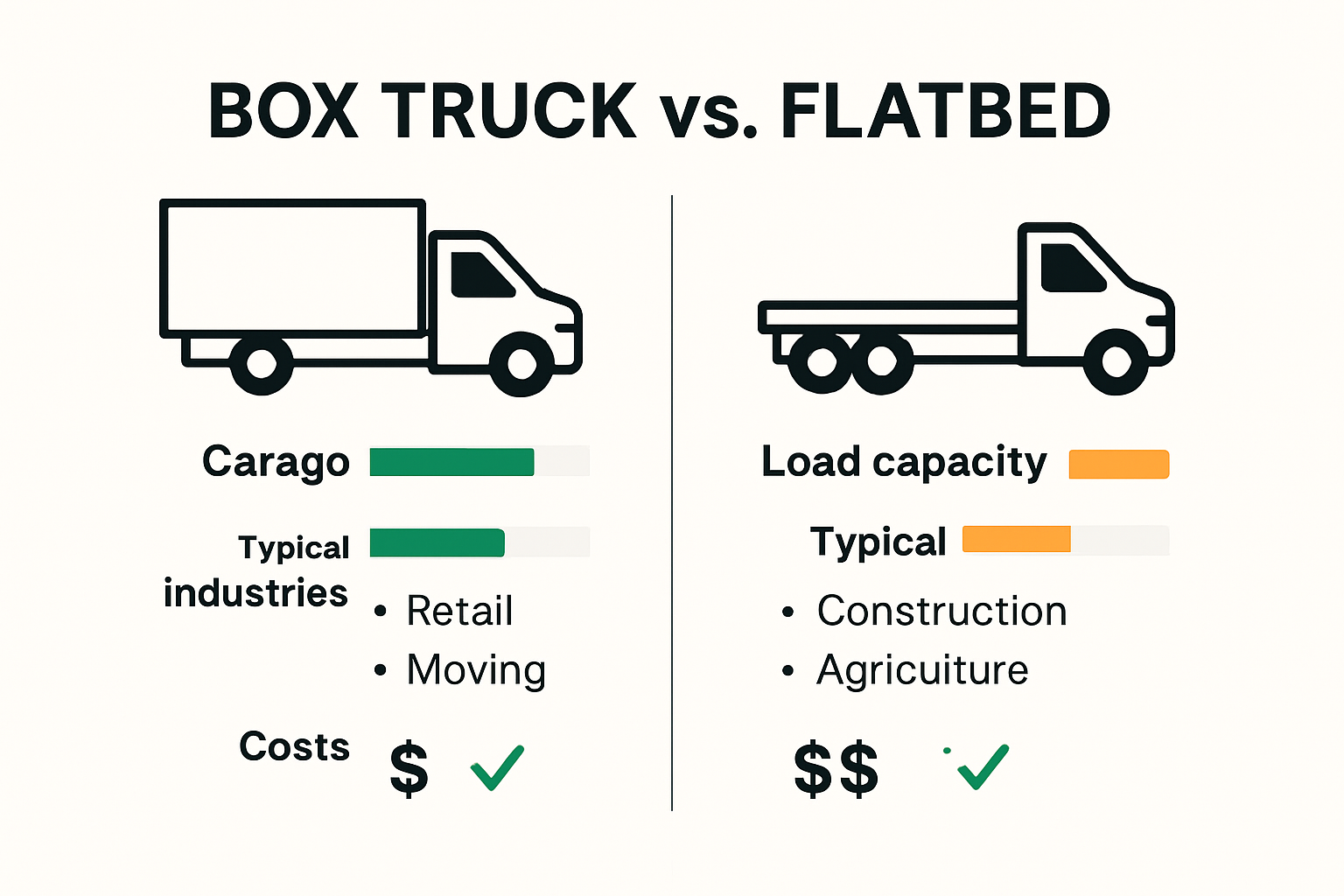
To help you quickly compare the key characteristics and uses of box trucks versus flatbed trucks, see the following table summarizing their main differences.
| Feature/Aspect | Box Truck | Flatbed Truck |
|---|---|---|
| Cargo Space | Fully enclosed, protected | Open platform, no sides or roof |
| Best For | Sensitive/fragile goods, weather-prone items | Oversized, irregular, heavy items |
| Loading/Unloading | Rear access only | Accessible from all sides/angles |
| Weight Capacity | Lower (for small/medium loads) | Higher (industrial/heavy-duty loads) |
| Typical Industries | Retail, food delivery, moving, e-commerce | Construction, agriculture, manufacturing |
| Protection from Environment | Superior (weather, theft, dust) | Limited (requires manual securing) |
| Regulatory/Compliance Needs | Easier compliance, standard safety features | Stricter tie-down, open-load regulations |
| Acquisition/Operating Costs | Lower purchase and rental costs | 20-40% higher initial and operating costs |
Best Uses for Box Trucks and Flatbeds
Understanding the optimal applications for box trucks and flatbeds is crucial for businesses seeking efficient transportation solutions. Each truck type offers unique advantages that make them ideal for specific industries and logistical challenges.
Construction and Heavy Equipment Transportation
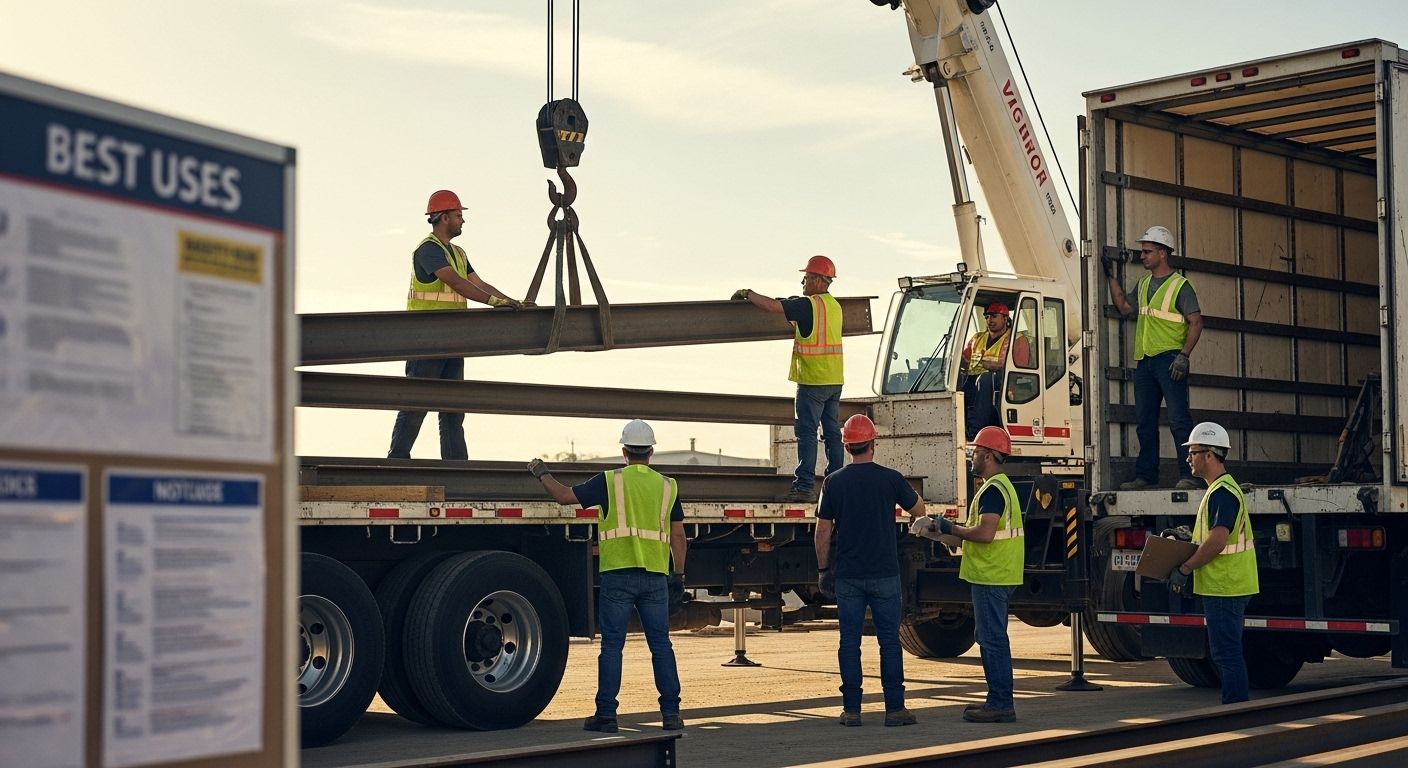
Utility research from transportation experts highlights that flatbed trucks are the backbone of construction and infrastructure projects. Their open design makes them perfect for transporting oversized and irregularly shaped materials such as steel beams, concrete structures, prefabricated components, and heavy machinery. Construction companies rely on flatbeds to move excavation equipment, bridge construction materials, and large-scale infrastructure components that would be impossible to transport in enclosed vehicles.
The flat, level surface of these trucks allows for quick loading and unloading from multiple angles. Wikipedia transportation research indicates that loads are typically secured manually using robust tie-down hooks around the bed’s edge, providing flexibility for contractors and logistics professionals dealing with unique cargo requirements.
Retail, Delivery, and Logistics Applications
Box trucks shine in urban and suburban delivery environments where cargo protection and maneuverability are paramount. Businesses in e-commerce, retail, and local distribution find box trucks ideal for:
- Furniture Delivery: Protecting large furniture pieces from weather and potential damage
- Retail Inventory Transport: Securing packaged goods during short and medium-distance deliveries
- Moving and Relocation Services: Offering climate-controlled and secure transportation for household items
The enclosed design of box trucks provides superior protection against environmental factors, making them perfect for sensitive cargo that requires consistent temperature and protection from dust, rain, and potential theft.
Specialized Industry Transportation
Beyond traditional uses, both truck types serve specialized industry needs. Flatbed trucks excel in agriculture, supporting the transportation of large farming equipment, irrigation systems, and bulk agricultural products. Manufacturing sectors utilize flatbeds for shipping oversized industrial components that cannot fit within standard enclosed vehicles.
Box trucks become essential in industries requiring precise cargo handling, such as:
- Catering and Food Service: Transporting prepared meals and temperature-sensitive ingredients
- Medical Supply Distribution: Ensuring sterile and controlled environments for sensitive medical equipment
- Print and Media Logistics: Safely moving delicate printing equipment and fragile materials
The versatility of these truck types demonstrates the importance of selecting the right vehicle for specific transportation requirements. Businesses must carefully evaluate their cargo, route conditions, and operational needs to choose between a box truck and a flatbed, ensuring maximum efficiency, safety, and cost-effectiveness in their logistics operations.
Costs, Rentals, and Legal Considerations
Selecting between a box truck and a flatbed involves more than comparing physical capabilities. Financial implications, rental options, and complex legal requirements play crucial roles in making an informed transportation decision.
Rental and Acquisition Expenses
The initial investment and ongoing operational costs differ significantly between box trucks and flatbeds. Box trucks typically have lower upfront purchase prices and more flexible rental options. Small businesses and independent contractors often find box trucks more economically accessible, with rental rates varying based on truck size, duration, and specific usage requirements.
Flatbed trucks represent a more substantial financial commitment. Their specialized design and higher weight capacity translate to higher purchase and rental expenses. Commercial vehicle market research indicates that flatbed trucks can cost 20-40% more than comparable box trucks, reflecting their enhanced load-bearing capabilities and industrial-grade construction.
Legal and Compliance Requirements
Federal Motor Carrier Safety Administration guidelines mandate specific regulatory compliance for commercial vehicles. Both box trucks and flatbeds require careful attention to legal considerations:
- Registration Requirements: Commercial trucks need proper DOT number registration
- Weight Limitations: Different weight categories determine additional licensing needs
- Insurance Specifications: Specialized coverage varies based on truck type and cargo
- Safety Inspection Protocols: Regular maintenance and safety checks are mandatory
Flatbed trucks often face more stringent regulations due to their open cargo design. Operators must implement comprehensive cargo securing strategies, ensuring loads are properly tied down and meeting federal transportation safety standards. This additional complexity can increase operational costs and require more specialized driver training.
Operational Cost Considerations
Beyond initial expenses, businesses must evaluate long-term operational costs. Box trucks generally offer more predictable maintenance expenses and better fuel efficiency for urban and short-distance transportation. Their enclosed design reduces potential cargo damage, potentially lowering insurance and replacement costs.
Flatbed trucks incur higher operational expenses, including:
- More frequent maintenance due to heavy-load stress
- Higher fuel consumption from increased vehicle weight
- Specialized equipment for cargo securing
- Enhanced insurance premiums reflecting higher risk profiles
Small to medium-sized businesses should conduct thorough cost-benefit analyses, considering their specific transportation needs, cargo types, and operational frequencies. While flatbed trucks offer superior heavy-load capabilities, box trucks provide more flexible and economical solutions for many commercial transportation scenarios.
Ultimately, the decision between a box truck and a flatbed transcends simple price comparisons. Businesses must holistically evaluate their unique operational requirements, balancing immediate financial constraints with long-term strategic transportation goals.
Choosing the Right Truck for Massachusetts and New England
Selecting the appropriate truck for transportation in Massachusetts and New England requires careful consideration of regional regulations, terrain challenges, and specific operational requirements. The unique geographic and regulatory landscape of this region demands a nuanced approach to commercial vehicle selection.
State-Specific Regulatory Compliance
Massachusetts Department of Transportation regulations impose strict guidelines for commercial vehicles that directly impact truck selection. Businesses must navigate precise dimensional restrictions, with maximum truck height limited to 13 feet 6 inches and width capped at 8 feet 6 inches. Federal Highway Administration research further highlights critical weight limitations specific to the region:
- Single axle trucks are restricted to 22,400 pounds
- Tandem axle trucks have a maximum weight of 34,000 pounds
These regulations make it imperative for businesses to carefully match their truck type to specific load requirements and regional transportation constraints.
The following table breaks down key state-specific legal and regulatory requirements for box trucks and flatbed trucks operating in Massachusetts and the New England region, as detailed in the article.
| Regulation/Requirement | Massachusetts/Region Standard | Box Truck Impact | Flatbed Truck Impact |
|---|---|---|---|
| Max Truck Height | 13 ft 6 in | Typically compliant | May require attention |
| Max Truck Width | 8 ft 6 in | Usually compliant | Larger models to check |
| Single Axle Max Weight | 22,400 lbs | Usually under limit | Needs confirmation |
| Tandem Axle Max Weight | 34,000 lbs | Often below limit | Often near/at limit |
| Required Safety Equipment | Mirrors, backup cameras, safety devices | Easier integration | May require add-ons |
| Cargo Securing Regulations | Federal/State tie-down laws | Standard compliance | Stricter, more complex |
| Registration/DOT Number | Mandatory for all commercial vehicles | Required | Required |
Safety and Equipment Considerations
Massachusetts commercial vehicle safety guidelines mandate specific safety equipment for trucks operating in the region. Critical requirements include:
- Mandatory lateral protective devices
- Comprehensive mirror systems (cross-over and convex mirrors)
- Required backup camera installations
- Advanced safety tracking systems
Box trucks often prove more adaptable to these stringent safety requirements, with their enclosed design providing additional protection and easier integration of safety technologies. Flatbed trucks require more extensive modifications to meet regional safety standards, potentially increasing overall operational costs.
Regional Transportation Challenges
New England’s diverse terrain presents unique challenges for commercial transportation. The region’s mix of urban environments, mountainous areas, and coastal regions demands versatile truck solutions. Box trucks excel in urban settings like Boston, providing maneuverability through narrow streets and tight parking scenarios. Conversely, flatbed trucks become essential for industrial and construction applications prevalent in manufacturing-heavy areas of Massachusetts and surrounding states.
Business owners must consider additional regional factors:
- Seasonal weather variations affecting vehicle performance
- Urban versus rural transportation needs
- Specific industry requirements in Massachusetts and neighboring states
- Local infrastructure and road conditions
Ultimately, the decision between a box truck and a flatbed transcends simple specifications. Businesses must conduct comprehensive assessments of their specific operational requirements, balancing regulatory compliance, safety considerations, and economic feasibility. Consulting with local transportation experts and carefully analyzing regional transportation guidelines ensures optimal truck selection for Massachusetts and New England’s unique commercial landscape.
Frequently Asked Questions
What are the main differences between box trucks and flatbed trucks?
Box trucks feature a fully enclosed cargo space, providing protection against weather and theft, making them ideal for sensitive items. Flatbed trucks have an open platform, allowing for easier loading and unloading of oversized or irregular loads from multiple angles.
Which types of loads are best suited for box trucks?
Box trucks are best for transporting sensitive or fragile items such as furniture, electronics, and temperature-controlled goods, providing maximum cargo integrity and security during transit.
What industries typically use flatbed trucks?
Flatbed trucks are widely used in construction, agriculture, and manufacturing industries, where transporting heavy machinery, oversized materials, and bulk products is essential due to their open design and higher weight capacity.
What are the rental and acquisition cost differences between box trucks and flatbed trucks?
Box trucks typically have lower acquisition and rental costs compared to flatbed trucks, which can be 20-40% more expensive due to their specialized design and enhanced load capabilities.
Find the Perfect Truck for Your Business in Massachusetts
Choosing between a box truck and a flatbed can be a challenge, especially when your cargo protection, weight capacity, and budget are all on the line. If you have been struggling to decide which truck best suits your business needs, or if you need reliable equipment that meets Massachusetts regulations, you are not alone. Whether your goal is safe local delivery or transporting oversized building materials, making the wrong choice can cost you time and money.
Why wait and risk costly mistakes in your fleet operations? At Apple Truck and Trailer, you get access to high quality used box trucks, rugged flatbeds, and full-service support from local experts. From lease and rental solutions to comprehensive maintenance and repair services, we make sure you get the right equipment and reliable help to keep your business on track. See current inventory, request a quote, or connect with a specialist today at https://appletruckandtrailer.com. Your next truck is waiting. Act now and move your business forward with confidence.