
Downtime on the Massachusetts Turnpike is more than just an inconvenience for logistics fleets—it drains resources and disrupts schedules. Fleet maintenance managers know that reactive repairs sting, but building a tractor trailer maintenance schedule can feel overwhelming. This guide reveals how organized inspections, proactive recordkeeping, and a balance of preventive, predictive, and reactive strategies dramatically reduce breakdowns and keep your equipment rolling. Bold scheduling and meticulous documentation are your keys to reliable performance.
Table of Contents
- What A Tractor Trailer Maintenance Schedule Involves
- Preventive, Predictive, And Reactive Maintenance Types
- Key Scheduling Tasks And Inspection Intervals
- DOT Compliance And Fleet Recordkeeping Requirements
- Common Pitfalls And Tech Solutions For Fleet Managers
Key Takeaways
| Point | Details |
|---|---|
| Daily and Pre-Operational Checks | Conduct daily safety checks to prevent costly breakdowns during operations. Regular inspections ensure equipment reliability and safety. |
| Comprehensive Maintenance Schedule | Implement a systematic maintenance program that includes daily, weekly, monthly, and annual inspections to reduce downtime and maintenance costs. |
| Types of Maintenance | Utilize a balance of preventive, predictive, and reactive maintenance strategies to optimize fleet operations and minimize unexpected failures. |
| Effective Documentation | Maintain detailed records of all maintenance activities to ensure compliance with regulations and to identify patterns that may indicate recurring issues. |
What a Tractor Trailer Maintenance Schedule Involves
A structured maintenance schedule is your roadmap for keeping tractors and trailers operational. Without it, you’re reacting to failures instead of preventing them. Here’s what actually goes into building and executing an effective maintenance program for your Massachusetts fleet.
Daily and Pre-Operational Checks
Before every shift, your drivers should run through critical safety checks. These catch problems before they become expensive breakdowns on the highway.
Key items your team should verify each day:
- Fuel and oil levels (low oil pressure causes rapid engine damage)
- Battery terminals for corrosion or loose connections
- Tire pressure and tread condition on all wheels
- Brake fluid and air system functionality
- Lights, wipers, and mirrors for visibility
- Steering responsiveness and play in the wheel
- Fluid leaks underneath the trailer or tractor
Pre-operational checks for tractors are foundational to preventing downtime. Drivers who skip these shortcuts compound maintenance problems.
Systematic Inspection Framework
Beyond daily checks, you need a comprehensive inspection schedule. The Technology & Maintenance Council (TMC) provides a framework that most Massachusetts logistics companies follow to stay compliant and operational.
Your maintenance program should include:
- Weekly walkarounds of your entire fleet
- Monthly detailed inspections of major systems
- Quarterly component assessments for wear and safety
- Annual comprehensive overhauls before renewal seasons
A well-documented maintenance schedule reduces unplanned downtime by up to 40%, directly protecting your profit margins.
Fluid and Filter Management
Engine oil, transmission fluid, coolant, and hydraulic fluid all deteriorate over time. Regular changes prevent sludge buildup and system failure.
Create a fluid maintenance calendar that tracks:
- Engine oil and filter changes (typically every 15,000-30,000 miles)
- Transmission fluid service intervals
- Coolant flushes and replacements
- Air filter replacements
- Fuel filter swaps to prevent injector damage
Don’t wait for a shutdown to discover your coolant is brown and thick. Preventive fluid work costs hundreds; engine replacement costs tens of thousands.

Brake System and Safety Components
Brakes are your liability and safety foundation. Federal regulations require specific inspection frequencies, and your drivers depend on reliable stopping power.
Brake maintenance covers:
- Pad and rotor inspections
- Brake fluid quality checks
- Air system pressure validation
- Slack adjuster functionality
- Safety valve operations
Documentation and Tracking
You cannot manage what you don’t measure. Detailed records prove compliance during audits and help you spot patterns in failures across your fleet.
Your maintenance logs should capture:
- Date, mileage, and technician for every service
- Parts replaced with part numbers
- Any defects found and corrective actions taken
- Vehicle downtime duration and reason
Tracking this data reveals which vehicles drain resources and which tractors and trailers perform reliably.
Pro tip: Create a master spreadsheet by vehicle that shows maintenance costs, downtime days, and upcoming service dates—this gives you the data to make fleet replacement decisions before vehicles become chronic repair problems.
Preventive, Predictive, and Reactive Maintenance Types
Your maintenance strategy falls into three categories. Each has different costs, timelines, and impacts on fleet uptime. Understanding the difference helps you allocate resources smarter.
Preventive Maintenance: Scheduled and Consistent
Preventive maintenance runs on a calendar. You perform work at set intervals regardless of equipment condition. Think of it as maintenance by the clock, not by the dashboard.
Common preventive actions include:
- Oil and filter changes every 15,000 to 30,000 miles
- Tire rotations and inspections on regular schedules
- Brake pad replacements at manufacturer intervals
- Coolant flushes every two years
- Belt and hose inspections quarterly
Preventive maintenance keeps most breakdowns from happening. It’s cheaper than reactive repairs but may include some unnecessary work on vehicles running strong.
Preventive maintenance reduces unexpected failures by 70 to 80 percent, protecting your delivery schedule and revenue.
Predictive Maintenance: Data-Driven Prevention
Predictive maintenance uses condition monitoring to tell you exactly when parts need service. Instead of guessing, you measure actual equipment condition and act only when data says so.
Predictive methods include:
- Oil analysis to detect engine wear particles
- Vibration monitoring on bearings and rotating components
- Thermal imaging to spot overheating areas
- Ultrasonic testing for fluid leaks
- Digital dashboards tracking component degradation
This approach eliminates unnecessary maintenance while catching real problems early. You fix things only when they need fixing.
Massachusetts fleets with predictive programs report 20 to 25 percent lower maintenance costs. Your technicians work smarter, not harder.
Reactive Maintenance: Fixing Breakdowns After Failure
Reactive maintenance happens when something breaks on the road. Your driver calls in, the truck gets towed, and you pay emergency rates while cargo sits.
Why reactive maintenance costs more:
- Emergency towing fees and roadside service charges
- Overtime labor to get trucks back in service fast
- Secondary damage from initial failure (broken alternator damages battery)
- Lost revenue while waiting for repairs
- Potential cargo spoilage or missed delivery windows
A single roadside breakdown can cost $2,000 to $5,000 depending on location and parts needed. Preventive work costs a fraction of that.
Reactive maintenance should be your safety net, not your strategy. The cost per repair dwarfs preventive spending.
Comparing All Three Approaches
The right strategy combines all three. Use preventive work for critical systems that fail unexpectedly. Layer in predictive monitoring on expensive components like transmissions. Accept that reactive repairs will happen occasionally.
Most successful Massachusetts logistics operations run 70 percent preventive, 20 percent predictive, and 10 percent reactive. That ratio keeps trucks moving and profit margins healthy.
Here’s a breakdown comparing the three maintenance strategies for fleet operations:
| Approach | Cost Efficiency | Impact on Uptime | Typical Use Case |
|---|---|---|---|
| Preventive | High savings over time | Minimizes breakdowns | Scheduled care for all vehicles |
| Predictive | Moderate to high | Catches issues early | Targeted monitoring of key assets |
| Reactive | Very low, costly | Unplanned downtime common | Emergency repairs after failures |
Pro tip: Track your maintenance spending by type for three months—if reactive repairs exceed 15 percent of total costs, shift budget toward preventive work immediately to prevent compounding failures across your fleet.
Key Scheduling Tasks and Inspection Intervals
Federal law and practical fleet management demand specific inspections at defined intervals. Miss these windows, and you risk violations, liability, and expensive downtime.
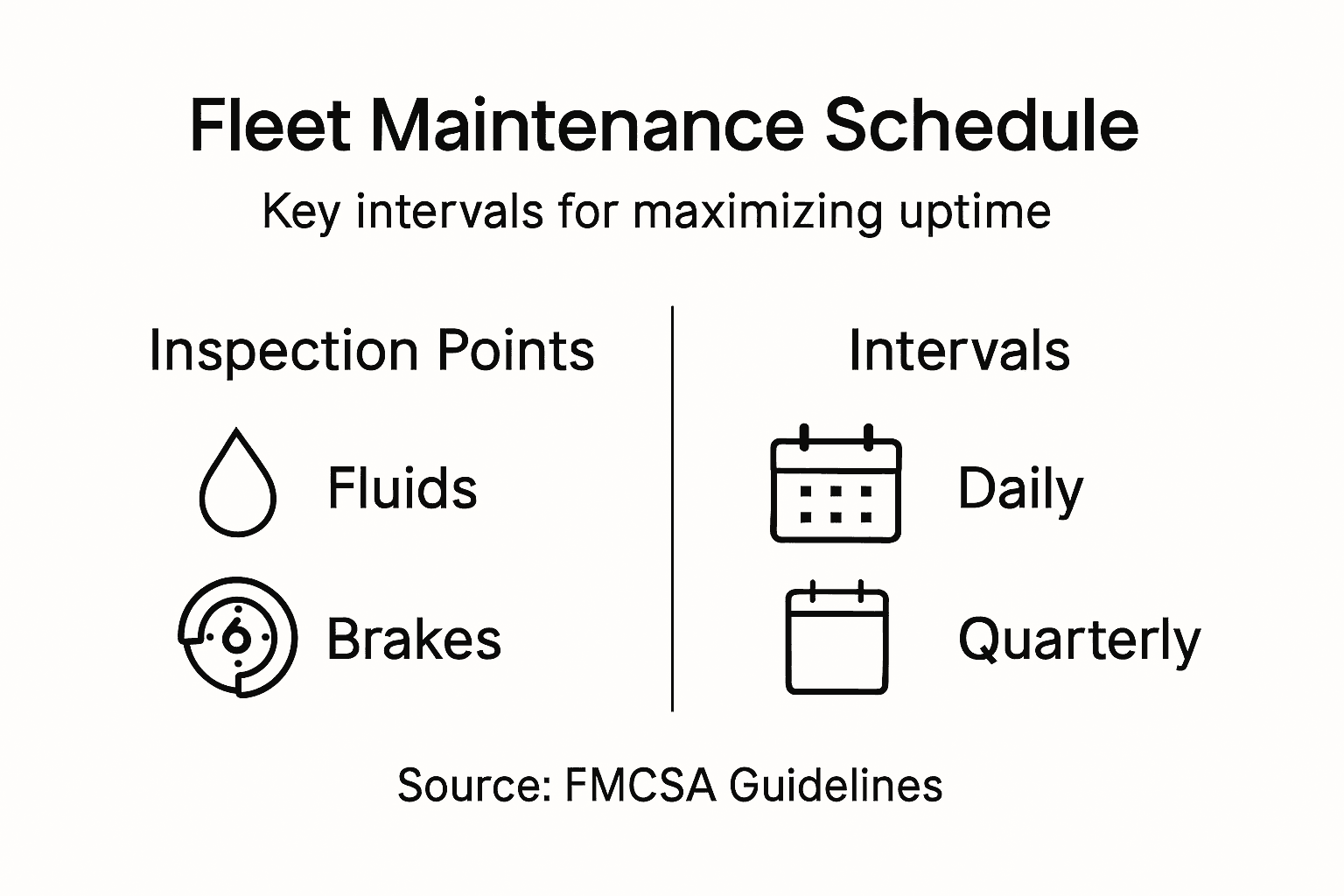
Daily and Pre-Shift Inspections
Before your driver touches the ignition, critical checks must happen. These catch emerging problems before they strand a truck on I-90.
Daily inspection checklist items:
- Engine oil and coolant levels
- Fuel tank capacity and condition
- Battery terminals and connections
- Tire pressure and visible tread depth
- Brake fluid level and responsiveness
- All lighting systems (headlights, taillights, turn signals)
- Wipers and windshield washer fluid
- Steering wheel play and responsiveness
- Visible leaks under the engine or transmission
Daily inspection checklists for tractor trailers should be printed and kept in every cab. Drivers initial them daily, creating a paper trail for your records.
Monthly and Quarterly Deep Dives
Beyond daily checks, schedule thorough inspections every 30 days. These catch wear patterns developing over weeks of operation.
Monthly tasks include:
- Check suspension components for cracks or looseness
- Inspect brake pads for remaining thickness
- Test air brake system pressure and response
- Examine all hoses for bulges or leaks
- Verify coupling pin security on trailers
- Check wheel bearing play and temperature
Quarterly inspections add load-test procedures and component replacements based on mileage thresholds.
Annual Federal Safety Inspections
Federal regulations require periodic vehicle inspections every 12 months. This is non-negotiable. One missed inspection opens liability doors and triggers DOT penalties.
Annual inspections cover:
- Complete brake system evaluation
- Lighting and electrical system testing
- Coupling and towing equipment verification
- Frame and structural integrity
- Tire condition on all positions
- Suspension geometry and wear
Schedule annual inspections before busy seasons. Massachusetts winter demands brake and lighting systems in perfect condition.
Missing your annual inspection deadline costs $1,000 to $5,000 in fines plus potential out-of-service orders.
Mileage-Based Maintenance Windows
Maintenance intervals don’t always align with calendars. Mileage-based tasks trigger when trucks rack up distance.
Common mileage triggers:
- 15,000 miles: Engine oil and filter change
- 30,000 miles: Transmission fluid service
- 50,000 miles: Brake inspection and pad replacement
- 100,000 miles: Major bearing and seal service
- 200,000 miles: Full system overhaul
Track mileage meticulously. Modern fleet management software alerts you when vehicles approach these thresholds, preventing missed maintenance.
Creating Your Scheduling Calendar
Layer daily, monthly, quarterly, and annual tasks into a master calendar. Assign responsibilities to specific technicians. Use color coding for task types.
Your scheduling system should capture:
- Vehicle identification and mileage
- Scheduled task and required components
- Assigned technician and labor hours
- Parts inventory requirements
- Estimated downtime duration
This creates predictability. Your drivers know when their tractors go in for service. Your shop team knows what parts to order. Your accounting team budgets maintenance costs accurately.
Pro tip: Set calendar reminders 30 days before annual inspections and implement a simple spreadsheet with columns for vehicle number, last inspection date, next due date, and assigned technician—sort by due date weekly to catch upcoming work before scheduling conflicts arise.
DOT Compliance and Fleet Recordkeeping Requirements
The Department of Transportation has one non-negotiable expectation: you document everything. Audits, accidents, and fines all hinge on the records you keep. Sloppy recordkeeping turns minor violations into major penalties.
Understanding DOT Inspection and Maintenance Requirements
Federal law mandates that you inspect, repair, and maintain every vehicle under your control. This isn’t optional guidance. Your Massachusetts fleet must comply with detailed safety standards or face enforcement action.
Motor carriers must systematically inspect and maintain all commercial vehicles to ensure safe operation. The regulations cover every component from brakes to lighting to coupling devices.
Your inspection and maintenance program must address:
- All safety-critical systems and components
- Scheduled preventive maintenance tasks
- Repair documentation and dates completed
- Test results on braking and electrical systems
- Parts replacements with identification numbers
The One-Year Record Retention Rule
DOT requires you keep detailed maintenance records for at least one full year from the service date. After a vehicle leaves your fleet, records must be retained for an additional six months.
This creates a 12 to 18-month window where every mechanic’s note becomes potential evidence in audits or liability claims. Organization matters tremendously.
Records must include:
- Vehicle identification number and license plate
- Date and nature of each maintenance action
- Technician name and signature
- Component inspected or repaired
- Test results on safety equipment
- Parts used with part numbers
A single missing inspection record during a DOT audit can trigger a $500 to $2,000 penalty and potential out-of-service orders for your fleet.
Creating Your Recordkeeping System
You need a system that captures data consistently across all vehicles and technicians. Digital systems beat paper folders because they’re searchable and audit-proof.
Your system should track:
- Daily driver inspection reports
- Monthly maintenance completion dates
- Parts inventory and replacements
- Labor hours per vehicle
- Downtime duration and reason
- Technician assignments and certifications
Many Massachusetts fleets use fleet management software that integrates with their maintenance schedule. This eliminates data entry errors and ensures compliance automatically.
What Happens During a DOT Audit
DOT compliance officers request vehicle records during roadside inspections or facility audits. They look for gaps, missing signatures, or incomplete data. Missing records count as regulatory violations.
Officers examine:
- Last annual inspection date and results
- Recent oil change and filter replacement documentation
- Brake system service records
- Tire and suspension maintenance history
- Repair completion and test results
If records are incomplete, your fleet gets cited. If records show deferred maintenance on safety components, you face serious fines and potential out-of-service orders.
Digital vs. Paper Documentation
Paper records get lost, fade, or get damaged. Digital records are backed up, searchable, and timestamp-protected. The regulatory trend favors digital systems.
Consider switching to cloud-based fleet management if you’re still using spreadsheets and folders. The investment pays back quickly through compliance confidence and reduced audit risk.
Pro tip: Implement a monthly record audit where your office manager pulls 5 to 10 random vehicle files and verifies all required documentation exists and is dated correctly—this catches gaps before DOT does and prevents accumulating compliance violations.
Common Pitfalls and Tech Solutions for Fleet Managers
Fleet maintenance fails for predictable reasons. Understanding these pitfalls and the technology that solves them separates successful operations from those constantly battling downtime.
The Pitfall: Inconsistent Recordkeeping and Manual Processes
Many Massachusetts fleets still rely on paper forms, spreadsheets, and memory. Technicians forget to log completed work. Supervisors miss inspection deadlines. Records get lost or damaged.
This creates compliance gaps that DOT audits expose instantly. You end up fighting violations instead of preventing breakdowns.
Manual processes also hide cost patterns. You cannot see that one tractor costs three times more to maintain than others. You cannot identify which drivers cause premature wear. Data stays trapped in scattered files.
The Pitfall: Reactive Maintenance Dominance
When you wait for trucks to break down, you pay the highest price. Emergency roadside repair bills, towing fees, overnight shipping on parts, and lost revenue compound quickly.
Reactive maintenance happens when:
- Preventive schedules slip due to workload
- Drivers skip daily inspections
- Budget constraints defer necessary work
- No system reminds you when service is due
You end up spending 40 to 50 percent more on repairs than you would with preventive planning.
The Pitfall: Delayed Repairs and Cascading Failures
Deferring brake pad replacement doesn’t save money. It destroys rotors, damages calipers, and eventually requires emergency service. A simple fluid leak becomes catastrophic bearing failure.
Small problems compound. One missed inspection leads to two more problems going undetected. Your best tractor gets sidelined while waiting for parts.
Delayed repairs cost 3 to 5 times more than addressing issues immediately, and increase safety liability exposure.
Tech Solution: Fleet Management Software Integration
Telematics and real-time monitoring systems provide predictive maintenance capabilities that catch problems before they cause breakdowns. These platforms track vehicle conditions continuously and alert you when service is due.
Modern fleet management software offers:
- Automated maintenance scheduling based on mileage or time intervals
- Real-time vehicle health monitoring and diagnostics
- Digital inspection forms drivers complete from tablets or phones
- Automatic parts inventory tracking and reorder alerts
- Compliance reporting that satisfies DOT audits instantly
- Historical data analysis to identify chronic problem vehicles
Cloud-based systems mean your office staff and technicians access the same data anywhere.
To help visualize which tech tools address key fleet manager challenges, see this quick reference:
| Fleet Challenge | Technology Solution | Business Benefit |
|---|---|---|
| Inconsistent recordkeeping | Digital fleet software | Reliable compliance, fast audits |
| High repair costs | Predictive analytics/IOT | Lower costs, fewer emergency repairs |
| Missed scheduling | Automated scheduling tools | Maintains planned maintenance cadence |
| Cost tracking gaps | VMRS coding system | Simplified budgeting, actionable data |
Tech Solution: Vehicle Maintenance Reporting Standards (VMRS)
VMRS is a standardized coding system for vehicle maintenance and repairs. Instead of technicians writing vague descriptions, they select standardized codes that describe exactly what was done.
This standardization enables:
- Consistent data across your entire fleet
- Comparison of maintenance costs between similar vehicles
- Identification of recurring component failures
- Trending analysis to predict future problems
- Accurate budgeting based on historical patterns
Tech Solution: Predictive Analytics and IoT Monitoring
Advanced fleets now use IoT sensors that monitor bearing temperature, oil particle counts, brake pressure, and battery voltage. These sensors feed data to analytical platforms that predict failures 30 to 60 days in advance.
You replace a bearing before it fails catastrophically. You service brakes before pad wear damages rotors. You swap batteries before they strand drivers.
This approach reduces downtime by 35 to 50 percent while cutting maintenance costs significantly.
Implementing Tech Solutions Step by Step
Do not try to transform everything at once. Start with digital inspection forms and basic fleet management software. Train your team on data entry and compliance reporting. Once that works smoothly, layer in predictive analytics.
Phased implementation prevents overwhelming your staff and maximizes adoption success.
Pro tip: Select fleet management software that integrates with your current equipment and provides free training—rushing implementation without proper staff training guarantees poor data quality and quick abandonment of the system.
Take Control of Your Fleet’s Uptime with Expert Maintenance Solutions
Managing a tractor trailer maintenance schedule involves juggling daily inspections, fluid management, brake system upkeep, and strict DOT compliance. These challenges can quickly overwhelm fleet managers who lack consistent recordkeeping or depend heavily on costly reactive repairs. The key to maximizing uptime and reducing unexpected breakdowns lies in a proactive, well-organized maintenance plan that blends preventive and predictive strategies.
At Apple Truck & Trailer, we understand the critical importance of staying ahead in truck maintenance. From quality used trucks and trailers to expert maintenance services, we provide comprehensive support tailored for Massachusetts fleets. Explore our Truck Maintenance – Apple Truck & Trailer offerings and find reliable solutions that help you keep every rig in top shape. Plus, our Semi Truck and Trailer – Apple Truck & Trailer inventory ensures you have access to dependable equipment that meets your demanding schedules.
Ready to build a maintenance program that safeguards your fleet’s performance and compliance? Visit Apple Truck & Trailer today to discover how our expert team and comprehensive resources can streamline your operations. Don’t wait for costly breakdowns start maximizing uptime now with trusted service and top-tier equipment.
Frequently Asked Questions
What is included in a daily tractor trailer maintenance check?
Daily checks should include verifying fuel and oil levels, battery terminals, tire pressure and tread condition, brake fluid, air system functionality, lights, wipers, mirrors, steering response, and checking for fluid leaks.
How often should I perform preventive maintenance on my tractor trailer?
Preventive maintenance should occur at scheduled intervals, typically every 15,000 to 30,000 miles for oil changes, and regular inspections for brakes, tires, and other key components based on manufacturer recommendations.
What are the benefits of predictive maintenance for fleet operations?
Predictive maintenance uses real-time data monitoring to identify when parts need service, allowing for more efficient repairs. This approach can reduce maintenance costs by 20 to 25 percent and minimize unexpected breakdowns.
Why is documentation important in maintaining a tractor trailer fleet?
Detailed documentation is crucial for compliance with federal regulations, tracking maintenance history, spotting patterns in failures, and ensuring accountability. It also protects your fleet during audits and liability claims.