
Selecting the right equipment drives results in the competitive world of commercial trucking across Massachusetts and New England. For fleet managers, understanding what actually defines a tractor trailer truck is not just technical detail—it shapes cost control, compliance, and driver satisfaction. This guide breaks down the core concept of a tractor trailer truck and highlights what matters most for efficient fleet operations, so you can align the right mix of tractors and trailers with your freight demands.
Table of Contents
- What Defines A Tractor Trailer Truck
- Major Types Of Tractor Trailer Trucks Explained
- Key Features And Fleet Applications
- DOT And State Safety Regulations
- Choosing The Right Truck For Your Fleet
Key Takeaways
| Point | Details |
|---|---|
| Understanding the Tractor Trailer Design | A tractor trailer truck features a powered tractor and a cargo trailer, providing flexibility by allowing more trailers to be utilized than tractors. |
| Choosing the Right Cab and Trailer | The cab style affects driver comfort and operational efficiency, while the trailer type impacts cargo capacity and revenue potential. |
| Compliance with Regulations | Adhering to both federal and state regulations is critical to avoid fines and ensure operational legality in fleet management. |
| Analysis of Cost Factors | Total cost of ownership, including fuel, maintenance, and insurance, should guide the selection of tractor trailers for optimal profitability. |
What Defines a Tractor Trailer Truck
A tractor trailer truck combines two distinct components: a powered front unit (the tractor) and a separate cargo-carrying section (the trailer). Understanding this two-part design is crucial for fleet managers evaluating equipment for your operations.
The tractor is the engine of the operation—literally. This is the powered vehicle that carries the driver, contains the diesel engine, and provides all the motive force needed to move the entire system. The trailer, by contrast, has no engine and relies entirely on the tractor for movement.
What makes this design work is the fifth wheel coupling. This mechanical connection point on the tractor allows the trailer to pivot and articulate independently, which is essential for maneuverability. Without this pivoting capability, a 60-foot-plus combination would be nearly impossible to navigate through Massachusetts intersections, loading docks, and tight warehouse areas.
The key operational advantage is flexibility. When you need to drop off a loaded trailer at a customer site, your tractor simply unhitches and moves to the next job. This means you can operate more trailers than tractors, increasing fleet utilization and reducing your equipment costs—a major consideration for fleet operators managing tight margins.
Core Components That Define the System
Several features distinguish tractor trailer trucks from other commercial vehicles:
- Large diesel engines (typically 400-600+ horsepower) to handle heavy loads and sustained highway driving
- Multiple axles (usually three to five) that distribute weight across the road surface and improve stability
- Heavy-duty transmission systems designed for constant torque and long-distance hauling
- Air brake systems capable of stopping 80,000+ pounds safely and consistently
- Reinforced chassis and frame engineered to handle repeated loading cycles without structural failure
The tractor unit is specifically the powered portion—the key distinction that separates it from a rigid truck where the cargo area is permanently attached to the cab.
This design fundamentally changes how you manage your fleet. You’re no longer locked into a one-to-one ratio of cargo capacity to powered units. A modern tractor can be configured to haul different trailer types throughout the day based on your changing customer demands.
When evaluating used equipment, the tractor’s condition matters most. Engine hours, transmission durability, and frame integrity directly impact your operating costs and downtime. The trailer is secondary—while important, worn trailers are far less expensive to replace or refurbish than a tractor with a tired engine.
Pro tip: When assessing a used tractor-trailer for your fleet, prioritize inspecting the tractor’s major systems first—engine, transmission, and fifth wheel condition—since these components represent 70% of your total maintenance costs.
Major Types of Tractor Trailer Trucks Explained
Not all tractor trailers are created equal. For fleet managers in Massachusetts and surrounding states, understanding the different configurations available is critical to matching equipment with your specific hauling needs and customer demands.
The core distinction comes down to two things: the cab style and the trailer type. Cab style determines comfort and functionality for drivers, while trailer type determines what cargo you can haul profitably.
Cab Configurations
Your tractor cab choice impacts driver retention, fuel efficiency, and operational flexibility.
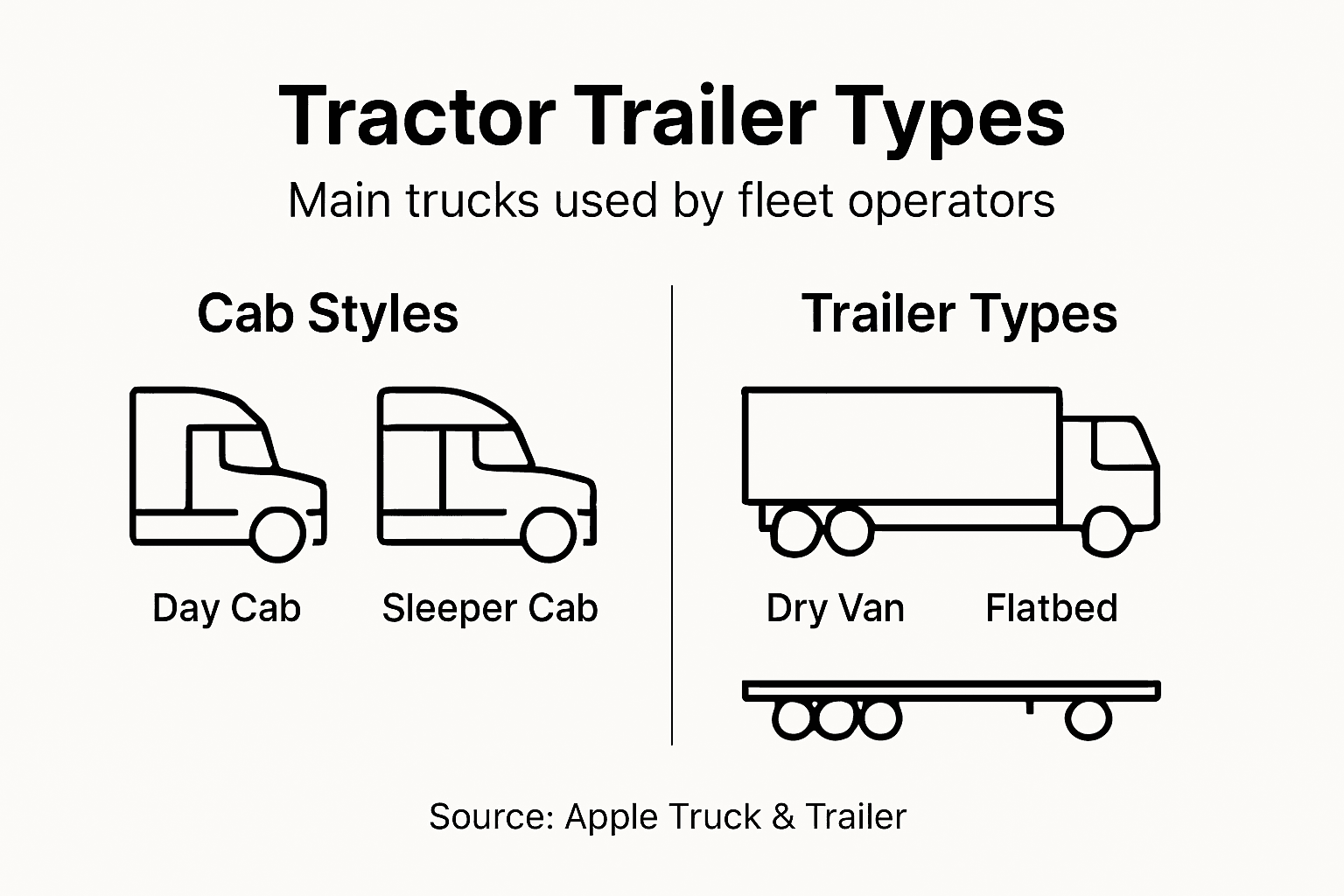
- Day cabs lack a sleeper berth and suit regional hauls under 300 miles where drivers return home nightly
- Sleeper cabs include a bunk for long-distance operations, essential for cross-country freight routes
- Conventional cabs position the engine beneath the cab, offering better weight distribution and driver space
- Cab-over-engine models mount the engine under the driver, improving maneuverability in tight spaces
Day cabs cost less upfront and perform better for local Massachusetts deliveries, but sleeper cabs unlock interstate commerce where the real margins exist.
Here’s a quick comparison of tractor trailer cab types and their operational benefits:
| Cab Type | Driver Comfort | Fuel Economy Impact | Typical Usage Scenario |
|---|---|---|---|
| Day Cab | Basic, no sleeper | Best fuel efficiency | Local/regional, under 300 miles |
| Sleeper Cab | Includes bunk setup | Slightly lower, heavier | Long-haul, cross-country routes |
| Conventional | Spacious interior | Balanced performance | Flexible, both local and long-haul |
| Cab-over-Engine | Compact space | Improved in cities | Urban delivery, tight clearance |
Trailer Types by Cargo Class
Trailer selection directly impacts your revenue per load and customer base reach. Different semi-trailer configurations are optimized for specific freight categories:
Dry vans are your workhorse equipment. These enclosed 53-foot trailers handle general freight, palletized goods, and packaged products. They’re the most versatile option for fleets handling mixed cargo.

Flatbed trailers carry oversized loads—machinery, steel, lumber, construction equipment. These command premium rates but require specialized loading experience and proper securement procedures.
Refrigerated trailers (reefers) transport temperature-sensitive cargo: produce, meat, pharmaceuticals, frozen foods. These trailers cost significantly more but serve high-value perishable markets with consistent demand.
Tanker trailers carry liquids and gases—fuel, chemicals, food-grade products. These require specialized driver certifications and hazmat training, limiting your driver pool but attracting premium freight rates.
The table below summarizes the business impact of different trailer types for fleet managers:
| Trailer Type | Cargo Specialization | Revenue Potential | Operational Challenge |
|---|---|---|---|
| Dry Van | General freight, pallets | High utilization | Few restrictions |
| Flatbed | Oversized, irregular loads | Premium rates, seasonal | Requires securement expertise |
| Reefer | Perishables, pharmaceuticals | Consistent high-value | Expensive, requires maintenance |
| Tanker | Liquids, hazardous goods | Very high, niche market | Requires certified drivers |
Matching trailer type to your regional freight patterns determines profitability far more than picking the cheapest equipment available.
Hybrid and Specialized Options
Some operations demand combinations. Double trailers (two 28-foot trailers behind one tractor) maximize volume for light freight. Car haulers transport vehicles for dealerships. Dump trailers serve construction and aggregate industries.
Your decision should align with customer base concentration in your service area. Massachusetts-based fleets typically focus on dry vans and reefers for Northeast distribution. Western operations might emphasize flatbeds for regional manufacturing.
Pro tip: Start with 70% of your fleet in dry vans (highest utilization and easiest to operate), then add specialized trailers only when you have committed contracts to justify the equipment investment and training costs.
Key Features and Fleet Applications
Tractor trailer trucks aren’t generic—they’re engineered systems where every component directly impacts your operational costs, safety, and revenue potential. Understanding the critical features helps you select equipment that actually matches your business model.
The engine is where it starts. Modern diesel engines deliver 400–600+ horsepower with torque ratings between 1,200–1,800 foot-pounds. This power translates directly to acceleration, hill-climbing ability, and fuel efficiency on highway grades. A tired engine costs you 2–3 miles per gallon compared to newer models.
The transmission matters equally. Manual transmissions cut costs but demand skilled drivers. Automated manuals offer a middle ground. Fully automatic transmissions improve driver retention and fuel economy, especially important when recruiting in tight labor markets like Massachusetts.
Critical Stability and Performance Features
Fleet safety and payload capacity depend on engineering fundamentals:
- Axle configuration (tandem, tridem, or quad) distributes weight and determines legal payload capacity across your service states
- Air brake systems with ABS prevent jackknife and increase stopping precision at full weight
- Suspension design absorbs road shock and protects cargo—important for reefers carrying sensitive perishables
- Frame construction handles repeated loading cycles without fatigue cracks or hidden structural damage
- Tires and tire management systems reduce blowouts and improve fuel economy by 3–5 percent
Vehicle stability and load handling capacity depend heavily on center of gravity positioning and axle weight distribution, which vary based on your specific application.
Application-Specific Equipment Selection
Your fleet’s primary mission should drive equipment specifications, not the other way around.
Long-haul operations prioritize sleeper cabs, fuel-efficient engines, and automated transmissions. Driver comfort reduces turnover—a major cost factor when experienced drivers command $70,000+ annual salaries in New England.
Regional and local fleets in Massachusetts benefit from day cabs, lighter weights, and superior maneuverability. Shorter routes don’t justify sleeper investments, and many local docks have height or length restrictions.
Specialized applications demand tailored solutions. Reefer fleets need precise temperature control and backup diesel generators. Tanker fleets require specific tank construction for product compatibility and hazmat compliance.
Matching equipment specifications to your primary freight type reduces maintenance surprises and maximizes the resale value when you eventually rotate units out.
Many fleet operators over-spec equipment early in their growth phase. A regional operator buying long-haul sleeper cabs wastes capital on unused sleeper berths and pays extra fuel costs for unnecessary weight.
Pro tip: Build your core fleet with equipment designed for your highest-volume freight type, then add specialty units only when that niche work reaches 25% or more of total revenue.
DOT and State Safety Regulations
Regulations aren’t optional—they’re the foundation of legal fleet operations. Violations cost thousands in fines, downtime, and potential liability exposure. For Massachusetts-based fleet managers, understanding both federal and state requirements is non-negotiable.
The Federal Motor Carrier Safety Administration (FMCSA) sets the baseline standards for all interstate operations. These rules cover equipment condition, driver qualifications, and mandatory reporting. State regulations in Massachusetts, Rhode Island, Connecticut, and New Hampshire layer additional requirements on top.
Federal Requirements You Can’t Ignore
FMCSA safety standards mandate strict compliance across every aspect of tractor trailer operations:
- Vehicle maintenance standards requiring documented inspections and timely repairs of critical systems
- Braking system specifications including air brake certification and ABS functionality verification
- Coupling device safety ensuring fifth wheel integrity and proper securement
- Lighting and reflective equipment meeting visibility requirements in all weather conditions
- Driver vehicle inspection reports (DVIRs) that document pre-trip and post-trip condition checks
These aren’t suggestions. FMCSA inspectors can place vehicles out-of-service immediately for violations, costing you revenue and damaging customer relationships.
State-Specific Compliance Layers
Massachusetts adds its own requirements beyond federal standards. Vehicle size and weight limits vary by state—what’s legal in Connecticut might exceed Massachusetts’ restrictions on certain bridges.
Cargo securement standards differ too. Flatbed loads require specific tie-down configurations verified by trained personnel. Hazmat tanker operations demand driver certifications and route planning compliance.
Non-compliance with DOT regulations triggers fines averaging $1,000–$5,000 per violation, plus potential out-of-service orders that halt revenue immediately.
Your fleet needs documented proof of compliance. Driver qualification files, maintenance records, and inspection reports must be retained for at least three years. Digital fleet management systems streamline this process and protect you during audits.
Practical Compliance Steps
Implement these fundamentals:
- Conduct pre-trip and post-trip inspections using standardized checklists
- Maintain detailed maintenance logs tracking all repairs and replacements
- Document driver qualifications and medical certifications annually
- Schedule preventive maintenance based on manufacturer recommendations
- Track hours of service compliance through electronic logging devices
- Train drivers on equipment inspection procedures and reporting requirements
Many fleet operators overlook DVIR requirements. Drivers must document equipment defects daily, and you must repair safety-critical items before the vehicle returns to service. This creates an audit trail protecting you legally.
Pro tip: Implement electronic logging devices and digital DVIR systems now—they automate compliance documentation, reduce audit liability, and often lower insurance premiums by 5–10% when you can demonstrate consistent safety practices.
Choosing the Right Truck for Your Fleet
Selecting tractor trailers isn’t a one-size-fits-all decision. The wrong choice locks you into poor fuel economy, excess maintenance costs, and driver turnover. The right choice multiplies your operational efficiency and profitability for years.
Start by analyzing your actual freight patterns, not hypothetical ones. What percentage of your loads are local versus regional? How many miles does a typical route cover? What cargo types dominate your business? These answers drive everything else.
Matching Equipment to Your Operating Model
Your primary business model determines whether sleeper cabs or day cabs make financial sense.
Regional fleets (operating 300–500 miles from base) typically perform better with day cabs. Drivers return home nightly, reducing sleeper berth maintenance costs and appeal to drivers who value family time. Day cabs weigh less, improving fuel economy by 5–8 percent compared to sleepers.
Long-haul operations (500+ mile routes) require sleeper cabs. Driver comfort becomes your competitive advantage when recruiting experienced drivers. The additional weight penalty pays for itself through reduced turnover and premium freight rates.
Local delivery fleets maximize profit with lightweight day cabs prioritizing maneuverability over power. Tight urban routes, low docks, and frequent stops reward vehicles with superior visibility and compact turning radius.
Tractor trailer configurations matched to cargo requirements directly impact your operational efficiency and safety profile across different routes and industries.
The Cargo-Equipment Alignment Framework
Mismatched equipment costs thousands annually:
- Dry vans suit general freight, consumer goods, and palletized loads—your highest-volume business opportunity
- Reefers command 15–25% premium rates but require higher fuel consumption and maintenance—only justified for 40%+ perishable volume
- Flatbeds serve construction, manufacturing, and agricultural sectors with specialized loading requirements and driver training needs
- Tankers demand hazmat certifications, specialized tank construction, and higher insurance—viable only with committed shipper contracts
Most growing fleets start with dry vans because they maximize utilization. You can haul almost any packaged product, reach diverse customer bases, and operate with standard driver qualifications.
Specialization only pays when you have consistent volume—otherwise you’re paying equipment costs for partial utilization.
The Financial Reality Check
Beyond acquisition costs, calculate total cost of ownership: fuel consumption, maintenance intervals, insurance premiums, driver wages, and resale value at rotation.
A sleeper cab costs 12–18% more upfront but consumes 8–12% more fuel. That premium only makes sense if you’re generating sufficient long-haul revenue to offset the economics.
Used equipment from reliable dealers like Apple Truck & Trailer helps control capital deployment early. Proven models with solid maintenance histories reduce unexpected breakdowns that harm customer relationships.
Pro tip: Conduct a detailed cost-per-mile analysis for your top 3–5 freight types, then right-size your fleet composition around the highest-margin loads while maintaining 15–20% flexibility for market fluctuations.
Find the Perfect Tractor Trailer Truck for Your Fleet Today
Choosing the right type of tractor trailer truck is essential to tackle the challenges of fluctuating freight demands and fleet utilization. Whether you need day cabs optimized for local routes or sleeper cabs built for long-haul comfort, understanding your specific cargo and operational requirements will save you money and improve fleet efficiency. Key factors like trailer type, cab configuration, and engine power directly affect your bottom line and driver retention.
At Apple Truck & Trailer, we specialize in providing high-quality used equipment tailored to your fleet needs. Explore our wide selection of Semi-Truck and Tractor-Trailer options designed to match your hauling demands. Looking to optimize your costs? Learn more about Tractor Trailer Lease Costs and find flexible solutions for your operations.
Don’t let mismatched equipment hold your fleet back. Visit us at https://appletruckandtrailer.com now to get personalized guidance and find trucks and trailers that align precisely with your freight patterns and growth goals. Act now to boost your fleet’s performance and profitability in Massachusetts and the New England region.
Frequently Asked Questions
What are the main types of tractor trailer truck cab configurations?
Cab configurations include day cabs, sleeper cabs, conventional cabs, and cab-over-engine models. Day cabs lack a sleeper berth for regional hauls, while sleeper cabs feature a bunk for long-distance operations. Conventional cabs have the engine beneath the cab for better weight distribution, and cab-over-engine models improve maneuverability in tight spaces.
How do different trailer types affect cargo capacity and revenue?
Trailer types such as dry vans, flatbed trailers, refrigerated trailers, and tanker trailers cater to different cargo specifics. Dry vans are versatile for general freight, flatbeds specialize in oversized loads, reefers transport perishables, and tankers carry liquids or gases, impacting your revenue potential and operational efficiency based on the cargo you handle.
What should fleet managers consider when evaluating used tractor trailers?
Fleet managers should prioritize the condition of the tractor’s major systems—engine, transmission, and fifth wheel—since these components represent a significant portion of maintenance costs. The condition of the trailer is secondary, as worn trailers are generally less expensive to replace or refurbish than a tractor with a tired engine.
How do regulations impact tractor trailer operations?
Regulations set by the Federal Motor Carrier Safety Administration (FMCSA) and state authorities establish mandatory compliance for vehicle maintenance, driver qualifications, and safety standards. Non-compliance can lead to fines, vehicle out-of-service orders, and damage to customer relationships.