
TL;DR:
- Brake defects cause nearly 30% of roadside out-of-service orders, making proactive inspection essential.
- A proper fleet maintenance checklist should cover vital components and ensure documentation to maintain compliance.
A single brake defect can pull your truck off the road and cost you between $16,000 and $25,000 in fines, towing fees, and lost loads. That figure gets worse when you realize that brake defects cause roughly 30% of all commercial vehicle out-of-service orders during roadside inspections. Yet many fleets still treat maintenance as something to address when problems show up, not before. A solid fleet truck maintenance checklist changes that equation entirely. This guide breaks down exactly what your checklist needs to cover to stay compliant with 2026 CVSA and FMCSA standards, protect your drivers, and keep your trucks moving.
Table of Contents
- Key takeaways
- Your fleet truck maintenance checklist and regulatory requirements
- Brake system inspection: the checklist that keeps trucks moving
- Scheduling other critical maintenance for long-term fleet health
- Building a preventive maintenance program that actually works
- My take on what most fleets still get wrong
- Keep your fleet road-ready with Appletruckandtrailer
- FAQ
Key takeaways
| Point | Details |
|---|---|
| Brakes are your biggest risk | Brake defects trigger nearly a third of all out-of-service orders, making them your top daily inspection priority. |
| DVIR rules are often misread | Federal law only requires a written DVIR when a defect is found; daily written reports are a company policy choice, not a mandate. |
| Annual inspections have teeth | About 133,000 vehicles are cited each year for missing valid inspection proof, the second most common maintenance violation. |
| Documentation protects you | FMCSA requires inspection records to be retained for 14 months and carried onboard during operation. |
| Proactive PM pays off | More than 50% of fleet managers now rank proactive preventive maintenance as their top operational priority. |
Your fleet truck maintenance checklist and regulatory requirements
Every commercial motor vehicle operating under FMCSA authority must meet two layers of inspection requirements: periodic inspections tied to the calendar and daily condition reporting tied to the driver. Understanding both is where most fleets either get it right or fall apart.
Under 49 CFR 396.17, all commercial vehicles require a documented annual inspection covering 15 vehicle categories. Proof of that inspection must be retained for 14 months and carried onboard the vehicle. About 133,000 vehicles are cited every year for missing valid inspection proof. That is the second most common maintenance violation across the industry, and it is almost entirely preventable.
The Driver Vehicle Inspection Report, commonly known as the DVIR, operates on a different cycle. A DVIR must cover at least 11 vehicle components, and proper completion of these reports is linked to preventing roughly 14,000 accidents annually. The components your checklist must address include:
- Service brakes, including trailer brake connections
- Parking brake
- Steering mechanism
- Lighting devices and reflectors
- Tires and wheels
- Horn and windshield wipers
- Rear vision mirrors
- Coupling devices
- Emergency equipment
- Frame and body components
The three-signature cycle is the most misunderstood part of DVIR compliance. The driver reports a defect, a mechanic certifies it repaired, and the next driver confirms the repair before dispatch. No truck with an unresolved documented defect goes out. Period.
Trailer inspections get skipped more often than any other category. Under FMCSA rules, trailers require the same inspection level as power units. If a driver swaps trailers mid-route, a new pre-trip inspection is required for the new trailer. Missing that step is a citation waiting to happen.
Brake system inspection: the checklist that keeps trucks moving
No part of your essential truck maintenance tasks carries more financial or safety weight than your brake inspection routine. The 2026 CVSA out-of-service criteria are specific: for a 5-axle tractor-trailer, two or more defective brakes trigger an automatic out-of-service order, regardless of how well the rest of the truck checks out.
Here is a structured brake inspection sequence your drivers and technicians should follow:
- Walk-around visual check. Inspect brake lining thickness. Worn linings below minimum thickness are an immediate disqualifier. Look for cracked drums, damaged air lines, leaking chambers, and missing or broken hardware.
- Check pushrod stroke. Measure pushrod stroke under air pressure between 90 and 100 PSI using CVSA Level I procedures. Exceeding stroke limits is an automatic out-of-service violation regardless of the condition of individual brakes.
- Test low-air warning. Fan down the air pressure. The warning light and buzzer must activate at or above 60 PSI. If they do not, the truck does not move.
- Check air loss rate. With brakes released, pressure loss should not exceed 2 PSI per minute in a single vehicle. With brakes applied, loss should not exceed 3 PSI per minute.
- Verify spring brake pop-out. Continue fanning air pressure down. Spring brakes must apply automatically at or before 20 PSI. This is your last line of defense in a total air failure.
- Test tractor protection valve. Disconnect the glad hand and verify the tractor protection valve activates correctly to prevent air loss.
- Confirm brake balance. Apply brakes hard from a low speed and check for pulling, dragging, or uneven response across axles.
Pro Tip: Digitize your brake inspection records with photo evidence attached to each entry. Under 2026 CSA scoring rules, documented photo evidence at the time of inspection doubles your defense value if a roadside inspector later flags a marginal reading.
Your inspection schedule should tier by frequency. Daily: walk-around visual and air pressure test. Weekly: lining condition and chamber inspection. Monthly: pushrod stroke measurement and slack adjuster check. Annually: full brake system inspection meeting 49 CFR 396.19 requirements performed by a qualified inspector.
Scheduling other critical maintenance for long-term fleet health
Brakes get the headlines, but the rest of your truck’s systems determine whether you make it to the next inspection without an unplanned repair bill. A well-structured fleet management maintenance guide addresses all of it on a predictable schedule.
Fluids and filters
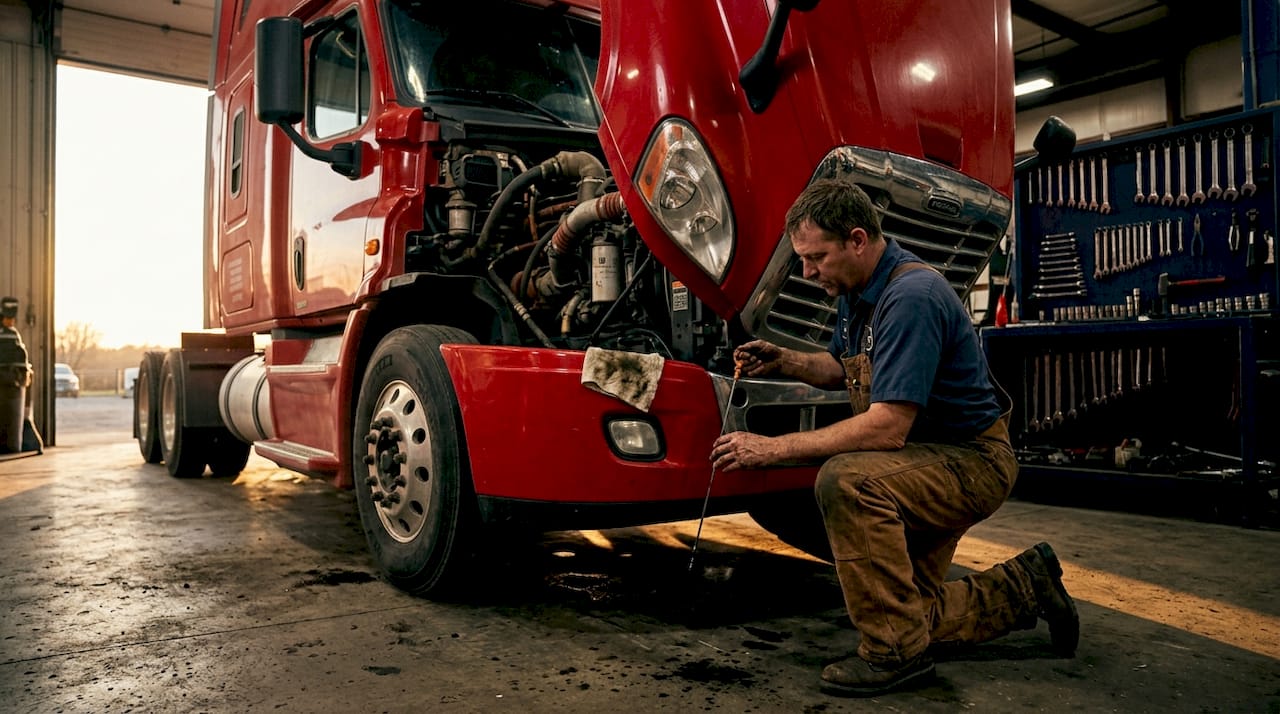
Oil, coolant, power steering fluid, and transmission fluid all have defined service intervals. Missing an oil change by 5,000 miles on a high-mileage engine is not just a mechanical risk. It shows up in your maintenance log as a gap that can hurt you during a compliance audit. Track fluid changes by odometer reading, not just calendar date.
Tires
Tire inspections should happen before every dispatch. Your checklist must include tread depth measurement, inflation check against manufacturer specs, and a visual scan for cuts, bulges, or uneven wear patterns. Federal rules prohibit operating on regrooved tires on the front axle of a truck under most conditions. Many drivers and even some fleet managers are not aware of that restriction.
Lighting and electrical
This is the category where fleets lose easy points. A working headlight that burns out between a shop visit and a roadside inspection costs you a violation. Check all lighting: headlights, brake lights, turn signals, clearance lights, marker lights, and reflectors. Verify the trailer electrical connection at every coupling. Use a trailer tester tool rather than relying on visual confirmation alone.
Here is a quick-reference maintenance frequency table for the most commonly missed tasks:
| Task | Frequency | Regulatory basis |
|---|---|---|
| Brake visual and air test | Daily | FMCSA 49 CFR 396.11 |
| Tire inflation and tread check | Before each dispatch | FMCSA 49 CFR 393.75 |
| Lighting and reflectors check | Daily | FMCSA 49 CFR 393.9 |
| Oil and filter change | Per OEM intervals | Manufacturer spec |
| Pushrod stroke measurement | Monthly | CVSA Level I criteria |
| Full annual DOT inspection | Annually | 49 CFR 396.17 |
| DVIR review and filing | When defect found | 49 CFR 396.11 |
Maintenance logs give you something no gut feeling can. They allow repair-versus-replace decisions based on cost-per-mile calculations across each vehicle. Without that history, your highest-cost trucks hide inside fleet averages and bleed your budget quietly. Digital logs that flag trends across mileage intervals are worth far more than paper forms that get filed and forgotten.
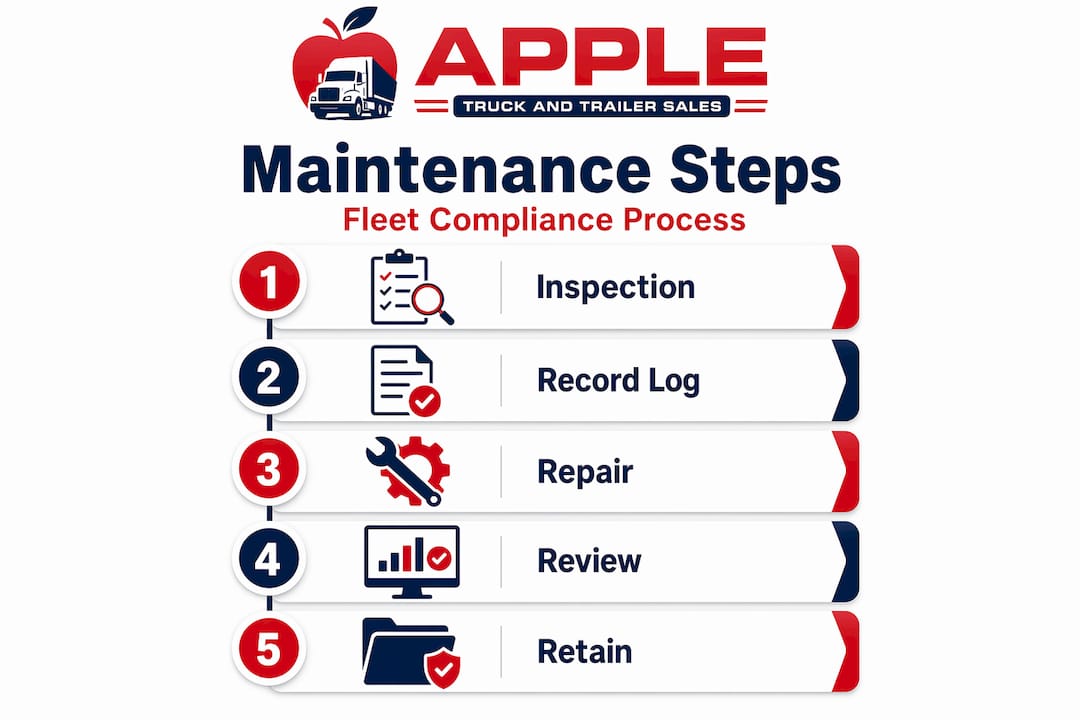
FMCSA requires inspection and repair records to be retained for 14 months. Your records should include the inspector’s credentials, measurements taken, findings, and corrective actions. Annual inspections must be performed by qualified inspectors meeting 49 CFR 396.19 and documented accordingly.
Building a preventive maintenance program that actually works
Reactive maintenance costs more than it should. The tow, the emergency repair rate, the missed delivery penalty, and the driver sitting idle add up faster than any scheduled maintenance interval ever would. The shift is not complicated, but it requires discipline.
More than 50% of fleet managers now rank proactive preventive maintenance as their top operational priority. The fleets acting on that priority are seeing measurable reductions in breakdowns and violations. Here is what a functional PM program actually requires:
- Defined PM intervals. Set intervals by mileage, engine hours, and calendar date. Use whichever threshold arrives first. Do not rely on a single trigger.
- Standardized inspection workflows. Every driver follows the same pre-trip sequence. Every technician uses the same post-trip checklist format. Consistency is what makes patterns visible.
- Parts inventory management. Keep critical high-wear parts on hand: brake linings, air filters, belts, and lighting components. Waiting on a part order while a truck sits is pure lost revenue.
- Vendor and contractor oversight. If you use outside shops for any portion of your maintenance, track their work in your own system. Their records become your compliance records.
Telematics changes the game when it comes to the gap between a fault appearing and a truck returning to service. Connected fleet maintenance software can flag fault codes in real time, alert dispatchers before a minor issue becomes a breakdown, and automatically trigger a work order. That is the difference between a $200 sensor replacement and a $3,000 roadside repair.
Pro Tip: Train your drivers to report “soft” issues during DVIRs, not just hard failures. A shimmy in the steering that does not trigger an out-of-service condition today can be a wheel-end failure next week. Drivers who understand what to look for, and who feel heard when they report it, are your earliest warning system.
Driver training and open communication between drivers and technicians are what separate fleets with low violation rates from those with chronic problems. When drivers understand the consequences of unreported defects and technicians trust the reports they receive, your entire maintenance system runs more efficiently. For more on reducing fleet downtime, the pattern is always the same: better inspection habits, faster reporting, and faster response.
My take on what most fleets still get wrong
I have worked with fleet operators across New England for years, and the same gaps show up repeatedly. Let me be direct about a few of them.
The DVIR misconception is the most persistent. Most fleet managers believe drivers must submit a written DVIR after every shift. That is not what federal regulation requires. Written DVIRs are only federally required when a defect is found. Requiring daily written reports is a company policy decision, not a regulatory mandate. I am not saying you should not require daily reports. I am saying you should know the difference, because it affects how you train drivers and how you respond to compliance questions.
Trailer inspections are where I have seen the most expensive surprises. Fleets track their tractors closely and then treat trailers as an afterthought. A trailer swap mid-route without a new pre-trip inspection is a citation that did not need to happen. Trailers carry the same inspection obligations as power units, and that message has not reached every driver yet.
The shift to digital inspection records is the single biggest operational improvement I have seen fleets make. Paper forms create the illusion of compliance. Digital records with timestamps, photos, and technician sign-offs create actual compliance. When a CSA audit comes, your digital trail is what protects you. The fleets I have seen struggle most are the ones still managing maintenance on spreadsheets and paper logs in 2026.
Brake inspections deserve their own honest conversation. The pushrod stroke measurement is the step most often skipped during weekly checks because it takes time and requires the right tools. That shortcut is what turns a $400 adjustment into a $20,000 out-of-service event. I have seen it happen more than once.
— Andrew
Keep your fleet road-ready with Appletruckandtrailer
Running a tight maintenance program starts with trucks that are worth maintaining. At Appletruckandtrailer, we have been helping fleet operators across Massachusetts, Rhode Island, Connecticut, and New Hampshire put reliable commercial equipment to work since 1986.
When you start with a quality used truck that has been properly inspected and documented, your maintenance burden from day one is lower. Our team understands what fleet managers actually need, not just the specs on a page. Whether you are looking for guidance on buying a used commercial truck or browsing our current inventory through truck and trailer sales in Massachusetts, we can help you build a fleet that stays compliant and on the road. Reach out to our team directly to discuss your fleet’s specific needs.
FAQ
What is required on a fleet truck maintenance checklist?
A compliant fleet truck maintenance checklist must cover at least 11 vehicle components for DVIRs and 15 categories for annual DOT inspections under 49 CFR 396.17, including brakes, tires, lights, steering, and coupling devices.
How often do commercial trucks need a DOT inspection?
All commercial motor vehicles require a full annual inspection documented by a qualified inspector under 49 CFR 396.17, with proof retained for 14 months and kept onboard the vehicle at all times.
What causes the most out-of-service violations?
Brake and lighting defects account for 52% of all FMCSA-recorded violations, with brake system defects alone triggering roughly 30% of all out-of-service orders during roadside inspections.
Is a daily written DVIR required by federal law?
No. Federal regulation under 49 CFR 396.11 only requires a written DVIR when the driver identifies a defect. Daily written reports for defect-free shifts are a company policy decision, not a legal requirement.
How long must fleet maintenance records be kept?
FMCSA requires inspection and repair records to be retained for at least 14 months, with annual inspection documentation kept onboard the vehicle and available for roadside review at all times.
Recommended
- 2025 Truck Maintenance Checklist for Businesses and Fleets – Apple Truck & Trailer
- Semi truck maintenance checklist: Boost fleet reliability – Apple Truck & Trailer
- Keeping Trailers Roadworthy: Safety and Compliance Essentials – Apple Truck & Trailer
- How to choose used trucks: a fleet manager’s guide – Apple Truck & Trailer