
Operating a commercial fleet across Massachusetts and neighboring states means juggling more than just routes and schedules. Staying compliant and keeping every trailer safe on the road is a daily challenge packed with regulatory requirements, seasonal threats, and mechanical wear. For your operation, a roadworthy trailer is one that meets safety standards for operation on public roads, with each inspection and maintenance decision stacking up to either prevent fines and breakdowns or invite costly downtime. This guide highlights practical steps to keep your trailers compliant and reliable while protecting your business from unnecessary risk.
Table of Contents
- What Roadworthy Trailers Really Mean
- Types of Trailers and Unique Needs
- Inspection Routines and Maintenance Practices
- Federal and State Regulatory Requirements
- Fleet Manager Responsibilities and Risks
- Common Compliance Mistakes to Avoid
Key Takeaways
| Point | Details |
|---|---|
| Roadworthy Standards | A roadworthy trailer must meet federal safety standards and undergo regular inspections to ensure proper function. |
| Ongoing Maintenance Commitment | Maintaining roadworthiness is an ongoing task, not a one-time certification; proactive inspections and record-keeping are crucial. |
| Type-Specific Maintenance | Different trailer types require tailored maintenance strategies based on their unique needs and compliance requirements. |
| Documentation is Critical | Systematic documentation of inspections and maintenance is essential for compliance and protecting against liability. |
What Roadworthy Trailers Really Mean
Roadworthiness isn’t some abstract concept that lives in a government manual. For fleet managers like you, it’s the difference between operating legally and facing downtime, fines, or worse. At its core, a roadworthy trailer is one that meets safety standards for operation on public roads and passes inspection under federal regulations. That sounds straightforward until you start managing dozens of trailers across Massachusetts and neighboring states where each trailer has its own maintenance history, age, and wear patterns.
The Federal Motor Vehicle Safety Standards (FMVSS) under 49 CFR Part 571 define exactly what makes a trailer roadworthy. These aren’t suggestions. These are legal requirements that affect every trailer you put on the road. A roadworthy trailer must have functioning brakes that can stop the vehicle within specific distances, lights that work properly for visibility and signaling, tires with adequate tread depth, mirrors positioned correctly, and structural integrity that won’t fail under normal operating conditions. Your steering must be responsive, your suspension must handle the load safely, and your overall construction can’t create hazards for other drivers. When you add it all together, roadworthiness means your trailer won’t become a liability at 65 miles per hour on Route 495.
What separates a marginally functioning trailer from a truly roadworthy one often comes down to systematic maintenance. Think about your trailer fleet like a fleet of employees. You wouldn’t send your best workers out without proper training, the right tools, and regular check-ins. Your trailers deserve the same approach. A roadworthy trailer has documented maintenance records showing that critical systems have been inspected, serviced, and repaired when needed. The brakes have been serviced according to manufacturer specifications. The lights have been tested. The tires have been inspected for wear and proper inflation. The coupling mechanisms work smoothly. When you conduct regular inspections aligned with commercial trailer requirements, you’re not just checking boxes for compliance. You’re building confidence that your trailers will perform reliably and won’t strand your drivers or damage cargo.
Here’s what often trips up fleet managers in Massachusetts: roadworthiness isn’t a one-time certification. It’s an ongoing commitment. A trailer that was roadworthy six months ago might not be today if maintenance has been deferred or if components have failed due to seasonal weather, salt on roads, or heavy use. Road conditions in New England are brutal. Salt, freeze-thaw cycles, and pothole-filled roads can age trailers faster than anywhere else. Your trailers need inspections before each trip, regular preventive maintenance on a schedule that makes sense for your operation, and immediate repairs when issues arise. You can’t treat a failing air brake system as something to fix “eventually.” That’s a safety issue and a compliance violation simultaneously.
Pro tip: Create a simplified roadworthiness checklist specific to your operation and have drivers complete it before departing, noting brake responsiveness, light function, tire condition, and any loose components, then pair this with quarterly professional inspections to catch wear patterns before they become violations.
Types of Trailers and Unique Needs
Not all trailers are created equal, and that’s exactly why your maintenance and compliance strategy can’t be either. Different trailer types carry different cargo, distribute weight differently, and have distinct mechanical systems that require tailored care. Understanding what you’re actually managing in your fleet is the first step toward keeping everything roadworthy. The difference between a flatbed hauling construction equipment and a refrigerated trailer delivering perishables goes way beyond what’s on top. It affects braking requirements, electrical systems, structural stress points, and inspection priorities.
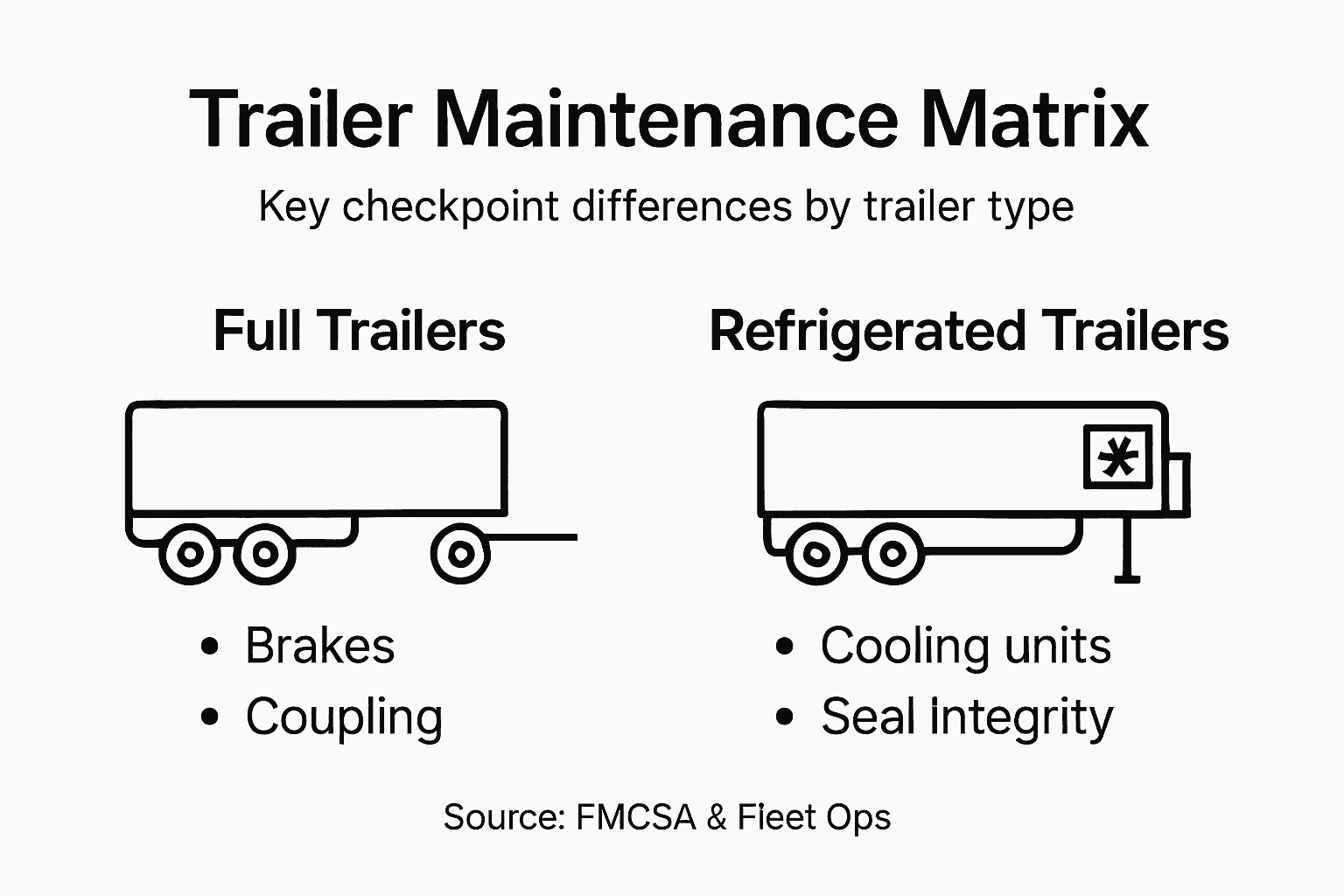
The fundamental divide in trailer classification comes down to how weight is distributed. Full trailers and semi-trailers have fundamentally different designs and compliance requirements. Full trailers carry their entire weight on their own axles, meaning they’re completely independent from the towing vehicle. Semi-trailers, by contrast, distribute weight between their own axles and the tractor unit through the kingpin connection. This distinction matters because it directly affects braking systems. Full trailers require independent braking systems with anti-lock brakes on both front and rear axles. Semi-trailers have different requirements since the tractor shares braking responsibility. If you’re mixing full trailers and semi-trailers in your Massachusetts fleet, you’re actually managing two completely different mechanical systems. Your maintenance technician might think they’re doing routine brake work, but they could be checking completely different components depending on which trailer type rolls into the bay.
Beyond that structural division, your fleet likely includes specialized trailers designed for specific cargo types. Refrigerated trailers for food distribution have diesel refrigeration units that need their own maintenance schedule and electrical connections. Flatbeds require tie-down hardware inspection and deck integrity checks. Enclosed trailers for furniture or goods need roof seals and interior condition monitoring. Tanker trailers for liquids have compartment integrity issues and specialized plumbing that food trailers never encounter. Livestock trailers have ventilation systems and flooring considerations. Each type brings its own failure modes and roadworthiness threats. A roof leak that’s an inconvenience on a dry goods trailer becomes a serious problem on a refrigerated unit because it compromises insulation and creates condensation that ruins cargo. A minor crack in a flatbed’s side rail might cause shifting loads. Understanding your specific trailer types means you’re not just running generic maintenance on everything.
Here’s what catches fleet managers off guard: compliance requirements vary by trailer type too. Your storage trailers and specialized utility trailers might have different inspection priorities than your commercial shipping trailers. Some specialized trailers fall under different regulatory categories entirely. A horse trailer used for personal transport has different requirements than a commercial livestock hauler. A utility trailer used seasonally might need different winterization steps than a year-round refrigerated unit. Massachusetts road conditions demand that you adjust maintenance based on what each trailer carries and how often it’s used. A trailer that sits idle four months of the year needs different preparation than one running constant routes. Salt exposure affects aluminum and steel differently. Weight distribution during off-season storage creates different stress patterns. Your roadworthiness strategy needs to account for these practical realities, not just treat every trailer like a generic box on wheels.
Here’s a quick comparison of trailer types and their unique maintenance priorities:
| Trailer Type | Unique Maintenance Needs | Common Compliance Focus |
|---|---|---|
| Flatbed | Deck integrity, tie-downs | Load securement hardware |
| Refrigerated | Refrigeration unit, insulation | Temperature records |
| Tanker | Compartment integrity, plumbing | Leak testing |
| Enclosed | Roof seals, interior checks | Cargo protection |
| Livestock | Ventilation, flooring | Animal safety systems |
Pro tip: Create a maintenance matrix for each trailer type in your fleet with specific inspection checkpoints, intervals, and known failure points, then assign it to your mechanics so they’re doing targeted inspections rather than generic walkarounds.
Inspection Routines and Maintenance Practices
Inspection and maintenance aren’t two separate activities competing for your attention. They’re a single system designed to catch problems before they become roadside emergencies or compliance violations. The trailers sitting in your lot right now are only as roadworthy as your last thorough inspection confirmed. Federal regulations don’t just suggest you inspect your trailers. They mandate it. You need annual inspections covering critical components like brakes, tires, steering, lighting, and structural integrity, with documented records proving you did the work and what you found. In Massachusetts, where winter salt and freeze-thaw cycles attack your equipment relentlessly, that annual requirement is really a floor, not a ceiling. You should be looking at your trailers more frequently if you want to catch corrosion and wear before they impact safety.
When you actually get down to the work of inspecting a trailer, you’re looking at a straightforward checklist that repeats. Tire tread depth, brake pad thickness, light function, reflector condition, hitch security, safety chains, load securement hardware, and structural integrity for cracks or rust. These are the fundamentals. You check them regularly, document what you find, repair what’s broken, and keep records that prove you did it all. The reason this matters is that routine vehicle inspections identify wear and damage early, preventing accidents before they happen. Your drivers complete pre-trip walkarounds looking for obvious problems. Your maintenance team conducts scheduled inspections following intervals that make sense for your operation. And then you keep meticulous records showing when you did each inspection, what you found, and what repairs you completed. This documentation is your legal defense if something goes wrong. It proves you were maintaining your equipment properly.
The maintenance practices that flow from these inspections need to match your specific operation. Lubrication points vary by trailer type and design. Fasteners that work themselves loose from constant road vibration need tightening on a schedule. Brake fluid needs changing at manufacturer intervals. Lights need testing and bulb replacement. Tire rotation patterns matter. Structural welds develop stress cracks from heavy loads and road impacts. You can’t do generic maintenance on specialized equipment. A refrigerated trailer needs refrigeration unit service that a flatbed never encounters. A tanker needs compartment integrity checks that a dry goods trailer doesn’t. This is where working with a service provider who understands truck and trailer inspection requirements becomes valuable. They can help you develop maintenance schedules that match your specific trailers and operation rather than applying a one-size-fits-all approach.
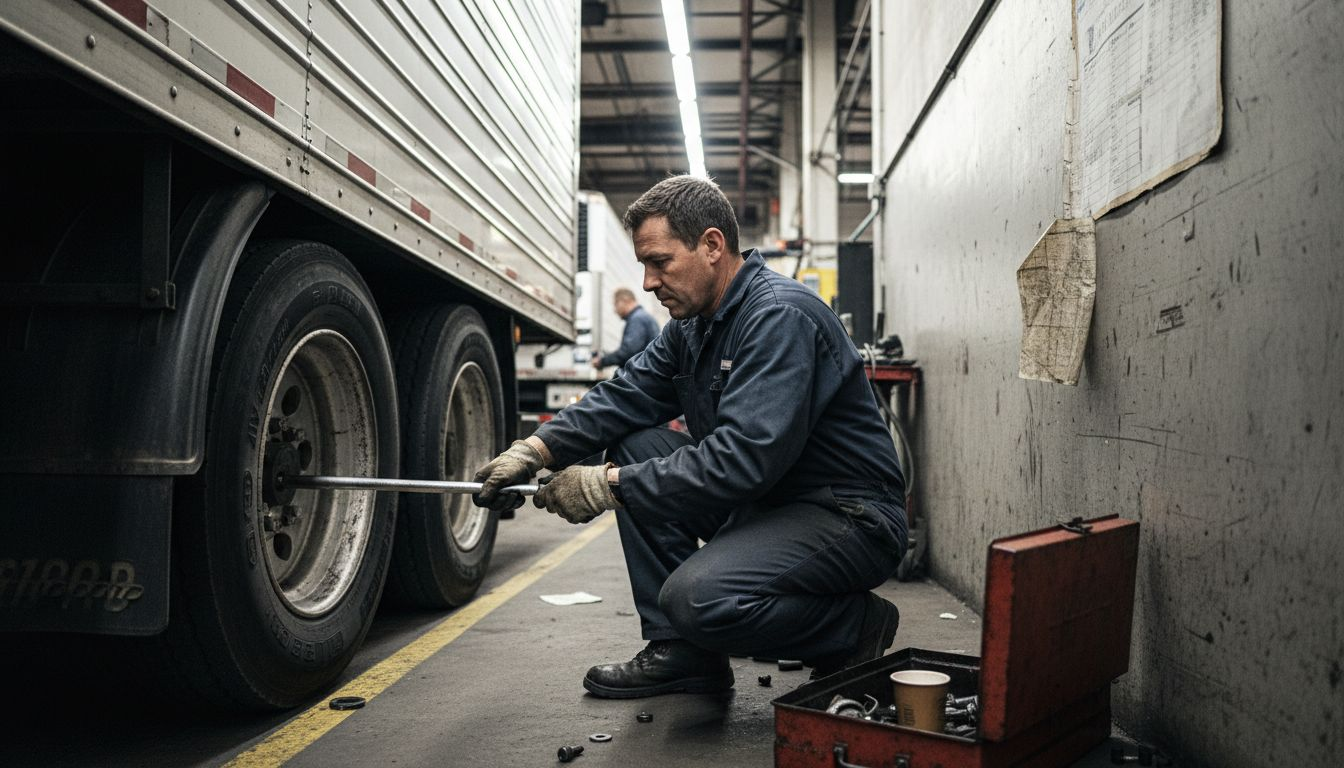
Here’s the practical reality many fleet managers face. You’re balancing the cost of preventive maintenance against the cost of downtime and repairs when something fails. But those aren’t actually competing priorities. A trailer that fails inspection costs you the trip, the cargo, the towing fee, and possibly driver safety. A small brake repair caught during scheduled maintenance costs a few hundred dollars and takes a couple of hours in the bay. A catastrophic brake failure on the highway costs everything plus potential liability. Routine maintenance on a schedule is always cheaper than reactive repairs after failure. Your inspection records prove to customers that you run a professional operation. They prove to insurers that you maintain equipment properly. They prove to regulators that you’re complying with federal requirements. They protect you legally if something goes wrong. The discipline of regular inspection and maintenance isn’t just about keeping trailers roadworthy. It’s about running a professional fleet operation.
Pro tip: Assign specific trailers to specific mechanics and make them responsible for that unit’s maintenance history, creating accountability and ensuring consistency in how inspections and repairs are documented rather than having whoever is available that day handle routine work.
Federal and State Regulatory Requirements
Compliance isn’t optional. It’s the baseline cost of operating a commercial fleet in Massachusetts and the surrounding region. When you put a trailer on the road, you’re not just following suggestions from the Department of Transportation. You’re adhering to federal standards that have the force of law behind them. The Federal Motor Vehicle Safety Standards (FMVSS) mandate that trailers sold or operated in the U.S. must meet strict requirements for critical safety components. Trailers must comply with federal safety standards covering lighting systems, tire specifications, and braking performance. These aren’t abstract regulations written by people who’ve never seen a truck. They exist because trailers that don’t meet these standards create genuine hazards on public roads. Brake failure at highway speed doesn’t just affect your trailer. It affects every vehicle around you. Lighting that doesn’t work makes your 53-foot trailer invisible to other drivers in darkness or poor visibility. Tires that fail strand your driver and create debris that damages other vehicles. These federal standards exist because people have died from equipment failures that proper standards would have prevented.
Beyond the federal baseline, Massachusetts adds its own layer of requirements that you need to understand and follow. Your trailers need proper registration and titling specific to Massachusetts standards. Road use restrictions in certain areas affect where and when you can operate specific trailer types. Some roads prohibit certain loads or vehicle weights at specific times. The state also conducts inspections that might be more frequent or stringent than federal minimums depending on your operation. What works in Rhode Island might not be allowed in Massachusetts. Connecticut has different rules than New Hampshire. As a fleet operating across multiple states in the region, you need to know the specific requirements for each state where your trailers operate. One trailer might comply with Massachusetts standards but violate Connecticut regulations, and you need systems in place to track those differences. This is where working with providers who understand regional regulations becomes valuable. They know the specific requirements for each state you operate in and can help you maintain compliance across your entire territory.
FMCSA regulations govern trailer equipment, inspection, and maintenance requirements with particular attention to coupling safety, brake systems, and lighting for trailers engaged in interstate commerce. If your trailers cross state lines, these regulations apply directly to your operation. The FMCSA doesn’t just set standards and walk away. They conduct roadside inspections, pull equipment for detailed examinations, and levy fines for violations. They can place trailers out of service until violations are corrected. They can impose penalties on drivers and companies. The compliance burden falls on you as the fleet owner. Your drivers can’t fix systemic maintenance problems. Your dispatch can’t overcome equipment failures. Ultimately, you’re responsible for ensuring your equipment meets standards before it leaves your facility.
The practical implication for your fleet is this: compliance requires systems, not just good intentions. You need documented maintenance schedules that you actually follow. You need inspection records that prove you’re checking critical systems regularly. You need a way to track which trailers meet which state requirements. You need mechanics trained on the specific inspection standards that apply to your equipment. You need a communication system that flags issues before they become violations. When you’re inspected, regulators want to see evidence that you maintain your equipment properly. They want records. They want proof. Good intentions don’t satisfy federal or state regulators. Documentation does. A trailer that looks well-maintained but has no inspection records is evidence of noncompliance. A trailer with a documented maintenance history showing regular inspections and timely repairs demonstrates a serious compliance program. Build your compliance systems around documentation, and your regulatory risk drops dramatically.
Pro tip: Create a compliance calendar specific to your Massachusetts and regional operations that tracks federal inspection deadlines, state registration renewals, and maintenance intervals for each trailer, then set automated reminders 30 days before each requirement so nothing slips through the cracks.
To help clarify compliance strategies, here is a summary of federal versus Massachusetts trailer requirements:
| Requirement Area | Federal Focus | Massachusetts Focus |
|---|---|---|
| Inspection Frequency | Annual minimum | May require more frequent |
| Braking Systems | FMVSS standards | State equipment check |
| Registration/Title | Not federally managed | State-specific documentation |
| Road Use Restrictions | Interstate guidelines | Local zone limitations |
Fleet Manager Responsibilities and Risks
You’re not just managing trucks and trailers. You’re managing legal liability, regulatory compliance, driver safety, and operational continuity all at once. The moment a trailer with faulty brakes leaves your facility, you’ve assumed responsibility for what happens next. If that trailer causes an accident, you’re facing potential lawsuits, regulatory penalties, and reputational damage that could take years to recover from. Understanding what you’re actually responsible for as a fleet manager is the foundation for building systems that protect your operation. Fleet managers bear responsibility for ensuring vehicle availability, safety, maintenance, and regulatory compliance. Your role extends beyond just keeping trailers running. You’re accountable for whether they’re safe, whether they’re legal, and whether they’re maintained to standards that protect everyone on the road. This isn’t theoretical liability. This is the daily weight of fleet management in Massachusetts.
The operational risks start with maintenance breakdowns and mechanical failures that your drivers can’t predict or prevent. A trailer that fails inspection costs you revenue that day because the trip doesn’t happen. But the real risk goes deeper. Fleet managers face risks from mechanical failures and non-compliance penalties if trailers are not properly maintained. You could face federal penalties ranging from hundreds to tens of thousands of dollars per violation. Your company could be placed out of service, meaning you can’t operate at all until violations are corrected. Your insurance could be cancelled if you don’t maintain proper compliance records. Your customers could refuse to work with you if your trailers consistently fail inspections or break down mid-delivery. These aren’t edge-case scenarios. Fleet managers deal with these consequences regularly when maintenance systems fail. The safety risk cuts even deeper. An unmaintained trailer could cause an accident that injures or kills someone. That’s not just a financial liability. That’s a human tragedy that your operation caused. That’s the kind of outcome that haunts people who made the decision to defer maintenance or skip inspections.
Your responsibility as a fleet manager also extends to driver management and safety coordination. Your drivers spend more time around your equipment than anyone else. They notice problems first. They feel brake fade or steering issues before an inspector would catch them. You need to create a culture where drivers report problems without fear of consequences, and you need to act on those reports immediately. You also need to ensure your drivers are trained on pre-trip inspections and that they understand their role in maintaining equipment safely. When you have systematic fleet management that integrates vehicle maintenance, safety regulations, and driver management, you create a safety culture that protects everyone. Your drivers become an additional layer of inspection and safety monitoring. They understand that they’re part of the system keeping themselves and others safe. When you skip that training or treat driver input as complaints to dismiss, you’re actually increasing your risk because you’re losing valuable safety information.
Here’s what keeps many fleet managers up at night: the regulatory environment keeps changing, and staying compliant requires constant attention. A new state regulation in Connecticut might affect how you maintain trailers. Federal FMCSA rules might shift inspection requirements. Your insurance company might impose stricter maintenance standards as a condition of coverage. Technology is evolving with electronic brake systems, telematics, and advanced lighting that requires specialized knowledge to maintain. You can’t just hire a mechanic who knows older systems and assume they understand everything in your modern fleet. You need ongoing training, updated maintenance schedules, and systems that adapt to changing requirements. This is why partnering with service providers who stay current on compliance requirements becomes valuable. They track regulatory changes so you don’t have to navigate them alone. They have mechanics trained on modern systems. They maintain documentation systems that protect your liability. The complexity of modern fleet management is too much for any single person to manage without systems and partnerships.
Pro tip: Implement a monthly fleet manager review meeting with your maintenance team, mechanics, and a compliance-focused partner where you discuss problem trailers, regulatory changes, and safety near-misses, ensuring accountability and staying ahead of issues rather than reacting to them.
Common Compliance Mistakes to Avoid
Most fleet managers don’t intentionally violate regulations. They make mistakes because they’re juggling too many priorities without proper systems in place. The difference between a compliant operation and one facing penalties often comes down to avoiding a handful of critical errors that catch managers off guard. The most damaging mistake is simple: you don’t do systematic inspections and maintenance, or you do them sporadically without documentation. Failing to perform systematic inspections and maintain records of repairs creates non-compliance that regulators catch immediately. You could have a trailer that’s perfectly maintained but if you can’t prove it with documentation, you’re in violation. A federal inspector at a weigh station doesn’t care about your good intentions. They want to see inspection records showing when you checked brakes, when you serviced them, what you found, and what you repaired. Without that paper trail, you’re operating blind from a compliance perspective. This is the mistake that costs fleets the most because it’s so easily preventable. Buy a maintenance management system. Use it. Train your mechanics to document everything. That single decision eliminates the biggest compliance risk most fleets face.
The second major mistake category involves overlooking critical maintenance items that directly impact safety. You skip brake inspections because the trailer seems fine. You don’t check tire pressure regularly because it feels like busywork. You ignore early signs of wear because the trailer still functions. Inadequate brake system checks, improper tire pressure, and neglecting early signs of wear are the exact failure modes that cause accidents and regulatory violations simultaneously. A trailer with worn brake pads passes inspection until one day it doesn’t stop in time. A tire with borderline tread fails during heavy rain, shredding and potentially causing an accident. A suspension component with early cracks breaks completely under load. These aren’t theoretical risks. They’re the predictable consequences of deferred maintenance. The counterintuitive truth is that preventive maintenance is always cheaper than reactive repairs. A brake pad replacement costs a few hundred dollars. A catastrophic brake failure on the highway costs tens of thousands in damage, injuries, liability, and regulatory penalties. Fleet managers who understand this shift their entire approach. They move from treating maintenance as an expense to be minimized to treating it as insurance that protects their operation.
A third mistake that catches many fleet managers involves assuming all trailers need the same maintenance approach. You create a generic maintenance schedule and apply it uniformly across your fleet without accounting for different trailer types, age, usage patterns, or operating conditions. A refrigerated trailer used year-round in heavy food distribution has completely different maintenance needs than a seasonal flatbed used during construction season. An older trailer sitting in winter storage needs different winterization than one running constant routes. A trailer that hauled corrosive materials needs different inspections than one carrying general freight. You need maintenance schedules tailored to your specific equipment and operation. This requires understanding your fleet at a granular level. What trailers do you actually have? How are they used? How many miles per month? What’s their age and condition? When you answer those questions systematically, you can build maintenance schedules that catch problems before they become violations.
Here’s a mistake that’s harder to catch but equally damaging: not maintaining proper documentation organization and accessibility. You do the inspections. You do the repairs. You have records. But they’re scattered across multiple systems, handwritten notebooks, email chains, and mechanics’ notes. When an inspector asks to see your maintenance history for a specific trailer, you can’t pull it up quickly. That inability to demonstrate compliance is itself a compliance violation. You need a centralized system where every inspection and repair is logged, dated, and searchable by trailer. Your mechanics need training on how to use that system. Your compliance person needs to review it regularly. Your leadership needs to understand that documentation is not paperwork it’s your legal defense and evidence of responsible fleet management.
Pro tip: Audit your current documentation practices by requesting maintenance records for three random trailers and timing how long it takes to compile them; if it takes more than 15 minutes per trailer, you need a better system because inspectors won’t wait while you search for records.
Ensure Your Trailers Stay Roadworthy and Compliant with Expert Support
Managing a commercial trailer fleet means staying ahead of maintenance challenges, regulatory inspections, and safety risks. The article highlights how critical it is to have systematic inspections and tailored maintenance routines that protect your investment and prevent costly downtime. If you struggle with keeping up documentation, managing varied trailer types, or navigating federal and Massachusetts regulations, know that you are not alone. Expert help can make all the difference in turning compliance from a burden into a competitive advantage.
Partnering with a trusted provider like Apple Truck & Trailer gives you access to comprehensive solutions including reliable used trailers, professional truck maintenance services, and specialized options like storage trailers on wheels to support your operational needs.
Take control of your trailer fleet’s roadworthiness now by exploring our inventory and maintenance offerings. Visit Apple Truck & Trailer today and build the reliable, compliant fleet your drivers and customers deserve.
Frequently Asked Questions
What is a roadworthy trailer?
A roadworthy trailer is one that meets safety standards for operation on public roads and passes inspection under federal regulations. It must have functioning brakes, lights, tires with adequate tread, and overall structural integrity.
How often should trailers be inspected for roadworthiness?
Trailers should be inspected regularly, ideally before each trip for basic safety checks, and undergo thorough inspections according to manufacturer guidelines, generally at least annually.
What unique maintenance needs do different types of trailers have?
Different types of trailers require tailored maintenance based on their design and cargo type. For example, refrigerated trailers need checks on their refrigeration units, while flatbeds require inspections of tie-down hardware and deck integrity.
What are common mistakes fleet managers make regarding trailer compliance?
Common mistakes include failing to perform systematic inspections and maintain proper documentation, overlooking critical maintenance items that affect safety, and applying a generic maintenance approach to all trailers without accounting for their unique needs.
Recommended
- Truck and Trailer Inspections—Why Compliance Matters – Apple Truck & Trailer
- 2025 Truck Maintenance Checklist for Businesses and Fleets – Apple Truck & Trailer
- Commercial Trailer Requirements: Ensuring Compliance in Massachusetts – Apple Truck & Trailer
- 7 Key Tips for Buying Storage Trailers for Sale – Apple Truck & Trailer