
TL;DR:
- Overnight trailer theft is a prevalent and documented risk for Massachusetts fleet operators due to vulnerabilities at the coupler and cargo doors. Implementing layered security measures, including physical locks, controlled parking, and GPS tracking, significantly deters theft and facilitates recovery. Consistent habits, environmental controls, and regular monitoring are essential for maintaining long-term trailer security and reducing insurance costs.
Overnight trailer theft is not a distant risk for Massachusetts fleet operators, it is a documented operational hazard that shows up in police reports, insurance claims, and loading dock conversations every week. If you manage even a handful of storage trailers, the temptation to rely on a single padlock and call it done is real. But that approach leaves serious money and cargo exposed. Knowing how to secure a storage trailer properly means thinking in layers: physical hardware at every critical point, smart parking practices, and active monitoring technology working together as a system.
Table of Contents
- Understanding essential security requirements for storage trailers
- Gathering and preparing security tools and environment
- Step-by-step process to secure your storage trailer effectively
- Common pitfalls and troubleshooting in trailer security
- Measuring security effectiveness and maintaining long-term protection
- Why layered trailer security outperforms single measures: an insider’s perspective
- Explore secure trailers and equipment solutions with Apple Truck & Trailer
- Frequently asked questions
Key Takeaways
| Point | Details |
|---|---|
| Layered security approach | Combining physical locks, smart parking, and GPS tracking offers the best protection against storage trailer theft. |
| Critical lock points | Focus on securing the coupler and cargo access doors as the highest leverage points for theft prevention. |
| Environment matters | Choose well-lit, controlled access storage locations with surveillance to lower theft risk significantly. |
| Consistent routines | Implement and follow a lock-and-scan checklist every time to maintain reliable security practices. |
| Technology aids recovery | GPS tracking and active monitoring reduce losses and can lower insurance costs but do not replace physical barriers. |
Understanding essential security requirements for storage trailers
Before you buy a single lock or move a single trailer, you need a clear picture of where your vulnerabilities actually are. A storage trailer has two primary weak points: the coupler (the connection point where it attaches to a tow vehicle) and the cargo doors. Thieves who steal trailers outright target the coupler. Thieves who want the contents without moving the trailer go straight for the doors. Every security layer you add should address at least one of those two points.
The case for layered security is not theoretical. Multiple barriers reduce theft risk because each additional device adds time, noise, and required tools to the theft attempt. A thief who can defeat a coupler lock in 30 seconds will abandon a trailer if removing the wheel boot adds another 10 minutes and a grinder to the job. The goal is not an impenetrable fortress but a high enough effort-to-reward ratio that your trailer becomes the wrong target.
Here is what a complete security setup addresses:
- Coupler point: Hardened coupler lock that fully covers the hitch socket
- Wheels: Wheel boots or locking wheel chocks to prevent rolling
- Cargo doors: Puck locks or hasp locks rated for high-cut resistance
- Access chains and hitch pins: Locking hardware to prevent quick-attach theft
- Location: Controlled-access lot with surveillance coverage and adequate lighting
- Technology: GPS tracker with geofencing and motion alerts
For operators who are still evaluating which trailer type fits their needs, these storage trailer buying tips offer useful context on how construction and door hardware vary across trailer styles. If you are working with a permanent storage setup, the semi trailer storage guide covers additional considerations for fixed-location trailers.
| Security layer | What it protects | Relative cost |
|---|---|---|
| Hardened coupler lock | Hitch, towing prevention | Low |
| Wheel boot or chock lock | Mobility | Medium |
| Puck lock on doors | Cargo access | Low |
| GPS tracker with geofence | Location, recovery | Medium |
| Controlled-access facility | Perimeter, environment | Variable |
| Surveillance cameras | Deterrence, evidence | Medium to high |
Gathering and preparing security tools and environment
Once you know what you need, the preparation phase is where most fleet operators either get it right or cut corners they later regret. Start with the hardware.
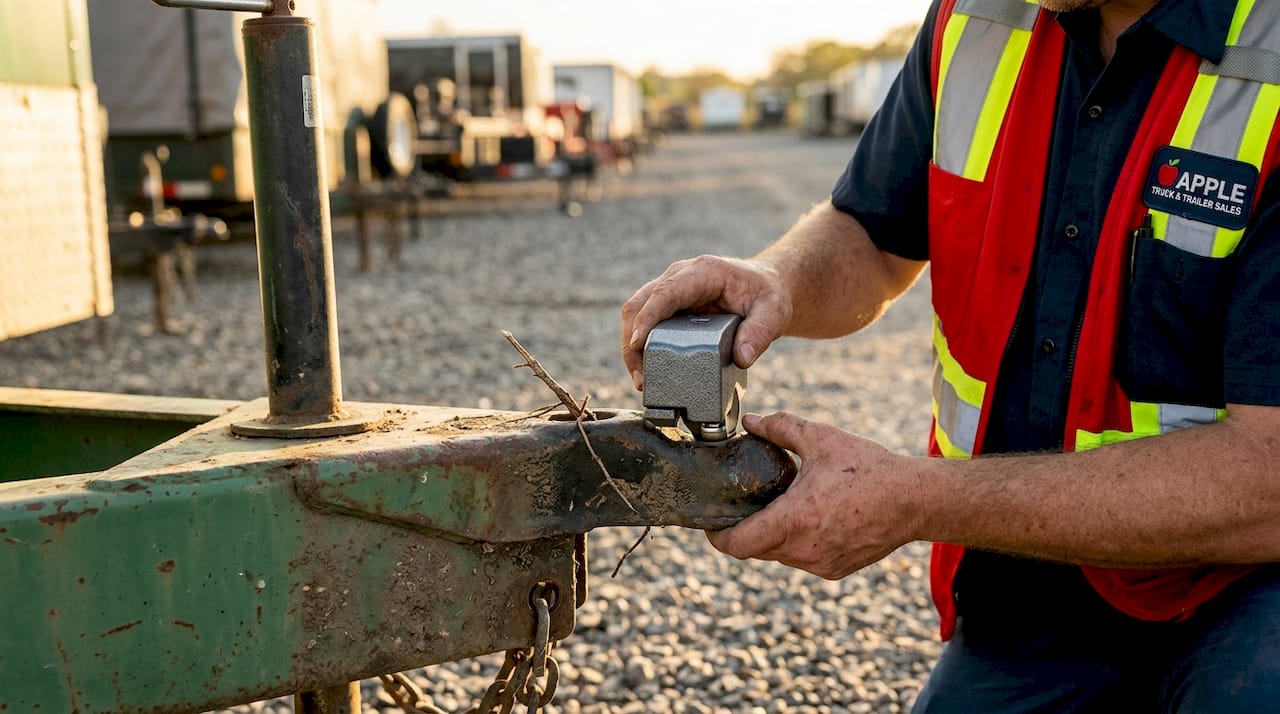
Hardened coupler locks should be made from boron-reinforced steel and sized to match your specific coupler diameter. A 2-inch ball coupler requires a different lock than a 2 and 5/16-inch coupler. Do not assume one size fits all. Use hardened coupler locks, wheel locks, and puck door locks at each of these critical points, and buy from brands whose products are third-party rated rather than just marketed as “heavy duty.”
Wheel boots (also called wheel clamps) should be rated for your trailer’s tire diameter and tire width. A boot that fits loosely can be rocked off without tools. Puck locks for cargo doors offer a major advantage over standard padlocks: their short shackle exposes almost no metal for bolt cutters or pry bars to grip.
For your storage environment, the bar is higher than most operators realize. Prioritize controlled access and surveillance with gated entry, personalized access codes that log who entered and when, and 24/7 monitoring. Facilities that use generic door codes shared among all tenants offer far less protection than those with individual PIN codes tied to specific accounts.
Here is a comparison of common lock types for cargo door security:
| Lock type | Cut resistance | Pry resistance | Best use case |
|---|---|---|---|
| Standard padlock | Low to medium | Low | Low-risk environments only |
| Puck lock | High | High | Primary door lock |
| Disc lock | High | Medium | Secondary or chain applications |
| Hasp with shrouded shackle | High | Medium to high | Dual-door trailers |
Additional tools and environmental steps to gather and set up:
- Locking safety chain with a case-hardened shackle
- Locking hitch pin for the receiver
- Motion-activated lighting for the perimeter
- GPS tracker concealed inside the trailer, not in plain sight on the exterior
- Contact information for your facility’s after-hours security line posted internally
Pro Tip: When scoping a storage location, drive through after dark before committing. Poor lighting and blind corners that appear minor during the day become significant vulnerabilities at 2 a.m.
If you are renting storage trailers rather than owning them, review these storage trailer rental considerations to understand what security responsibilities shift between renter and owner. For those purchasing, storage trailer purchase guidance for Massachusetts covers how construction quality and locking hardware should factor into your buying decision.
Step-by-step process to secure your storage trailer effectively
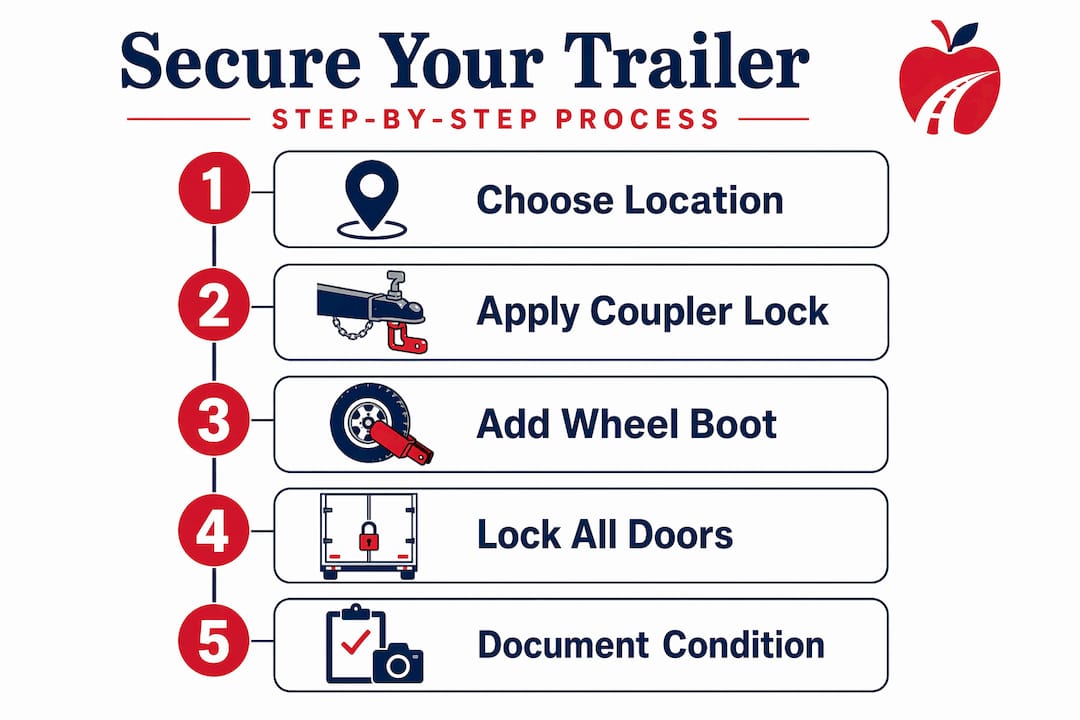
With your tools in hand and your environment selected, here is how to apply these layers in practice. Work through this sequence every time a trailer is parked.
- Install the coupler lock first. Fit it tightly over the hitch socket with zero visible gap. Wiggle the lock after installation. If it moves, it does not fit correctly. A loose coupler lock can be defeated with a pry bar in seconds.
- Apply the wheel boot to the driver-side rear wheel. Many operators leave wheels unprotected because they assume the coupler lock is enough. It is not. One lock is never enough to reliably stop a determined theft attempt.
- Install puck locks on all cargo doors. If your trailer has dual rear doors, lock both. Check that the hasp hardware itself is through-bolted rather than surface-mounted screws, which can be removed with a drill in under a minute.
- Position the trailer intelligently. Park the tongue against a wall, fence, or concrete barrier so a tow vehicle cannot line up to the coupler. Where possible, park your tow vehicle directly in front of the trailer. Place the trailer under or directly adjacent to a working light source and within sight of a camera.
- Activate GPS tracking with motion alerts and geofencing. Set the geofence boundary tight enough that any unauthorized movement triggers an alert before the trailer leaves your lot. Test the alert on your phone before leaving the site.
- Walk the perimeter before you leave. Check that every lock is fully engaged, all lights are functional, and no cargo is visible through gaps in door seals. This final scan takes 90 seconds and catches mistakes.
- Log the departure check. Fleet operators using lock-and-scan checklists retain documentation that matters for insurance claims and theft investigations. Control every entry and exit point and maintain records of who accessed the trailer and when.
Pro Tip: Photograph your fully locked trailer from multiple angles every time you secure it off-site. If theft occurs, timestamped photos confirm the security setup was intact, which matters enormously during an insurance claim.
Keeping trailers roadworthy and properly maintained also reinforces security because well-maintained door hardware, lighting, and lock fixtures function reliably when you need them most.
Common pitfalls and troubleshooting in trailer security
Even operators who understand layered security make predictable mistakes. Knowing them ahead of time is cheaper than learning through a theft.
Lock fit is everything. A lock that doesn’t fit tightly or leaves wiggle room can be ineffective regardless of its price or marketing. When buying coupler locks, verify the exact coupler size on your trailer before purchasing. Bring the measurement with you or verify with the manufacturer.
GPS tracking is not a prevention tool. It tells you where your trailer went after theft occurs. It does not stop the theft from happening. Operators who invest heavily in tracking but skip the physical hardware have their priorities backward.
Inconsistent locking habits and poor parking choices create predictable weaknesses that thieves exploit. If your crew locks the trailer fully on Mondays but skips the wheel boot on Fridays, that pattern becomes visible to anyone watching your operation. Routine is your friend.
Additional pitfalls to avoid:
- Leaving the trailer tongue pointed toward an open lane or road access
- Using the same generic padlock you use for tool storage on high-value cargo trailers
- Skipping locks during short stops under 30 minutes (“we’ll be right back”)
- Storing trailers in locations without any after-hours contact or monitoring capability
- Allowing cargo contents to be visible through vents, windows, or unsealed door gaps
“The most secure trailer on the lot is still vulnerable if the person locking it up is in a hurry or skips a step because the shift is over.” This is the overlooked truth in trailer security: hardware is only as reliable as the habits surrounding it.
Measuring security effectiveness and maintaining long-term protection
Securing your trailer is not a one-time task. The value of your security system is in whether it holds up week after week, across multiple drivers and storage locations.
Here is what to monitor consistently:
- GPS and motion alerts: Review alert logs weekly. False positives (wind, vibration) can be tuned out, but gaps in alert coverage need immediate attention.
- Incident reports: Document every attempted or completed theft, including near-misses and vandalism. Patterns reveal weak points.
- Checklist compliance rates: If you manage a crew, audit lock-and-scan checklists monthly. A 90% compliance rate sounds good. That 10% gap is your exposure.
- Facility security audits: Confirm quarterly with your storage facility that cameras are operational, access codes are current, and lighting is working.
- Insurance review: Fleets using active access control and asset tracking see a 76% reduction in annual losses and a 31% drop in insurance premiums. Share your security documentation with your insurance provider annually.
| Action | Frequency | Responsible party |
|---|---|---|
| Lock-and-scan checklist | Every securing event | Driver or operator |
| GPS alert log review | Weekly | Fleet manager |
| Facility security audit | Quarterly | Logistics manager |
| Insurance security review | Annually | Fleet or operations manager |
| Lock hardware inspection | Monthly | Driver or maintenance |
Why layered trailer security outperforms single measures: an insider’s perspective
Here is something the security product marketing never says clearly enough: a single high-end lock is not a security system. It is one component of one. And the gap between those two things is where theft happens.
After decades of working alongside fleet operators in New England, the pattern is consistent. A business installs a quality GPS tracker after a trailer goes missing. Another bolts on an expensive coupler lock after someone walks off with an unattended unit. Each response addresses the last theft, not the next one. Security works best as layered defenses targeting multiple points and using technology for active monitoring rather than relying on a single passive device.
What most operators underestimate is the value of environmental and behavioral layers that cost very little. Parking the tongue against a wall costs nothing. Running a 60-second perimeter check before leaving costs nothing. These habits, applied consistently by every person on your team who touches a trailer, do more to prevent opportunistic theft than a $400 lock installed incorrectly and checked sporadically.
The other insight worth sitting with: thieves assess risk fast. A trailer with one lock takes 45 seconds to evaluate. A trailer with a coupler lock, a wheel boot, puck locks, bright lighting, a visible camera, and a tongue pressed against a wall takes 45 seconds to walk away from. That is the goal. Not impossible to steal. Just not worth the effort compared to the next lot over.
For ongoing guidance on keeping your fleet assets protected and operational, the trailer security and maintenance insights at Apple Truck & Trailer offer practical, fleet-specific advice grounded in real New England operating conditions.
Explore secure trailers and equipment solutions with Apple Truck & Trailer
Knowing how to secure a storage trailer is the foundation. Having the right trailer with proper door hardware, compatible locking points, and the right fit for your operation is what makes every security step more effective.
Apple Truck & Trailer has been serving Massachusetts fleets since 1986, with a full inventory of commercial trucks and trailers suited for businesses ranging from regional carriers to contractors needing portable storage. Their team can help you identify trailers with door configurations that accept high-security puck locks and hasp hardware without modification. They also offer secure storage containers for applications where a fixed unit is more practical than a trailer. And if you want support maintaining what you already own, their fleet trailer maintenance service keeps door hardware, lighting, and lock fixtures in the condition your security system depends on.
Frequently asked questions
What is the most effective way to secure a storage trailer overnight?
Using multiple security layers including a hardened coupler lock, wheel boots, puck locks on doors, smart parking against a solid barrier, and GPS tracking with motion alerts gives you the strongest overnight protection available.
Can GPS tracking alone prevent trailer theft?
No. GPS trackers support recovery by alerting you after movement occurs and helping locate the trailer, but they do not physically stop a theft, which is why physical barriers must come first.
How can I improve security when storing a trailer off-site?
Choose a facility with gated, monitored entry that assigns individual access codes per tenant, maintains active surveillance cameras, and offers live after-hours monitoring rather than recorded-only systems.
What are the most common mistakes that reduce trailer security?
The biggest mistakes are using a coupler lock with poor fit and inconsistent habits, skipping wheel or door locks during short stops, and positioning the trailer tongue in an accessible open lane where a tow vehicle can approach easily.
Do security upgrades affect insurance premiums for fleets?
Yes. Fleets with active tracking and layered security have documented a 31% reduction in premiums, making the hardware investment recoverable through insurance savings over time in addition to the theft prevention benefit.
Recommended
- 7 Key Tips for Buying Storage Trailers for Sale – Apple Truck & Trailer
- 7 Key Considerations for Storage Trailers for Rent – Apple Truck & Trailer
- 7 Key Tips for Finding the Best Storage Trailer for Sale – Apple Truck & Trailer
- Buyer’s Guide: Best Semi Trailer Storage Solutions for 2024 – Apple Truck & Trailer