
TL;DR:
- Effective commercial truck leasing depends on understanding specific cost factors like truck type, lease length, mileage limits, and maintenance inclusions.
- Full-service leases bundle maintenance and insurance into fixed payments, offering predictability but at higher monthly costs compared to standard leases.
- Careful evaluation of lease terms, operational needs, and regional conditions ensures the best financial and operational fit for fleet managers.
Budgeting for a commercial fleet in Massachusetts sounds straightforward until the invoices start arriving. Many fleet managers assume leasing is always the cheaper path, but that belief can lead to costly surprises if you haven’t read the fine print. The real challenge isn’t finding the lowest monthly rate. It’s understanding what drives that rate, what’s covered, and whether the agreement actually fits your operation. This article breaks down every major cost factor in commercial truck leasing, compares the two main lease structures side by side, and gives you practical strategies to optimize your agreement before you sign.
Table of Contents
- Understanding the true cost factors in commercial truck leasing
- Comparing lease options: Full-service vs. standard leases
- What impacts your monthly payment: Real-world breakdowns
- How to budget and optimize your lease agreement
- What most fleet managers miss about leasing costs
- Find the right truck leasing solution for your fleet
- Frequently asked questions
Key Takeaways
| Point | Details |
|---|---|
| Major lease cost drivers | Truck type, mileage, lease terms, and what’s included like maintenance or insurance all influence the monthly payment. |
| Predictable budgeting | Full-service leases consolidate variable costs into a steady monthly bill, simplifying fleet financial planning. |
| Customization is key | Negotiating lease terms and inclusions can help align costs and services with your exact operational needs. |
| Smart comparison shopping | Using clear cost breakdowns and side-by-side comparisons prevents hidden fees and surprises during the lease. |
Understanding the true cost factors in commercial truck leasing
Most fleet managers look at a quoted monthly payment and think they understand the full cost of a lease. That number, however, is just the starting point. The actual cost of leasing a commercial truck depends on a cluster of variables that interact in ways that aren’t always obvious from a dealer’s brochure.
The major factors that determine your lease cost include:
- Truck type and model: A Class 8 tractor trailer carries a much higher lease payment than a medium-duty box truck because the underlying vehicle value is greater. Specialized equipment like refrigerated units or flatbeds adds another layer of cost.
- Lease length: Shorter terms often mean higher monthly payments but less long-term commitment. Multi-year agreements typically lower the monthly rate but lock you in longer.
- Mileage limits: Most commercial leases set an annual mileage cap. Exceeding it triggers per-mile overage fees that can add up fast on regional routes.
- Maintenance inclusions: Some leases include scheduled maintenance, tire replacement, and roadside assistance. Others hand those responsibilities entirely to you.
- Insurance requirements: Leases usually require specific coverage levels. Whether insurance is bundled in or billed separately changes your true monthly cost significantly.
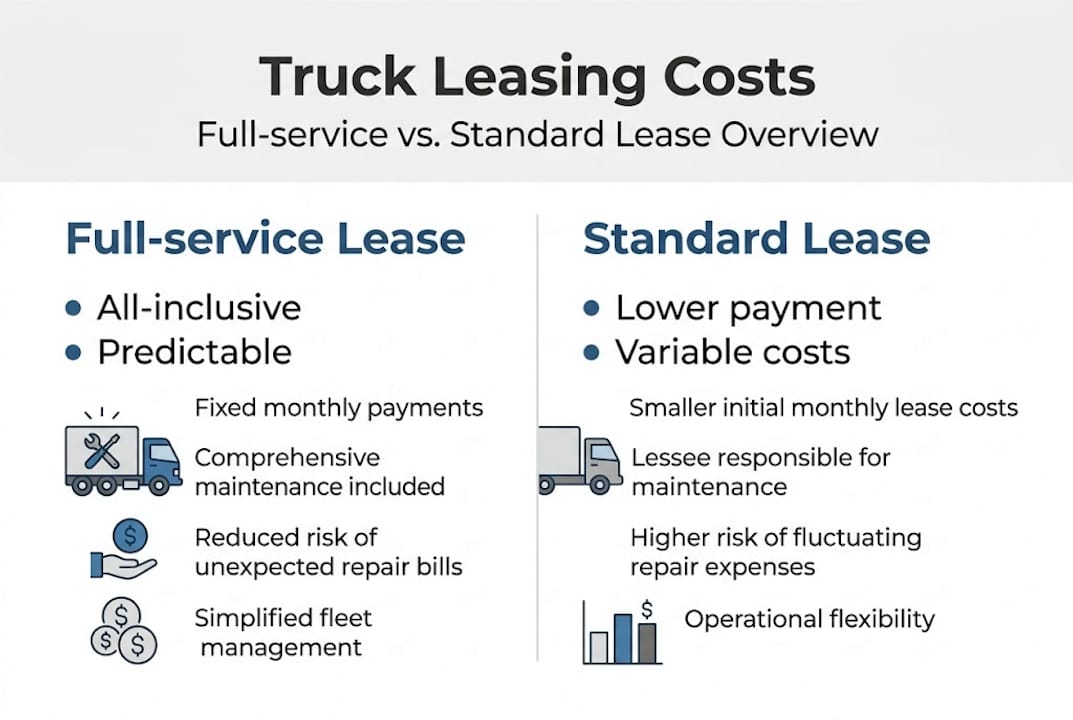
One approach that simplifies this equation is the full-service lease. A full-service “all-in” truck lease is often chosen to make budgeting more predictable by shifting variable maintenance and ownership costs into a fixed monthly payment. Instead of fielding surprise repair bills or juggling multiple vendor invoices, you pay one consistent amount.
“Predictability in fleet costs isn’t just a financial preference. It’s an operational necessity. When you can’t forecast your truck expenses month to month, every budget cycle becomes a guessing game.”
Understanding the cost savings and limitations of leasing before committing is essential. If you’re specifically evaluating medium-duty equipment, reviewing box truck leasing costs will give you a more precise baseline for that segment.
Pro Tip: Before signing any lease, ask the dealer to provide a complete written list of what’s included and excluded. “Maintenance included” can mean anything from oil changes to full drivetrain coverage. Get the scope in writing.
Comparing lease options: Full-service vs. standard leases
Now that the cost factors are clear, let’s directly compare the two main types of truck leases available. Understanding the structural difference between them is the foundation of any smart leasing decision.
A full-service lease (sometimes called a “net lease” or “all-in lease”) bundles the truck payment with maintenance, tires, insurance, registration, and roadside assistance into one monthly fee. You hand the keys back at the end of the term, and the lessor handles everything in between.
A standard lease (also called a “finance lease” or “open-end lease”) covers the vehicle itself. You’re responsible for maintenance, repairs, insurance, and any end-of-term residual value obligations. The monthly payment is lower, but your exposure to variable costs is much higher.
| Feature | Full-service lease | Standard lease |
|---|---|---|
| Monthly payment | Higher | Lower |
| Maintenance included | Yes | No |
| Insurance bundled | Often yes | No |
| Tires and roadside | Usually yes | No |
| Budget predictability | High | Lower |
| Flexibility at end of term | Limited | More options |
| Best for | Fleets prioritizing stability | Operators managing their own shop |
The table above makes the tradeoff clear. If your team runs routes across Massachusetts and neighboring states without a large in-house maintenance operation, a full-service lease removes the burden of managing repair schedules, sourcing parts, and tracking compliance.
If you prioritize budgeting stability in fleet planning, full-service leasing smooths variable expenses into a fixed payment. But always confirm exactly what’s included, from the maintenance scope and roadside coverage to any service exclusions buried in the contract.
Steps to evaluate which lease type fits your operation:
- Inventory your current maintenance capacity. Do you have an in-house mechanic, or do you rely on third-party shops?
- Calculate your average annual repair and tire spend per truck from the last two years.
- Compare that number against the premium difference between a standard and full-service lease payment.
- Assess how much budget variability your operation can realistically absorb month to month.
- Review your route profile. High-mileage regional routes increase wear and make full-service coverage more valuable.
For operators specifically exploring leasing in Massachusetts, local weather and road conditions add another layer of wear to consider. Pothole-heavy winters and salt exposure accelerate tire and suspension costs, which shifts the math toward full-service coverage. Understanding the broader leasing benefits for operators in this region gives you context that national averages won’t provide.
What impacts your monthly payment: Real-world breakdowns
With the basic lease types in mind, let’s look at what actually determines your month-to-month costs. Two fleet managers walking into the same dealership can leave with very different payments based on choices they make during the negotiation.
The core payment drivers are:
- Truck value: A new Class 8 tractor can carry a sticker price above $150,000. Even on a standard lease, the depreciation component of your monthly payment tracks that value closely.
- Residual value: The lessor’s estimate of what the truck is worth at lease end. A higher residual means a lower monthly payment since you’re financing less depreciation.
- Contract length: A 36-month lease spreads costs over a shorter period than a 60-month term, pushing monthly payments higher but reducing long-term interest accumulation.
- Mileage allowance: Standard commercial leases are often written at 100,000 to 150,000 miles per year. Exceeding that cap can cost $0.10 to $0.25 per mile in overages.
- Risk factors: Your company’s credit profile, fleet size, and operating history affect the rate the lessor applies.
Typical monthly lease ranges for Massachusetts fleets (estimated figures):
| Truck type | Standard lease (monthly) | Full-service lease (monthly) |
|---|---|---|
| Box truck (Class 4-5) | $900 to $1,400 | $1,300 to $1,900 |
| Straight truck (Class 6-7) | $1,200 to $1,900 | $1,700 to $2,500 |
| Tractor trailer (Class 8) | $2,200 to $3,500 | $3,000 to $4,800 |
| Refrigerated unit (Class 7-8) | $2,500 to $4,000 | $3,500 to $5,500 |
These ranges reflect regional conditions and general market pricing. Your actual payment depends on the specific equipment, dealer, and negotiated terms. For a closer look at tractor trailer lease costs, you’ll find breakdowns that go deeper into Class 8 specifics.

Full-service leasing replaces fluctuating maintenance, insurance, and ownership costs with a consistent fixed monthly payment. That consistency matters most when you’re managing multiple units and trying to match cash flow to revenue cycles.
Questions to ask a dealer before signing:
- What is the exact mileage cap and overage rate?
- Is maintenance limited to OEM-approved service centers?
- What happens if the truck is in the shop and unavailable? Is a loaner provided?
- Are tires covered for normal wear, blowouts, or both?
- What are the end-of-lease damage standards, and who inspects the truck?
- Is early termination possible, and what does it cost?
Getting clear answers to these questions eliminates the most common sources of unexpected costs. Don’t move forward until every line item has a clear, written answer.
How to budget and optimize your lease agreement
Now, to move from understanding costs to taking control, here’s how to plan and optimize your truck lease so it works for your operation rather than against it.
1. Annualize your total lease cost. Multiply the monthly payment by the term length and add estimated overage fees, any insurance premiums not bundled in, and projected fuel surcharges. That number is your true commitment, not just the monthly figure on the quote sheet.
2. Model your mileage carefully. Pull actual GPS or dispatch data from the last 12 months. If your trucks average 120,000 miles per year and the lease cap is 100,000, you’re already looking at 20,000 miles of overage per truck. At $0.15 per mile, that’s $3,000 per truck annually in penalties you didn’t plan for.
3. Negotiate maintenance scope up front. Ask for a detailed maintenance schedule written into the contract. Specify which components are covered, such as brakes, tires, engine, transmission, and electrical systems. Vague language like “scheduled maintenance” protects the lessor, not you.
4. Align term length with your business cycle. If your contracts with clients run 24 months, don’t sign a 60-month truck lease. Misaligned timelines create situations where you’re paying for equipment you no longer need.
5. Build in an exit review. Many leases allow a mid-term review or early return option with conditions. Negotiate this in advance rather than trying to add it later when you have less leverage.
6. Clarify end-of-lease standards. “Normal wear and tear” means different things to different lessors. Ask for written standards with photos if possible. Unexpected damage charges at lease end are one of the most common fleet manager complaints.
Smart leasing strategies combine contract discipline with operational data. When you know your routes, your mileage, and your maintenance history, you negotiate from strength.
Full-service leasing makes budgeting more predictable by shifting variable costs into a fixed monthly payment, but only if the contract defines those costs clearly.
Pro Tip: Request a sample lease agreement before your negotiation meeting. Reading the fine print before you’re at the table gives you time to identify unclear terms and prepare specific questions without time pressure.
What most fleet managers miss about leasing costs
Here’s the perspective that most leasing guides skip: the cheapest monthly payment is rarely the smartest decision for a working fleet.
Fleet managers often shop for the lowest number on the quote sheet and treat that as a win. But a low standard lease payment can quietly cost more than a higher full-service rate once you add emergency repairs, unplanned downtime, and administrative time spent managing vendors. A truck sitting in a third-party shop for three days doesn’t just cost repair money. It costs revenue, customer trust, and driver time.
The real risk in commercial leasing isn’t overpaying on the monthly rate. It’s signing a contract with poorly defined terms that expose you to cost spikes you can’t predict or control. We’ve seen operators budget $2,200 per month for a truck and end up with an effective monthly cost of $2,900 once overages, deferred maintenance penalties, and insurance gaps are factored in.
The decision between leasing and buying isn’t just financial. It’s operational. Prioritize business fit and full transparency in every agreement. A slightly higher payment that removes ambiguity is almost always worth it. The lease that fits your operation, your routes, and your team’s capacity to manage maintenance is the one that actually saves you money over time.
Find the right truck leasing solution for your fleet
Understanding leasing costs is the first step. Connecting with a trusted local provider who can match those numbers to real equipment is the next one.
At Apple Truck and Trailer, we’ve been helping fleet operators across Massachusetts, Rhode Island, Connecticut, and New Hampshire find the right commercial trucks and leasing structures since 1986. Whether you’re evaluating the benefits of leasing versus buying or ready to compare specific equipment options, our team brings the regional expertise and inventory depth to give you real answers. If you’re still weighing the full picture of buying vs. leasing, we can walk through that analysis with you directly.
Frequently asked questions
What is typically included in a full-service commercial truck lease?
A full-service lease usually covers maintenance, insurance, roadside assistance, and often registration, all consolidated into one fixed monthly payment for budget predictability. Always request a written list of inclusions and exclusions before signing.
How do lease costs differ for different types of trucks?
Leases for heavier or specialized trucks carry higher payments because of greater vehicle value, more complex maintenance requirements, and higher insurance exposure. A Class 8 tractor typically costs two to three times more per month to lease than a Class 4 box truck.
Can I negotiate better terms in a truck lease agreement?
Yes. Mileage caps, maintenance scope, contract length, and end-of-lease damage standards are all negotiable. Coming to the table with your actual operational data, such as annual mileage and maintenance history, gives you stronger leverage.
Why are fixed monthly payments important for fleet budgeting?
Fixed payments eliminate the month-to-month budget volatility caused by unexpected repairs, tire replacements, and insurance adjustments. A full-service “all-in” lease makes variable fleet costs consistent and forecastable, which simplifies financial planning across your entire operation.
Is leasing always cheaper than buying for my fleet?
Not always. Leasing offers lower upfront costs and predictable monthly expenses, but buying can deliver lower total cost over the long run if you manage maintenance well and capture resale value. The right answer depends on your capital position, utilization rate, and how long you typically keep equipment.
Recommended
- Truck Leasing – Cost Savings and Limitations for Fleets – Apple Truck & Trailer
- Benefits of Truck Leasing for Fleet Operators – Apple Truck & Trailer
- The Ultimate Guide to Tractor Trailer Lease Cost – Apple Truck & Trailer
- Leasing a big rig: Smart strategies for fleet operators – Apple Truck & Trailer