
TL;DR:
- Truck rental rates in Massachusetts vary widely based on season, service type, and hidden fees such as deposits and insurance. Understanding actual costs, including secondary charges like fuel surcharges and holdover fees, is essential for effective planning. Full-service leases often mitigate the risks of unplanned downtime and hidden costs, making them a better choice for sustained freight operations.
Renting a semi truck and trailer in Massachusetts sounds simple until you see the first invoice. Rates swing sharply based on season, service type, and a list of fees most providers bury in the contract. A single overnight holdover can cost more than a full day’s base rate, and insurance deposits alone can tie up $15,000 in working capital. This article cuts through that confusion with real Massachusetts pricing, a breakdown of every fee category you should expect, and a practical framework for deciding whether a short-term rental, a full-service lease, or outright purchase makes the most sense for your operation right now.
Table of Contents
- Understanding rental rates and fee structures
- Unpacking hidden costs: Insurance, deposits, fuel, and fees
- Full-service leases vs. standard rentals: Pros and cons
- How to optimize your rental decision: Practical strategies for fleet managers
- What most fleet managers miss about truck rentals in Massachusetts
- Ready to take the next step? Explore Massachusetts truck rental and leasing solutions
- Frequently asked questions
Key Takeaways
| Point | Details |
|---|---|
| Massachusetts pricing realities | Typical rental rates are $200-$250/hour, with hidden fees and variable seasonality factors. |
| Hidden costs add up | Insurance, deposits, and environmental fees can significantly raise overall rental costs. |
| Lease vs. rental impacts risk | Full-service leases reduce maintenance surprises but cost more up front than standard rentals. |
| Strategic questions matter | Asking providers detailed questions helps fleet managers avoid unexpected expenses and optimize pricing. |
Understanding rental rates and fee structures
Before you can negotiate, you need to know what normal actually looks like in Massachusetts. Rates here don’t follow a single national standard because this market reflects dense urban freight demand, tight highway corridors, and a regulatory environment that directly shapes pricing.
According to the Massachusetts trucking tariff, truck and driver service for a 53-foot trailer runs $200 per hour at standard rates, $250 per hour during peak periods, and $400 per night for holdover situations where equipment sits on-site overnight. These are not bare rental rates for a truck you drive yourself. They reflect contracted service with a driver, which is the most common arrangement for shippers who need flexibility without adding headcount.
Here’s how the basic rate structure breaks down:
| Rate type | Standard | Peak season | Overnight holdover |
|---|---|---|---|
| Hourly (with driver) | $200/hr | $250/hr | N/A |
| Overnight holdover | N/A | N/A | $400/night |
| Weekly estimate | $8,000+ | $10,000+ | Varies by days |
Day rates are not arbitrary. They reflect real freight demand, and when demand spikes, so does every number on your invoice. For operations planning semi truck weekly rentals, understanding whether you’re booking in a peak window versus a slow period can mean thousands of dollars in savings.
Additional charges that layer onto base rates often include:
- Fuel surcharges tied to diesel indexes
- Tolling fees for Massachusetts Turnpike and Pike segments
- Waiting time fees if your dock isn’t ready on arrival
- Drop and hook charges for trailer positioning
Getting a clear picture of truck and trailer rental pricing before committing to a provider is not just helpful, it is essential. Ask for a written rate confirmation that covers all fee categories before anything is signed.
“Rental day rates serve as a real-time signal of freight demand pressure in a given market. When rates spike, it usually means capacity is tight and your options are shrinking.”
Unpacking hidden costs: Insurance, deposits, fuel, and fees
Base rates tell only part of the story. The charges that actually hurt fleet managers are the ones that don’t appear on the initial quote. These secondary costs are predictable once you know what to look for, but they catch a lot of operations off guard.
According to detailed tractor trailer rental cost data, commercial insurance for rented equipment starts at $200 per month and can run significantly higher depending on cargo type and coverage requirements. Deposits range from $5,000 to $15,000 depending on the provider and equipment value. Excess mileage fees land between $0.10 and $0.20 per mile over the agreed limit, and environmental fees add $5 to $10 per day to the running total.

Here’s a side-by-side look at what a standard quote versus the real total often looks like:
| Cost category | What the quote shows | What you actually pay |
|---|---|---|
| Daily base rate | $500/day | $500/day |
| Insurance | Not listed | $200+/month |
| Deposit | Mentioned in footnote | $5,000 to $15,000 upfront |
| Excess mileage | Listed as $0.15/mi | Can add $300+ on busy routes |
| Environmental fee | Not mentioned | $5 to $10/day |
| Fuel surcharge | Estimated low | Actual diesel cost + margin |
| Total estimated | $500/day | $750 to $900+/day effective |
The difference between the quote and the final bill is not fraud. It’s the product of fragmented pricing structures that have developed over decades. Providers aren’t trying to deceive you, but the burden of reading every line is entirely on you.
Here’s how to get ahead of hidden costs before you sign anything:
- Request an itemized quote covering all fee categories, not just the base rate
- Ask specifically about excess mileage thresholds and per-mile overage rates
- Confirm whether your existing commercial insurance covers rented equipment or whether you need a rider
- Get the deposit terms in writing, including refund conditions and timeline
- Ask whether fuel is included, estimated, or billed at market rate plus a margin
Pro Tip: Some providers waive environmental fees for long-term agreements or high-volume customers. Ask directly. The worst they can say is no, and many fleet managers never think to negotiate this line item.
Exploring leasing options may actually protect you from some of these variable charges, since bundled lease agreements often lock in costs that fluctuate in standard rental contracts. If storage is part of your logistics picture, storage trailer rental rates operate under a different fee structure and may be a cleaner option for facilities-based needs.
Full-service leases vs. standard rentals: Pros and cons
Once you understand individual fee categories, the next question is whether a full-service lease or a short-term rental actually serves your operation better. These two options are not just price points. They represent fundamentally different risk profiles.
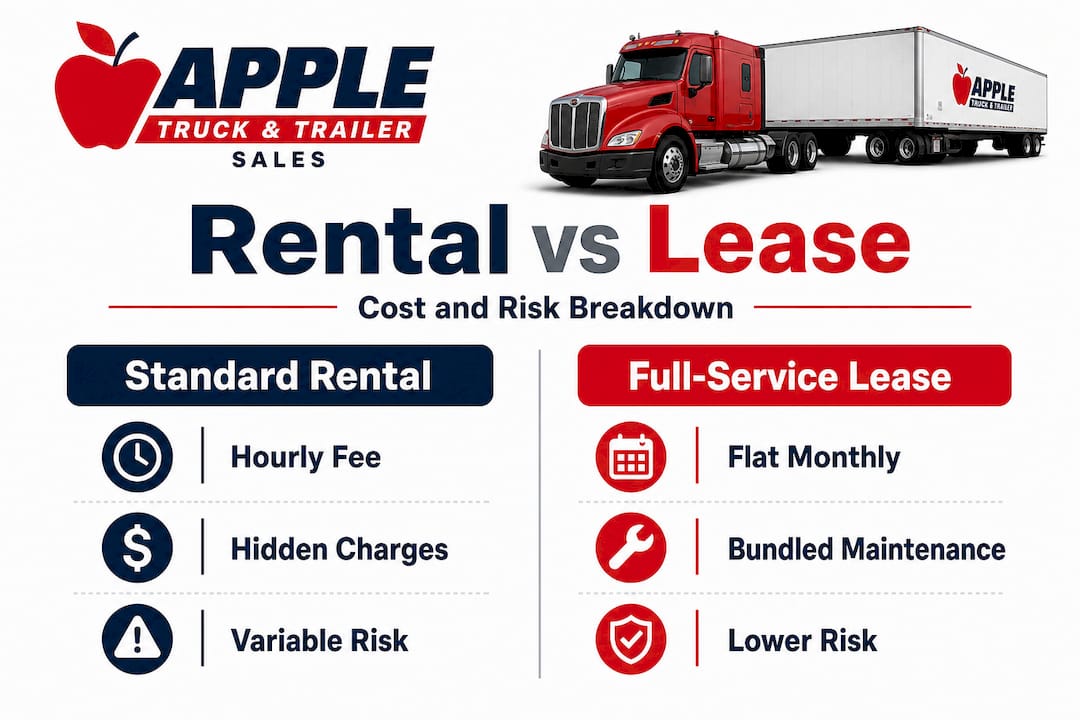
The Massachusetts trucking tariff structure confirms what experienced fleet managers already know: full-service leases bundle preventive maintenance, roadside assistance, and often regulatory compliance into a higher base cost that eliminates several of the variables that make standard rentals unpredictable. That higher monthly number looks expensive on paper. In practice, it removes the single biggest wildcard in fleet operations: unplanned downtime.
Consider this realistic scenario. You rent a tractor-trailer for a 30-day project. Midway through, a brake system issue grounds the unit. You pay for the lost day, the emergency repair, and potentially a replacement unit at peak rates because you need to keep moving. In a full-service lease, that repair is covered. The clock keeps running on your agreement, but the out-of-pocket surprise disappears.
Where standard rentals make sense:
- Seasonal overflow demand where you need units for 30 to 90 days
- Single large projects with a defined start and end date
- Situations where you already have maintenance capacity in-house
- Operations testing a new route or market before committing
Where full-service leases win:
- Sustained operations running more than 90 days per year
- Smaller fleets without dedicated maintenance staff
- High-mileage routes where equipment wear is significant
- Operations where downtime directly translates to contract penalties
Short-term rental choices in Massachusetts are genuinely useful for the right situations. But treating a rental as a long-term cost strategy often backfires. When you add up the variable fees, insurance riders, and risk of unplanned repairs, many fleet managers find that a structured lease is the financially conservative choice even though it looks more expensive upfront.
Pro Tip: Calculate your true cost of downtime before comparing rental and lease quotes. If a single day of lost operations costs your business $3,000 to $5,000, a lease that prevents even two unexpected breakdowns per year more than pays for itself. If your truck service Massachusetts needs are handled in-house, that changes the calculus significantly.
How to optimize your rental decision: Practical strategies for fleet managers
Understanding costs and options is valuable. Turning that understanding into a decision framework is what actually moves your operation forward. Here are concrete steps built around the Massachusetts market specifically.
Step-by-step optimization process:
- Audit your actual usage pattern over the past 12 months. Count the days you needed additional capacity and identify whether they clustered around specific seasons.
- Calculate the real cost of your last rental, including all secondary fees, and compare it to what a monthly lease would have cost for the same period.
- Identify your three most expensive secondary charges from recent rentals. These are your negotiation targets with any new provider.
- Get competing quotes from at least two providers before committing. Rates vary more than most fleet managers expect between operators serving the same Massachusetts corridors.
- Confirm whether your freight contracts include penalty clauses for delivery delays. If they do, downtime risk should weigh heavily in your lease versus rental decision.
Rental day rates signal freight demand in ways that reveal market pressure you can actually use. When rates spike, that’s your signal to either lock in a lease agreement before costs climb further or to front-load your capacity during lower-demand windows.
Critical questions to ask every provider:
- What is your equipment’s average age and maintenance history?
- How quickly can you replace a unit if mine goes down?
- Are fuel surcharges fixed, estimated, or calculated at market rate?
- What triggers peak pricing and how much notice will you give me?
- What is your process for disputing excess mileage charges?
Massachusetts-specific pitfalls to avoid:
- Booking during late-Q4 freight surges without price locks
- Underestimating toll costs on routes through the Boston metro area
- Assuming your standard commercial policy covers rented 53-foot trailers without confirming with your broker
- Ignoring the holdover fee structure when your freight window has any flexibility risk
Review the detailed pricing guide before finalizing any agreement. And if you’re at the point where recurring rental costs are approaching what ownership would cost, it’s worth looking at truck and trailer sales to see whether acquiring your own equipment makes more financial sense than continued renting.
What most fleet managers miss about truck rentals in Massachusetts
Here’s the truth that doesn’t show up in any rate sheet: average pricing is almost meaningless for planning purposes in this market. Fleet managers consistently make decisions based on baseline rates and then absorb the real cost as a surprise at invoice time.
The Massachusetts trucking tariff makes clear that peak season pricing alone can add 50% to your hourly rate. Overnight holdovers at $400 per night are not rare edge cases. They happen regularly whenever freight timelines slip, dock schedules run long, or a storm pushes your delivery window. These are not exceptions. They are predictable occurrences in any active logistics operation, especially in New England where weather introduces real schedule uncertainty six months out of the year.
The bigger problem is how fleet managers interpret quotes. A $200-per-hour rate sounds manageable until you factor in a holdover, peak pricing for the first three hours of a morning run, and an excess mileage charge on a Boston to Springfield corridor. That “manageable” rate has now produced an invoice well above expectations. This isn’t the provider’s fault. It’s a planning failure.
Massachusetts also has regulatory considerations that affect rental cost in ways operators coming from other states don’t anticipate. Weight restrictions on certain roads, oversize permit requirements, and seasonal frost law postings that limit axle loads all create operational constraints that push jobs into narrower windows, which then drive holdover frequency.
Good truck parking in Massachusetts is genuinely scarce near the major freight corridors. When drivers can’t find legal overnight parking, holdover fees become unavoidable. That $400-per-night charge isn’t just a rental fee. It’s often the product of infrastructure reality in this region.
The fleet managers who navigate this market best are the ones who stop treating rentals as transactional line items and start treating them as supply chain risk. Every variable fee is a risk exposure. Every peak window is a pricing event you either prepared for or didn’t. Plan accordingly.
Ready to take the next step? Explore Massachusetts truck rental and leasing solutions
Massachusetts freight operations deserve providers who understand the local market, not just the national rate averages.
Apple Truck & Trailer has been serving fleet managers across Massachusetts, Rhode Island, Connecticut, and New Hampshire since 1986. Whether you need short-term capacity, a structured Massachusetts truck leasing program, or guidance on when buying makes more sense than renting, the team at Apple Truck & Trailer brings decades of regional experience to every conversation. If you’re evaluating options and want a realistic picture of what your operation actually needs, reviewing smart leasing strategies for fleet operators is a strong place to start. Reach out directly for a custom quote built around your actual usage pattern, not a national average that doesn’t reflect Massachusetts pricing reality.
Frequently asked questions
How much does it cost to rent a semi truck and trailer in Massachusetts?
Rates for truck and driver service with a 53-foot trailer start at $200 per hour at standard rates, rising to $250 during peak season and $400 for overnight holdover situations.
What hidden fees should I expect when renting tractor trailers?
Beyond the base rate, plan for commercial insurance at $200+ per month, deposits from $5,000 to $15,000, excess mileage at $0.10 to $0.20 per mile, plus fuel and environmental fees of $5 to $10 per day.
Do full-service leases reduce risk compared to standard rentals?
Yes. Full-service leases bundle maintenance into the agreement, eliminating most unplanned repair costs, though the base monthly cost is higher than a standard rental rate.
How does seasonality affect semi truck rental prices?
Peak season rates can jump 50% above standard pricing in Massachusetts, and overnight holdover charges of $400 per night become significantly more common during high-demand freight periods.
Recommended
- Powerful Massachusetts Semi Truck Rentals: How Much Does it Cost to Rent a Semi Truck for a Week? – Apple Truck & Trailer
- Truck Leasing Massachusetts – Apple Truck & Trailer
- Freightliner leasing Massachusetts fleets 2026 guide – Apple Truck & Trailer
- Tractor Trailer Storage Containers for Massachusetts Fleets – Apple Truck & Trailer