Freightliner leasing Massachusetts fleets 2026 guide
Leasing a Freightliner truck can surprise fleet managers with monthly payments hundreds of dollars lower than traditional loans, yet the financial picture gets murkier when you account for residual values, terminal adjustments, and contract restrictions. Massachusetts fleet operators face unique considerations when choosing between TRAC leases, loan financing, or lease-purchase programs, especially given the regional service infrastructure available through authorized Freightliner dealerships. This comprehensive guide breaks down lease types, payment structures, dealer support networks, contract risks, and fleet expansion strategies to help you make informed decisions in 2026.
Table of Contents
- Understanding Freightliner Lease Options In Massachusetts
- Authorized Freightliner Leasing And Service Support In New England
- Risks And Considerations In Freightliner Lease-Purchase Agreements
- Building A Growing Fleet With Multiple Freightliner Leases
- Explore The Best Freightliner Trucks And Leasing Options In Massachusetts
- Frequently Asked Questions
Key takeaways
| Point | Details |
|---|---|
| TRAC lease advantages | TRAC lease payments appear lower because you pay depreciation to residual value rather than full truck cost. |
| Regional service access | Advantage Truck Group operates eight full-service Freightliner locations across Massachusetts, New Hampshire, and Vermont for rapid fleet support. |
| Lease-purchase risks | High monthly payments and contract restrictions in lease-purchase agreements can trap drivers in debt cycles. |
| Fleet scaling potential | About 20% of clients lease a second truck, signaling viable growth opportunities for expanding operations. |
| Contract scrutiny | Understanding full lease schedules, including fees, taxes, and residual calculations, prevents unexpected financial exposure at term end. |
Understanding Freightliner lease options in Massachusetts
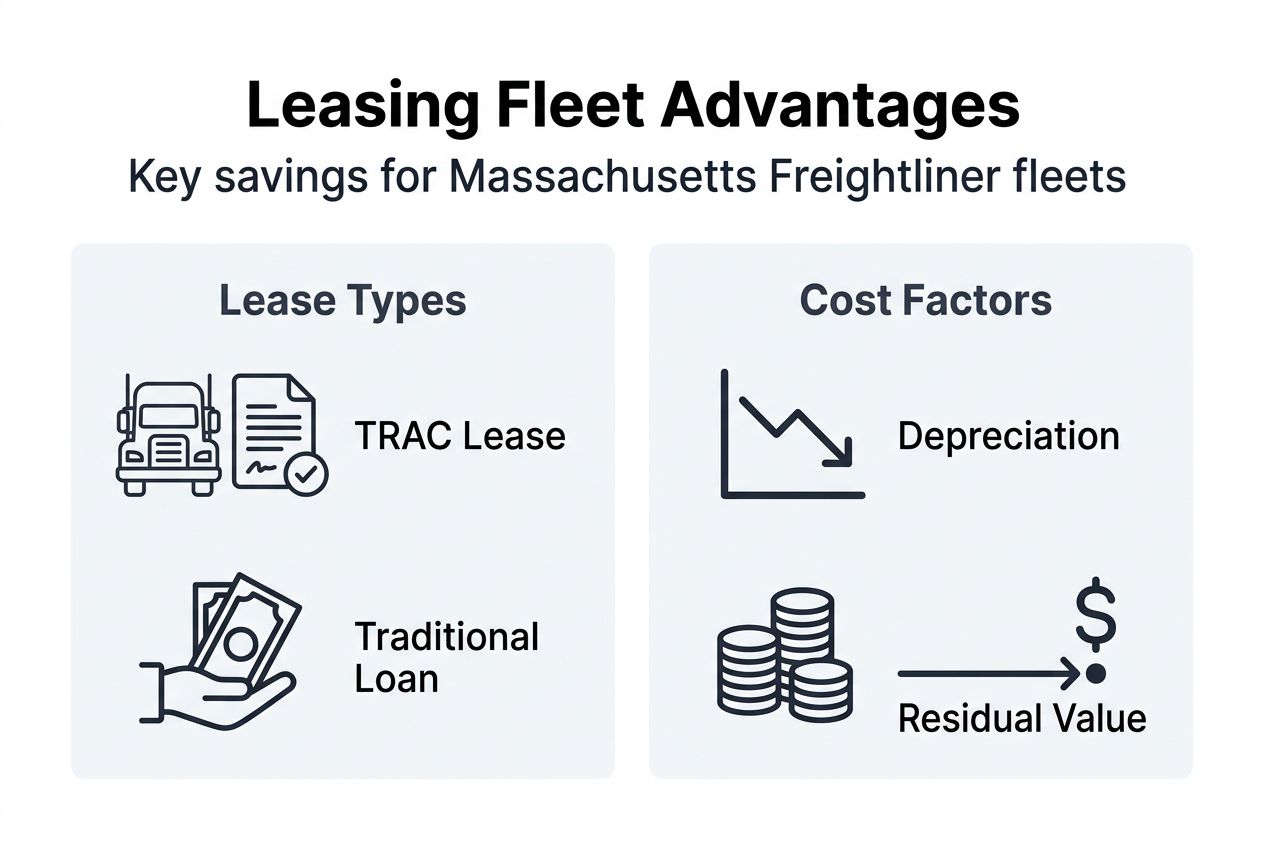
When evaluating Freightliner financing, Massachusetts fleet managers encounter two primary pathways: TRAC leases and traditional loan financing. These structures differ fundamentally in payment calculation, ownership progression, and end-of-term obligations.
A TRAC lease structures payments around depreciation from purchase price down to a predetermined residual value. Loan payments typically run higher because you finance the complete truck cost minus your down payment. Consider a $120,000 Freightliner Cascadia with a 60-month term: a TRAC lease might calculate monthly payments at $2,250 based on depreciation to a $45,000 residual, while an equivalent loan at 6.5% APR would require approximately $2,868 monthly. The $618 monthly difference represents significant cash flow savings for fleets managing multiple units.
However, TRAC leases introduce complexity at term end. You face three options: purchase the truck at residual value, return it and walk away, or navigate terminal rental adjustment clauses if actual depreciation differs from projected residual. The terminal adjustment can create unexpected costs if market values drop below your contracted residual.
| Financing Type | Monthly Payment | Total Payments | End-of-Term Cost | Total Cost |
|---|---|---|---|---|
| TRAC Lease | $2,250 | $135,000 | $45,000 (buyout) | $180,000 |
| Traditional Loan | $2,868 | $172,080 | $0 (own outright) | $172,080 |
Pro Tip: Request complete lease schedules before signing, including all fees, sales tax treatment, and exact residual calculation methods. Hidden acquisition fees or documentation charges can add $1,500 to $3,000 to your effective cost.
Massachusetts fleets should evaluate truck leasing cost savings and limits alongside operational requirements. TRAC leases work best for operations planning vehicle turnover every four to six years, while loans suit fleets keeping trucks eight-plus years. Tax treatment also differs, with lease payments typically fully deductible as operating expenses versus depreciation schedules for purchased assets. Understanding truck leasing benefits for fleets helps align financial structure with your business model and growth timeline.
Authorized Freightliner leasing and service support in New England
Proximity to authorized service centers directly impacts fleet uptime and operational efficiency when leasing Freightliner trucks. Massachusetts operators benefit from robust regional infrastructure that reduces downtime costs and simplifies maintenance coordination.
Advantage Truck Group maintains eight locations throughout Massachusetts, New Hampshire, and Vermont, providing comprehensive Freightliner sales, leasing, parts, and service support. Their network includes facilities in Middleboro, Westfield, and Canton in Massachusetts, plus strategic locations in Manchester and Portsmouth, New Hampshire, and Williston, Vermont. This geographic coverage ensures most New England fleets can access authorized service within 60 miles of operations.
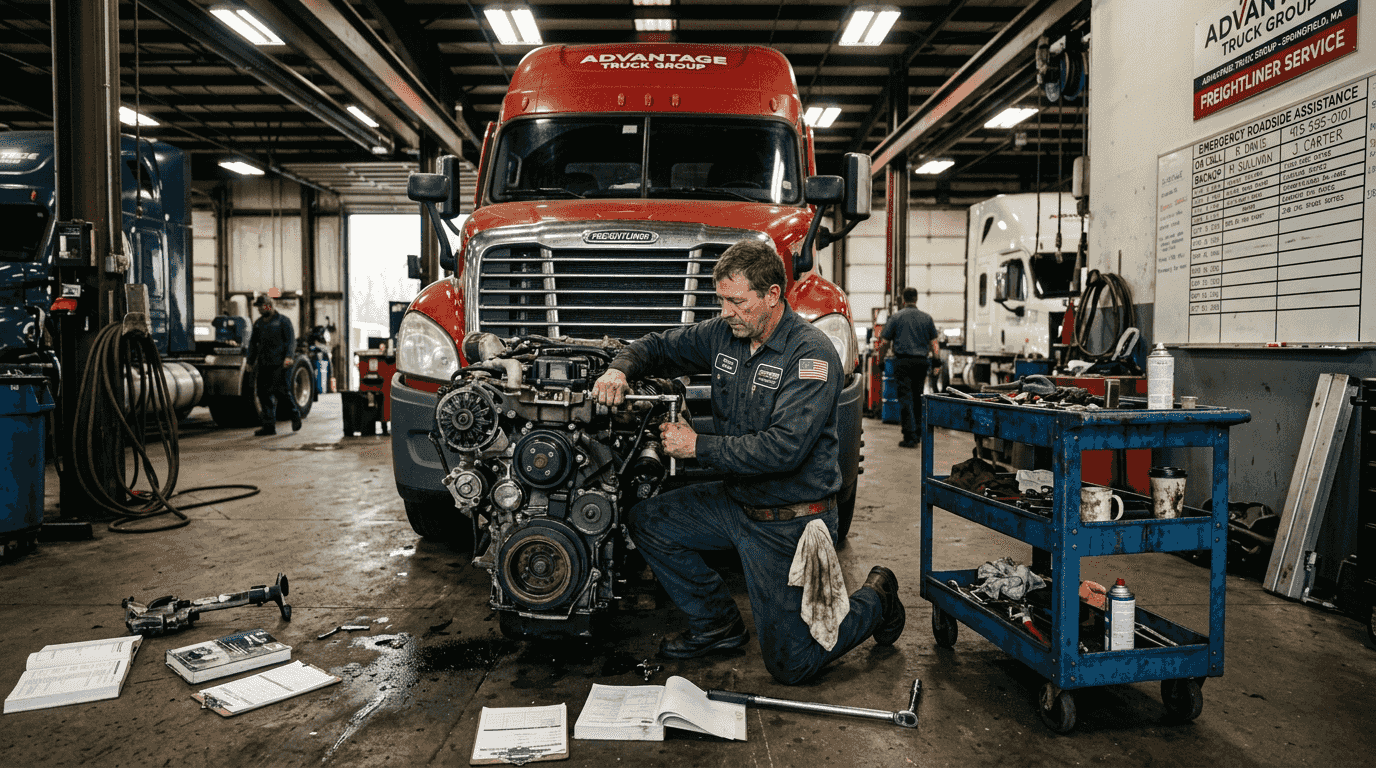
The network offers critical advantages beyond proximity. ATG provides 24/7/365 emergency roadside assistance and holds 15 consecutive years of Elite Support certification from Daimler Trucks North America. Elite Support certification requires meeting strict performance metrics for parts availability, technician training, and customer satisfaction, directly translating to faster repairs and reduced downtime.
For multi-location fleets, ATG offers consolidated billing and centralized account management. You can coordinate maintenance schedules, track service history across units, and manage lease payments through single points of contact rather than juggling multiple vendor relationships.
Pro Tip: Verify your leasing dealer’s Elite Support status and compare average repair turnaround times. A certified dealer averaging 24-hour turnarounds beats a non-certified shop with 48-hour averages, potentially saving you thousands in lost revenue per incident.
The Freightliner brand’s market leadership in North America stems partly from this dealer network strength. When evaluating lease options, consider not just monthly payments but also the service infrastructure supporting your trucks. Massachusetts fleets exploring truck and trailer sales should prioritize dealers with proven service capabilities alongside competitive financing terms.
Risks and considerations in Freightliner lease-purchase agreements
Lease-purchase programs marketed to owner-operators carry substantial risks that fleet managers and business owners must understand before committing drivers or entering agreements themselves. These contracts differ markedly from standard TRAC leases or equipment financing.
Lease-purchase agreements often trap participants through high weekly payments, restrictive operational terms, and hidden fees that make successful completion nearly impossible. Common problematic terms include:
- Mandatory routing through specific freight brokers at below-market rates
- Prohibitions on leasing to other carriers or seeking outside loads
- Weekly payments of $800 to $1,200 regardless of freight availability
- Excessive fees for insurance, maintenance, and administrative services
- Balloon payments or residual buyouts that reset debt cycles
A 2023 court decision highlighted how lease-purchase structures blur lines between independent contractor and employee status. Courts scrutinize whether drivers maintain genuine independence or function as employees misclassified to avoid wage and hour protections. If your lease-purchase program restricts where drivers can haul, sets their rates, or controls their schedules, you risk employee misclassification liability.
“The court examined whether the lease terms gave drivers true independence or simply created the appearance of independent contractor status while maintaining employer control over daily operations and income potential.”
Before entering any lease-purchase agreement, complete this verification checklist:
- Calculate total cost of ownership including all fees, insurance, and mandatory services
- Verify you can secure loads independently without carrier restrictions
- Confirm actual weekly payment amounts and identify all potential additional charges
- Review termination clauses and understand penalties for early exit
- Consult an attorney specializing in transportation law to review contract terms
- Compare net income projections against company driver wages in your market
Massachusetts fleet operators should educate drivers about these risks rather than simply avoiding lease-purchase entirely. Some legitimate programs exist, but they require careful vetting. Understanding whether leasing a semi truck makes sense for your specific operation prevents costly mistakes and protects both your business and your drivers from predatory contract structures.
Building a growing fleet with multiple Freightliner leases
Leasing multiple Freightliner trucks creates pathways for fleet expansion without the capital intensity of outright purchases. Strategic multi-unit leasing enables growth while preserving cash for operations, maintenance reserves, and market opportunities.
Data shows approximately 20% of lease clients add a second truck, indicating leasing supports business scaling for operators who master the first unit’s economics. This progression typically follows a proven pattern: establish consistent freight lanes with one truck, demonstrate profitability over 12 to 18 months, then add capacity to serve existing customers or expand routes.
Successful owner-operators with multiple leased trucks earn significantly more than company drivers, though they also assume greater risk and operational responsibility. A company driver in Massachusetts might earn $65,000 to $75,000 annually with benefits. An owner-operator with two trucks, each generating $180,000 in revenue, could net $90,000 to $120,000 after expenses, depending on freight rates and operational efficiency.
| Fleet Size | Annual Revenue Potential | Estimated Net Income | Required Management Time |
|---|---|---|---|
| 1 Truck (owner-operator) | $150,000 to $180,000 | $45,000 to $60,000 | Full-time driving + admin |
| 2 Trucks (owner + driver) | $280,000 to $360,000 | $70,000 to $100,000 | Driving + driver management |
| 3-5 Trucks (small fleet) | $450,000 to $900,000 | $90,000 to $180,000 | Full-time management |
Multi-truck leasing strategies that support sustainable growth include:
- Stagger lease start dates to avoid simultaneous balloon payments or buyout decisions
- Maintain 90-day operating capital reserves per truck to cover payment gaps
- Negotiate volume discounts on lease rates, insurance, and maintenance when adding units
- Implement fleet management software to track per-truck profitability and identify underperformers
- Establish relationships with multiple freight brokers to ensure consistent load availability
Massachusetts fleets exploring truck leasing options should model cash flow scenarios for multi-unit operations before committing. The second truck doesn’t simply double income; it introduces driver management complexity, increased insurance costs, and coordination overhead. However, for operators with proven systems and reliable freight networks, strategic leasing enables growth without the $100,000-plus capital requirements of purchasing additional units.
Consider mixing leased and owned assets as you scale. Buying used commercial trucks for proven lanes while leasing new units for expansion routes balances capital efficiency with operational flexibility. This hybrid approach lets you test new markets with lower commitment while maintaining owned assets for core business.
Explore the best Freightliner trucks and leasing options in Massachusetts
Navigating Freightliner leasing options becomes simpler with expert local guidance tailored to Massachusetts fleet operations. Whether you’re adding your first truck or expanding to multiple units, working with experienced dealers who understand regional requirements and service infrastructure makes the difference between profitable growth and costly missteps.
Apple Truck & Trailer specializes in commercial truck leasing throughout Massachusetts, offering flexible programs designed for fleet operators at every scale. Our team helps you evaluate TRAC leases versus traditional financing, structure payment terms that match your cash flow, and avoid common contract pitfalls that trap inexperienced operators. We also maintain an extensive inventory of quality used trucks and trailers for purchase when leasing doesn’t align with your operational timeline. If you’re considering a used commercial truck purchase, our specialists can walk you through inspection priorities, financing options, and total cost of ownership calculations to ensure you make informed decisions that support your business goals. Contact our team today to discuss customized leasing solutions for your Massachusetts fleet.
Frequently asked questions
What is the difference between TRAC lease and a loan for Freightliner trucks?
A TRAC lease structures payments around depreciation from purchase price to a predetermined residual value, resulting in lower monthly costs but requiring a buyout decision at term end. Traditional loans finance the full truck cost minus down payment, creating higher monthly payments but ending with outright ownership. TRAC leases offer flexibility to return trucks or purchase at residual, while loans build equity from the first payment.
How can Advantage Truck Group’s services benefit freight fleets in New England?
Advantage Truck Group operates eight full-service Freightliner dealerships across Massachusetts, New Hampshire, and Vermont, providing 24/7 emergency support and 15 consecutive years of Elite Support certification. Their network delivers rapid parts access, certified technician service, and consolidated billing for multi-location fleets, directly reducing downtime and simplifying maintenance coordination.
What are the main risks associated with lease-purchase agreements for truck drivers?
Lease-purchase programs often impose high weekly payments between $800 and $1,200, restrict drivers to specific freight brokers at below-market rates, and include hidden fees that make successful completion difficult. Courts have scrutinized these agreements for potential employee misclassification, as restrictive terms may indicate employer control rather than true independent contractor status. Drivers should review complete contract terms with a transportation attorney before committing.
Can leasing multiple Freightliner trucks help grow my fleet business?
Leasing multiple trucks enables fleet expansion without the capital intensity of outright purchases, with approximately 20% of operators adding a second truck after mastering first-unit economics. Multi-truck operations can generate $90,000 to $180,000 in net income for small fleets, though success requires careful cash flow management, staggered lease terms, and proven systems for driver coordination and freight sourcing.