TL;DR:
- Mobile truck and trailer repair involve dispatching technicians to fix common issues onsite, reducing towing and shop delays. Properly matching repair types to service locations improves efficiency, with complex repairs requiring a shop. Selecting qualified providers with OEM diagnostic tools and proper certification is essential to avoid repeat failures and uncontrolled costs.
Mobile truck & trailer repair is the practice of sending a qualified technician directly to a stranded vehicle to diagnose and fix problems without towing or shop delays. Up to 95% of common issues can be resolved onsite when a breakdown is caught early. That single fact reshapes how fleet managers should think about maintenance budgets and response protocols. The industry term for this service category is “roadside repair” or “field service maintenance,” and understanding where it fits in your overall program is the fastest way to protect uptime and control costs across your operating corridors.
What types of repairs are right for mobile truck & trailer service?
The clearest way to use on-site truck repair effectively is to match the repair type to the service location before you dispatch anyone. Onsite repair works best for localized, straightforward faults. Sending a mobile unit to a job that requires a lift, a transmission press, or a full engine teardown wastes time and money.
Repairs well suited to mobile service:
- Trailer tire repair and tire blowouts
- Battery replacements and charging system faults
- Minor air system leaks and brake adjustments
- Lighting, wiring, and basic electrical faults
- Preventive maintenance tasks such as oil changes and filter swaps
- Glad hand and landing gear repairs
- Minor refrigeration unit resets on reefer trailers
Repairs that require a shop visit:
- Engine rebuilds or major internal engine work
- Transmission removal and overhaul
- Heavy suspension component replacement requiring a press or alignment rack
- Frame straightening or structural trailer repair
- Fault codes that require OEM-level diagnostic depth beyond field tools
The table below summarizes the split clearly.
| Repair type | Recommended location | Reason |
|---|---|---|
| Tire blowout or flat | Mobile | Fast fix, no lift needed |
| Battery and charging faults | Mobile | Portable tools sufficient |
| Air brake adjustment | Mobile | Routine, field-accessible |
| Engine rebuild | Shop | Requires lift, press, and clean environment |
| Transmission overhaul | Shop | Specialized tooling required |
| Suspension alignment | Shop | Alignment rack mandatory |
| Electrical fault diagnosis | Mobile or shop | Depends on fault code complexity |
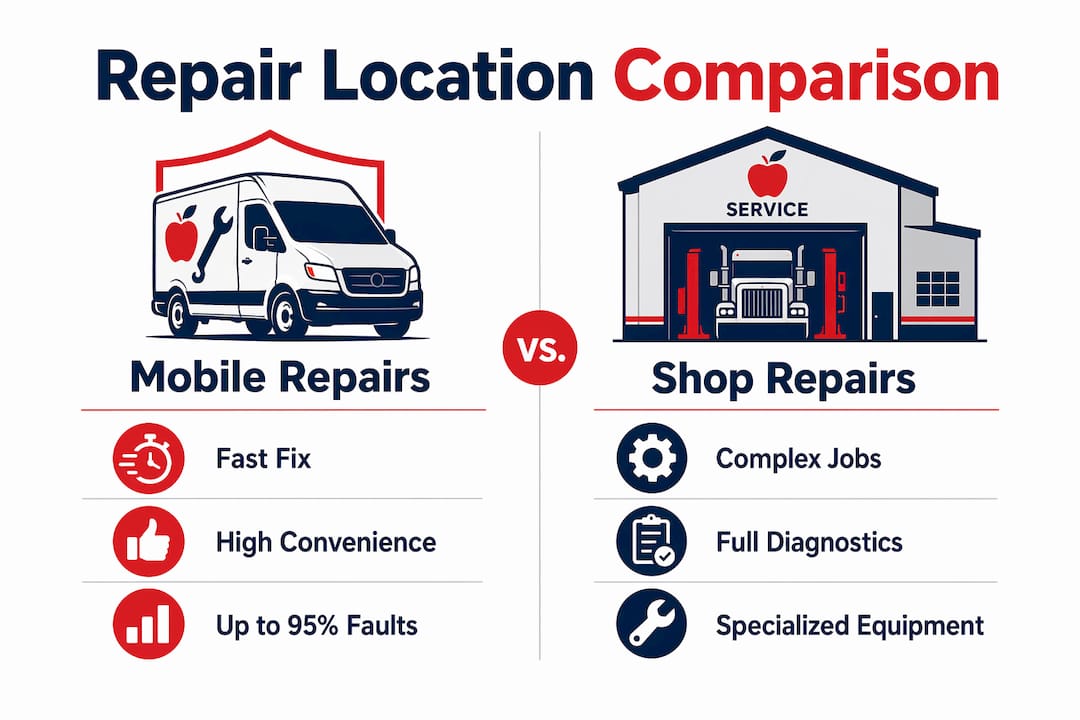
A hybrid maintenance strategy routes appropriate jobs to mobile units while reserving shops for complex work. This approach reduces dead time from towing and keeps trucks earning revenue.
How do you choose a qualified mobile repair provider?
Provider selection is the highest-leverage decision you make in a mobile repair program. The wrong vendor costs you twice: once for the incomplete repair and again for the tow to a shop. Experts recommend 15–20 minutes of structured vetting per provider before any breakdown occurs.
The non-negotiable criteria for any mobile fleet services vendor are:
- OEM diagnostic software. Platforms like Cummins Insite and Detroit Diesel Diagnostic Link are required for root cause analysis on modern engines. Investment in OEM diagnostic software can exceed $50,000 for full coverage. A provider without these tools can only clear codes, not fix the underlying fault.
- ASE T-Series certification. The ASE T-Series credentials cover medium and heavy truck systems. Certified technicians demonstrate tested competency across brakes, electrical, drivetrain, and preventive maintenance.
- 24/7 live call answering. A recorded message at 2:00 AM does nothing for a driver stranded on I-95. Confirm live answering before you add any vendor to your approved list.
- Upfront transparent estimates. Verbal estimates that change after the repair is complete are a red flag. Require written estimates before work begins.
- Parts inventory on the service vehicle. A technician who has to order parts before starting adds hours to your downtime. Ask what common parts they carry on the truck.
Pro Tip: Call the provider’s after-hours line before you ever need them. If you reach a live dispatcher within three rings, they pass. If you get voicemail, remove them from your list.
You can also use a fleet risk assessment checklist to build a structured scoring system for each vendor. Scoring providers on the same criteria every time removes guesswork from the approval process.

How to coordinate mobile repairs for maximum fleet efficiency
A structured coordination workflow separates fleets that consistently recover from breakdowns quickly from those that rack up repeat repair costs. The core of that workflow is a routing framework built on three variables: failure severity, vehicle location, and repair complexity.
Follow these steps to build a repeatable process:
- Classify the fault immediately. When a driver calls in, categorize the fault as mobile-eligible or shop-required using a pre-built decision tree. Fault codes that are safe to clear in the field go to mobile dispatch. Codes requiring OEM-depth diagnosis go to the nearest approved shop.
- Dispatch from a pre-vetted vendor list. Maintain a list of approved mobile providers organized by operating corridor. A driver stranded in southern Massachusetts needs a different contact than one in New Hampshire. Appletruckandtrailer serves Massachusetts, Rhode Island, Connecticut, and New Hampshire, making regional vendor mapping straightforward for fleets operating in the Northeast.
- Confirm parts availability before dispatch. A five-minute call to confirm the technician carries the needed part saves two hours of waiting on a parts run.
- Document every repair to 49 CFR Part 396 standards. Mobile repair documentation must meet the same federal standards as shop repairs. Records must include vehicle ID, nature of the work, parts replaced, and technician certifications. Poor documentation risks audit failure.
- Log the repair in your central maintenance system the same day. Ad hoc dispatch without centralized logging creates fragmented records. Fragmented records create audit exposure and make it impossible to spot repeat failure patterns.
Pro Tip: Build your pre-vetted vendor list before your next breakdown, not during one. Assign a corridor manager to review and update the list every 90 days.
Integrating truck service in Massachusetts into your coordination framework gives Northeast fleets a reliable anchor point for both mobile dispatch and shop-level work.
Common challenges when using mobile repair services
The biggest risk in mobile repair is misrouting a complex job to a field technician. Mobile diagnostics without OEM-specific software produce temporary fixes that lead to return breakdowns. That outcome costs more than the original tow would have.
Fleet managers run into these problems most often:
- Repeat breakdowns from incomplete diagnosis. A technician who clears a fault code without identifying the root cause sends the driver back onto the road with an unresolved problem. Require a written root cause statement on every repair order.
- Parts delays in the field. Mobile technicians carry limited inventory. If the needed part is not on the truck, the repair stalls. Build parts availability confirmation into your dispatch checklist.
- Unexpected cost escalation. Mobile repair can save towing costs of $500–$3,000 and daily downtime costs of $448–$760 per vehicle. Those savings disappear if the mobile fix is incomplete and the vehicle still needs a tow afterward.
- Safety-compromised repair locations. A breakdown on a narrow highway shoulder is not always a safe repair site. Technicians should have authority to refuse unsafe conditions and arrange a tow to a safer location.
“The savings from mobile repair materialize only when the fix is complete and the vehicle does not return for the same fault. A partial repair followed by a tow costs more than a direct shop visit from the start. Treat mobile repair as a precision tool, not a default response to every breakdown.”
Knowing how to reduce downtime across your fleet means recognizing when mobile repair is the right call and when it is not.
Key Takeaways
A hybrid approach that routes appropriate faults to mobile technicians and complex repairs to shops is the most cost-effective way to manage fleet maintenance and protect uptime.
| Point | Details |
|---|---|
| Mobile repair scope | Up to 95% of common faults can be resolved onsite when diagnosed early. |
| Provider vetting | Confirm OEM diagnostic software, ASE T-Series certification, and 24/7 live answering before any breakdown. |
| Documentation compliance | Every mobile repair must meet 49 CFR Part 396 standards to avoid audit failure. |
| Hybrid routing | Route simple faults to mobile units and complex jobs to shops to avoid costly repeat repairs. |
| Cost protection | Savings of $500–$3,000 in towing costs only materialize when the mobile fix is complete the first time. |
What I’ve learned from watching fleets get mobile repair wrong
The fleets that get the most value from mobile repair are not the ones with the biggest vendor networks. They are the ones with the clearest decision rules. I have watched operations with dozens of approved providers still rack up repeat breakdowns because nobody defined which fault codes were safe to clear in the field versus which ones needed shop depth. The technician clears the code, the driver rolls, and the truck is back on the shoulder 200 miles later.
The second mistake I see constantly is treating mobile repair as a cost center to minimize rather than a capability to build. Fleets that invest in pre-vetting vendors, building corridor-specific contact lists, and training dispatchers on fault classification recover from breakdowns faster and spend less per incident over a full year. The upfront work takes a few hours. The payoff shows up in every quarter’s maintenance report.
The third lesson is about documentation. Mobile repair records that do not meet 49 CFR Part 396 standards are not just a compliance risk. They are a maintenance intelligence gap. You cannot spot a recurring brake issue on Unit 47 if three of the five repair events were logged on paper and never entered into your system. Centralized, standardized records are what turn mobile repair from a reactive cost into a proactive tool.
The fleets I respect most treat mobile and shop repair as two parts of one program, not two competing options. That shift in thinking is what separates operations that consistently hit high uptime from those that are always reacting to the next breakdown.
— Andrew
Appletruckandtrailer supports your fleet’s repair and maintenance needs
Fleet managers in the Northeast have relied on Appletruckandtrailer since 1986 for commercial truck and trailer sales, service, and support across Massachusetts, Rhode Island, Connecticut, and New Hampshire.
Whether you are building out a maintenance program, sourcing a replacement unit, or looking for guidance on buying a used commercial truck that fits your operational requirements, Appletruckandtrailer brings decades of regional expertise to every conversation. The team understands the demands Northeast fleets face and can help you match the right equipment and service strategy to your routes. Visit appletruckandtrailer.com to connect with the team and get the support your fleet needs.
FAQ
What is mobile truck & trailer repair?
Mobile truck & trailer repair is the practice of dispatching a certified technician to a vehicle’s location to perform diagnostics and repairs without towing. Up to 95% of common issues can be resolved onsite when caught early.
What repairs can a mobile technician handle?
Mobile technicians handle tire repairs, battery replacements, air brake adjustments, electrical faults, and preventive maintenance tasks. Engine rebuilds, transmission overhauls, and structural repairs require a shop with specialized equipment.
How do I verify a mobile repair provider is qualified?
Confirm the provider holds ASE T-Series certification, carries OEM diagnostic software such as Cummins Insite, and offers 24/7 live call answering. Experts recommend 15–20 minutes of structured vetting per provider before any breakdown occurs.
What documentation does mobile repair require?
Mobile repair records must meet 49 CFR Part 396 standards, covering vehicle ID, work performed, parts replaced, and technician certifications. Incomplete records create audit risk and maintenance blind spots.
When should I choose a shop over a mobile repair unit?
Choose a shop when the fault requires OEM-depth diagnostics, heavy equipment such as a lift or alignment rack, or when the repair location is unsafe for field work. Misrouting complex repairs to mobile units leads to repeat breakdowns and higher total costs.
Recommended
- Big Truck Road Service Near Me: Cut Downtime by 25% in MA – Apple Truck & Trailer
- Why regular truck service matters: 58% fewer breakdowns – Apple Truck & Trailer
- How to find reliable roadside semi repair near me in 2026 – Apple Truck & Trailer
- How to Reduce Downtime for Commercial Truck Fleets – Apple Truck & Trailer