
TL;DR:
- Government ceiling rates are just reference points; commercial rates are often 20-50% lower.
- Rental costs are influenced by trailer type, age, rental duration, optional services, and regional demand.
- Operational reliability and strategic rental planning have a greater impact on total costs than daily rates alone.
When fleet managers search for semi trailer rental rates, many start with government benchmarks and walk away with a distorted picture. The gap between published ceiling rates and what commercial operators actually pay is surprisingly wide, and assuming the two are close can throw off your whole budget. Whether you are planning seasonal capacity expansion or managing a long-term fleet in Massachusetts or anywhere in New England, understanding how real-world rental pricing works will save you money and prevent costly contract surprises. This guide breaks down the actual numbers, explains what drives price variation, and gives you practical tools to negotiate with confidence.
Table of Contents
- Understanding semi trailer rental pricing benchmarks
- Key factors that affect semi trailer rental costs
- Comparing types of semi trailer rentals: Dry van vs. reefer vs. flatbed
- Tips to optimize your fleet’s rental agreements
- A realistic outlook: What most fleet managers miss about trailer rental costs
- Need help renting or buying semi trailers in Massachusetts?
- Frequently asked questions
Key Takeaways
| Point | Details |
|---|---|
| GSA rates set price ceiling | GSA rates provide upper pricing limits, but actual commercial rates are usually lower. |
| Negotiation is vital | Large fleets often pay 20-50 percent below published rates by negotiating terms. |
| Trailer type drives price | Refrigerated (reefer) trailers cost significantly more than dry vans or flatbeds. |
| Watch contract fine print | Pay close attention to maintenance, insurance, and hidden fees in rental agreements. |
Understanding semi trailer rental pricing benchmarks
Government benchmarks give fleet managers a useful starting point, but they are not the market. The U.S. General Services Administration publishes ceiling rates that cap what federal agencies pay for short-term trailer rentals. For 2026, the GSA ceiling rates set the upper limit at approximately $33 per day for a 53-foot dry van, flatbed, or air-ride trailer, or $165 per week and $660 per month. Refrigerated units, known as reefer trailers, carry significantly higher rates at around $83 per day, $414 per week, or $1,658 per month.
Here is a quick reference table to see those benchmarks at a glance:
| Trailer type | Daily rate | Weekly rate | Monthly rate |
|---|---|---|---|
| Dry van (53 ft) | ~$33 | ~$165 | ~$660 |
| Flatbed/air ride (53 ft) | ~$33 | ~$165 | ~$660 |
| Reefer (53 ft) | ~$83 | ~$414 | ~$1,658 |
Market reality check: These GSA figures represent a ceiling, not a floor. Commercial operators renting multiple units or signing longer-term agreements routinely pay well below this level.
So why do these numbers matter if you are a private fleet operator? Because they function as a reference point, not a price tag. Many rental providers use them to anchor initial quotes, especially when dealing with smaller or first-time customers. Understanding the ceiling helps you spot when a quote is inflated.
The bigger picture is that commercial rates are often 20 to 50% lower for volume fleets, depending on negotiation leverage and whether you are renting new or used equipment. A fleet renting ten units for six months is in a fundamentally different conversation than one renting a single trailer for two weeks. Understanding the rental factors for semi trailers helps you build that leverage before you ever pick up the phone.
Knowing your semi trailer types explained also positions you to negotiate smarter. Suppliers price based on demand, and knowing whether you need a standard dry van versus a specialty unit changes the entire conversation.
Key factors that affect semi trailer rental costs
Now that you see the high-level pricing, here is what actually drives those numbers up or down. The daily or weekly rate on a trailer quote is shaped by several variables, and ignoring any one of them can mean paying significantly more than you should.
Here are the five main factors that determine what you will actually pay:
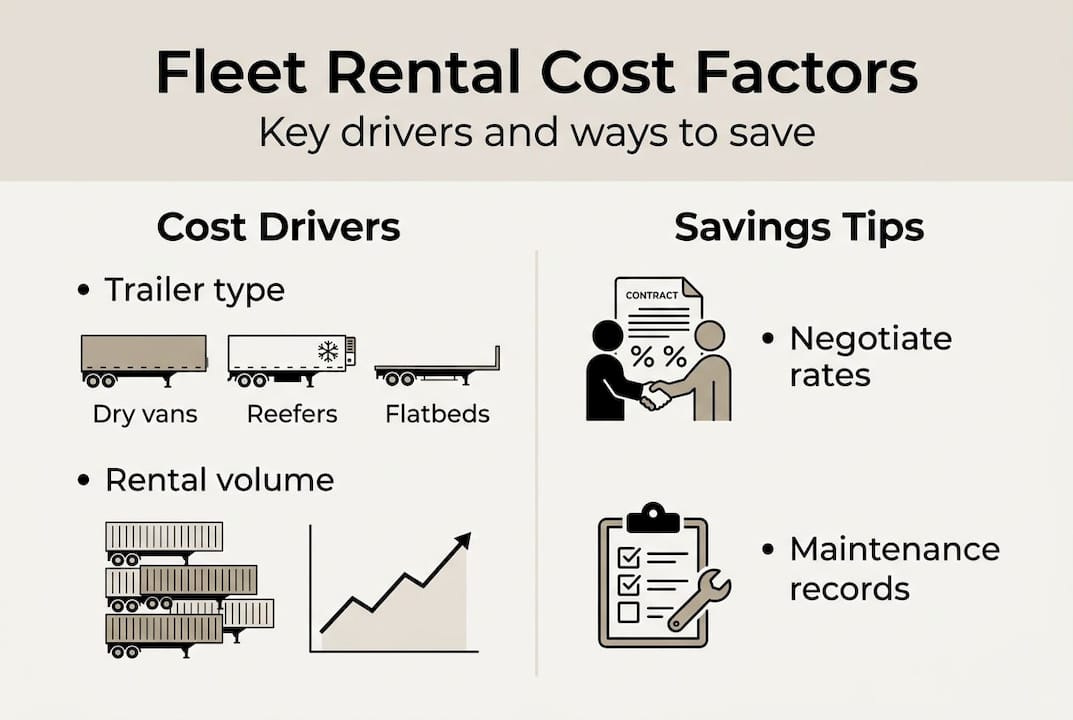
- Trailer type: Refrigerated units cost nearly 2.5 times more than dry vans because of the mechanical complexity of the cooling system, higher maintenance frequency, and energy costs. Flatbeds and specialty trailers fall somewhere in between depending on their configuration.
- Age and condition: New trailers command premium rates. Opting for well-maintained used equipment from a reputable provider can bring your semi truck rental cost breakdown down considerably without sacrificing reliability.
- Rental term length: Short-term rentals almost always carry a higher per-day cost. Committing to a 90-day or longer agreement gives providers the revenue certainty they need to offer meaningful discounts.
- Optional services: Maintenance packages, GPS tracking, and roadside assistance add to base rental costs. Some packages bundle these in; others bill them separately. Always ask what is included.
- Location and demand: Seasonal demand spikes in the Northeast, particularly around peak retail and produce seasons, push rates higher. Massachusetts and surrounding states see real pricing pressure in Q4 and late spring.
Reefer trailers deserve special attention. Beyond the higher daily rate, these units often carry fuel surcharges for the refrigeration system and stricter return condition requirements. If your cargo does not actually require temperature control, choosing the right storage trailer features in a standard dry van will save you money every single day.

The GSA benchmark data confirms that commercial rates vary widely based on volume and negotiation, with real-world prices often landing 20 to 50% below published ceilings. Use that knowledge as leverage.
Pro Tip: If you are renting multiple trailers for a project season, ask for a volume agreement upfront rather than adding units one at a time. Each incremental unit you add mid-contract gives you far less negotiating power than a bundled fleet deal at the start.
Comparing types of semi trailer rentals: Dry van vs. reefer vs. flatbed
But what about the specific type of trailer you choose? Here is what you need to know before booking. Each rental category serves different cargo needs, and picking the wrong type means either overpaying for capacity you do not need or risking a compliance problem with your cargo.
| Trailer type | GSA benchmark (daily) | Best for | Key consideration |
|---|---|---|---|
| Dry van | ~$33 | General freight, packaged goods | Most widely available, lowest cost |
| Reefer | ~$83 | Perishables, pharma, temperature-sensitive goods | Highest operating cost, strict return terms |
| Flatbed/air ride | ~$33 | Heavy equipment, oversized loads, construction materials | Load/unload flexibility, weather exposure |
The GSA ceiling rates for 53-foot trailers show that dry van and flatbed units share similar benchmark pricing at around $33 per day, while reefers jump to $83. In the commercial market, actual pricing follows the same relative spread, even if the absolute numbers are lower.
To select the right trailer type for your operation, work through this sequence:
- Define your cargo requirements first. Does your freight require temperature control? If not, a dry van or flatbed is almost certainly the better financial choice.
- Map your route. Flatbeds are ideal for construction or industrial hauls where crane or forklift loading is required. Dry vans give better cargo protection on mixed routes.
- Calculate total operating days. If you need the unit for more than 30 days, negotiate a monthly flat rate rather than paying per day.
- Factor in regional demand. In Massachusetts and New England, dry vans are the most available unit type, which keeps competition strong and rates reasonable.
- Review your return terms carefully. Reefer units often require full cleaning and documentation of temperature logs upon return. Build that time and cost into your plan.
If temperature-controlled freight is part of your operation, look closely at your choosing a reefer rental options in New England before committing. And for long-term yard or on-site storage needs, semi trailer storage solutions can offer a cost-effective alternative to daily rentals.
Tips to optimize your fleet’s rental agreements
Once you have honed in on the trailer type and general cost, maximize value by following these best practices. A great rate on paper can turn into an expensive arrangement if the contract terms work against you.
Start with these negotiation and review strategies:
- Lock in your term before signing. Open-ended rentals almost always cost more per day than fixed-term agreements. Commit to the longest term you can justify based on your operational calendar.
- Request an itemized quote. Ask the provider to separate base rental, maintenance, insurance, and any fuel or mileage fees. Bundled quotes hide expensive add-ons.
- Ask about off-peak rates. Trailer demand in New England drops during certain winter and mid-summer windows. Timing your contract start to align with low-demand periods can unlock meaningful savings.
- Negotiate on condition, not just price. A slightly older trailer in excellent mechanical shape often performs as well as a newer unit at a fraction of the rate.
- Clarify maintenance responsibility. Who pays for tire replacements, brake adjustments, or lighting repairs mid-contract? Ambiguity here is where budgets get blown.
- Review insurance clauses carefully. Some contracts require you to carry primary commercial liability; others include it in the rate. Know what your existing policy covers before signing.
The GSA data reinforces that well-positioned fleet operators routinely achieve rates 20 to 50% below benchmark prices by leveraging contract length and unit selection. That is a significant margin worth fighting for.
For those evaluating short-term truck rental options in Massachusetts, understanding how tire condition and service frequency affect your agreement is equally important. Solid trailer maintenance tips can also help you evaluate whether a provider’s maintenance standards match what you need before you sign.
Pro Tip: Always ask for a copy of the most recent maintenance record on any unit you are considering. A provider who hesitates to share that information is telling you something important.
A realistic outlook: What most fleet managers miss about trailer rental costs
These tactical tips can save you thousands, but here is the deeper truth we have learned over decades in this industry. Most fleet managers focus almost entirely on the daily rate, treating trailer rental like a commodity purchase. That thinking is where money gets left on the table.
The daily rate is just one number. What actually determines total cost is operational continuity. A trailer that breaks down twice in a quarter costs you far more in driver idle time, missed deliveries, and customer penalties than the difference between a $28 and a $33 daily rate. Reliability, fast service response, and a provider who knows your routes matter more than shaving two dollars per day.
We have also seen fleets treat rental as a pure stopgap, when in reality a well-structured comprehensive rental strategy can be a permanent capacity management tool. Renting during peak demand and owning core fleet units gives operators flexibility that pure ownership or pure rental never can. The operators who win consistently are the ones who see rental agreements as a strategic lever, not just a line item.
Need help renting or buying semi trailers in Massachusetts?
If you are managing fleet capacity in Massachusetts or across New England, the right partner makes all the difference. Since 1986, Apple Truck & Trailer has helped fleet operators find the right trailers at the right terms, whether that means a short-term rental, a long-term lease, or adding reliable used equipment to your owned fleet.
Our team works directly with logistics managers to match your cargo requirements, seasonal demand patterns, and budget to the best available units in our inventory. We cover Massachusetts, Rhode Island, Connecticut, and New Hampshire with personalized service you will not get from a national chain. Explore our truck and trailer sales Massachusetts inventory or learn more about buying a used commercial truck to see how ownership and rental options compare. Request a quote today and let us put our decades of experience to work for your fleet.
Frequently asked questions
What is the average daily rental rate for a semi trailer in Massachusetts?
Semi trailer rental rates in Massachusetts typically range from $24 to $33 per day for standard dry vans, depending on fleet volume and contract length. The GSA dry van ceiling sits at approximately $33 per day, so commercial fleets often negotiate rates well below that figure.
Why do reefer trailers cost more to rent than dry vans?
Reefer trailers carry higher daily rates because of the refrigeration equipment, more frequent maintenance requirements, and greater energy consumption involved in keeping cargo temperature-controlled. The GSA reefer benchmark of approximately $83 per day reflects these elevated operating costs.
Can I negotiate semi trailer rental rates for my fleet?
Yes, and you should. Fleets that leverage contract length, unit volume, and willingness to rent used equipment can achieve rates 20 to 50% below published benchmark ceilings in the commercial market.
What should I look for in a semi trailer rental contract?
Focus on maintenance responsibility, insurance requirements, hidden fees like fuel surcharges or mileage overages, and whether the contract allows early termination or unit swaps if your needs change.
Recommended
- Semi Trailer Basics: Key Facts for Fleet Owners – Apple Truck & Trailer
- Best Semi Truck and Trailer Rentals: How Much to Rent a Semi Truck and Trailer? – Apple Truck & Trailer
- Trailer Rental FAQs: Solving Common Fleet Challenges – Apple Truck & Trailer
- Powerful Massachusetts Semi Truck Rentals: How Much Does it Cost to Rent a Semi Truck for a Week? – Apple Truck & Trailer