
Most American businesses overlook how much trailer specifications actually affect their bottom line. A single mismatch in weight or configuration can push operational costs up and compromise fleet safety. With regulations tightening and diverse cargo demands on the rise, knowing what these technical details mean is now indispensable. This guide explains the numbers, requirements, and practical considerations every American fleet operator needs to make smart, cost-effective trailer choices.
Table of Contents
- What Trailer Specifications Really Mean
- Comparing Trailer Types and Configurations
- Essential Features and Sizing Standards
- Legal and Compliance Factors in Massachusetts
- Avoiding Common Specification Mistakes
Key Takeaways
| Point | Details |
|---|---|
| Understanding Trailer Specifications | Buyers must comprehend specifications like Aggregate Trailer Mass and Gross Trailer Mass to ensure legal compliance and operational efficiency. |
| Importance of Trailer Types | Selecting the right trailer type based on cargo requirements is crucial for maximizing efficiency and ensuring safety during transportation. |
| Navigating Legal Compliance | Fleet managers need to stay informed about state-specific regulations to avoid fines and ensure operational legality in trailer usage. |
| Avoiding Specification Mistakes | Operators should conduct thorough assessments before purchase to prevent costly errors related to weight distribution and dimensional compatibility. |
What Trailer Specifications Really Mean
Understanding trailer specifications requires more than simply reading numbers. These technical details represent critical performance indicators that directly impact your transportation efficiency, safety, and operational costs. Trailer specifications encompass multiple key measurements that determine a trailer’s fundamental capabilities and limitations.
The most crucial specifications buyers must comprehend include Aggregate Trailer Mass (ATM), Gross Trailer Mass (GTM), payload capacity, and dimensional specifications. ATM represents the maximum total weight a trailer can safely carry, including its own weight and cargo. GTM specifically measures the weight the trailer exerts on its wheels during transportation. These measurements aren’t just numbers—they’re legal compliance requirements that determine whether your trailer can legally operate on highways and meet transportation regulations.
Trailer specifications also include critical structural details like axle configuration, suspension type, brake system capacity, and material composition. Fleet managers and logistics professionals must meticulously analyze these specifications to ensure their trailers match specific operational requirements. For instance, a refrigerated goods transportation company will need different trailer specifications compared to a construction equipment hauler. Axle configurations impact weight distribution, suspension type determines load stability, and material composition influences durability and maintenance costs.
Pro Tip: Documentation Verification: Always request and carefully review manufacturer specification sheets before purchasing a trailer, cross-referencing the technical details with your specific operational needs and local transportation regulations.
Below is a summary of critical trailer specification terms and their business impact:
| Specification | What It Measures | Impact on Operations |
|---|---|---|
| Aggregate Trailer Mass | Total allowed trailer + cargo weight | Determines legal load limit |
| Gross Trailer Mass | Weight on trailer wheels during transit | Influences drive safety and stability |
| Payload Capacity | Maximum cargo weight | Impacts choice of suitable freight |
| Axle Configuration | Number and placement of axles | Affects weight distribution, handling |
| Suspension Type | Method of load support | Alters ride quality and durability |
Comparing Trailer Types and Configurations
Trailer configurations represent a complex ecosystem of specialized transportation solutions designed to meet diverse logistical challenges. Trailer types vary significantly across industries, with each configuration engineered to address specific freight transportation requirements. Understanding these variations is crucial for fleet managers, logistics professionals, and businesses seeking optimal transportation efficiency.
The primary trailer types include flatbed trailers, dry van trailers, refrigerated trailers, lowboy trailers, and specialized equipment transporters. Flatbed trailers offer maximum flexibility for oversized or awkwardly shaped cargo, enabling easy loading from multiple angles. Dry van trailers provide enclosed protection for standard freight, shielding goods from environmental conditions. Refrigerated trailers maintain precise temperature controls for perishable goods, while lowboy trailers specialize in transporting heavy machinery and equipment with low ground clearance.
Each trailer configuration presents unique advantages and limitations. Weight capacity, dimensional constraints, and specialized features determine their suitability for specific transportation tasks. Construction companies might prefer heavy-duty flatbeds for equipment transport, whereas food distribution networks rely on temperature-controlled refrigerated trailers. The selection process demands careful analysis of cargo characteristics, transportation distance, environmental conditions, and regulatory compliance requirements.
Here’s a comparison of key trailer types and their major applications:
| Trailer Type | Typical Cargo | Key Advantage | Main Limitation |
|---|---|---|---|
| Flatbed | Construction materials | Flexible loading/unloading | Exposed to weather and theft |
| Dry Van | Boxed general freight | Enclosed weather protection | Limited to packaged cargo |
| Refrigerated (Reefer) | Perishable foods, medicines | Maintains temperature control | Higher maintenance requirements |
| Lowboy | Heavy machinery, equipment | Can haul overheight loads | Lower ground clearance needed |
| Specialized Equipment | Oversized, unique items | Tailored to specific freight type | Less versatility, higher cost |
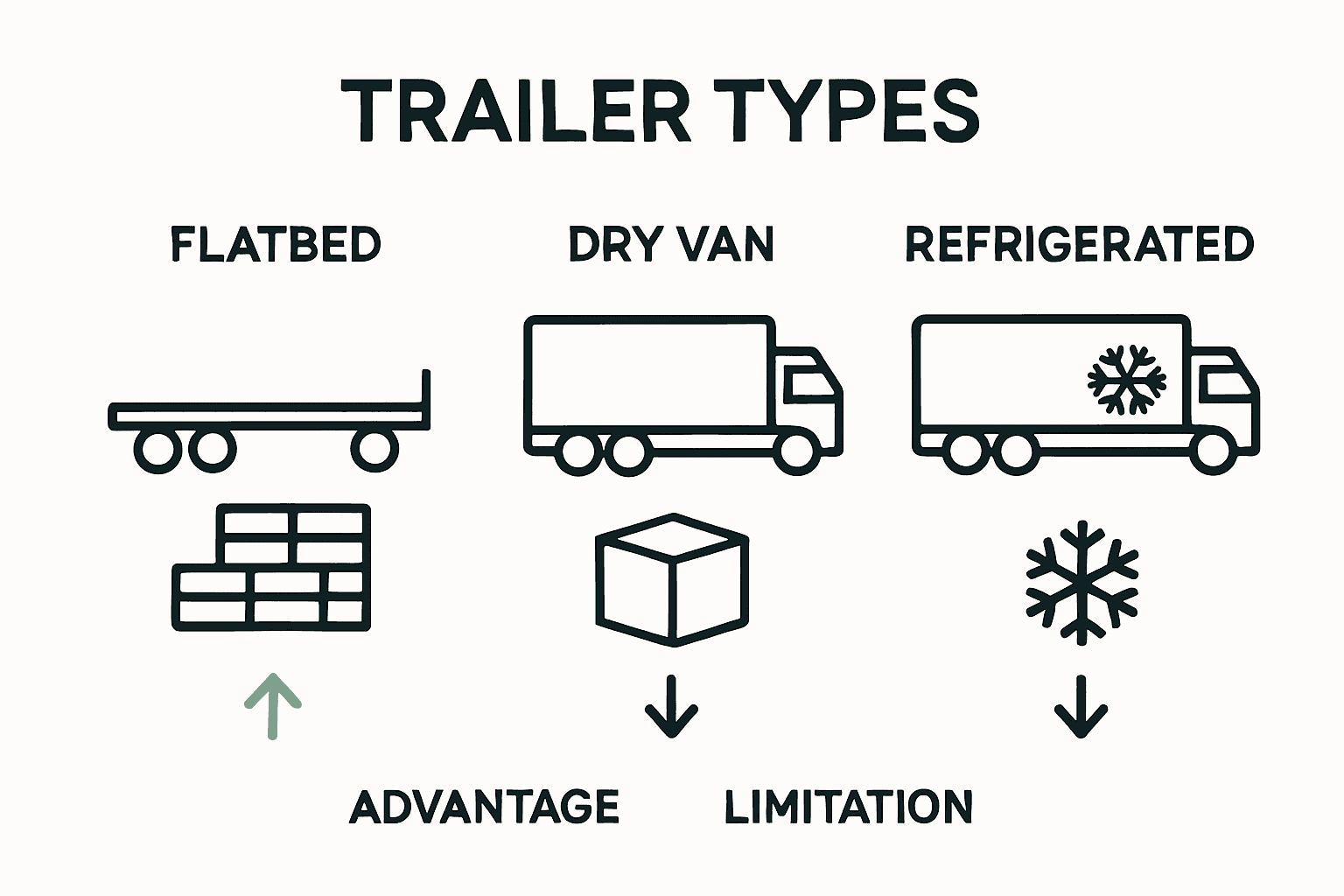
Pro Tip: Configuration Matching: Always match your trailer type precisely to your cargo’s specific requirements, considering weight, dimensions, environmental sensitivity, and transportation conditions to maximize efficiency and minimize potential transportation risks.
Essential Features and Sizing Standards
Trailer sizing and features form the critical foundation of transportation infrastructure, determining a vehicle’s overall performance and utility. Trailer specification standards encompass multiple complex dimensions that go far beyond simple measurements. Fleet managers and logistics professionals must understand these intricate details to select equipment matching their precise operational requirements.
Key sizing standards typically include deck length, width, axle configurations, and weight capacity. Standard trailer widths range from 72 to 102 inches, with deck lengths varying between 10 and 53 feet depending on intended use. Trailer coupler types play a crucial role in connecting trailers to towing vehicles, with options like straight-tongue, A-frame, and gooseneck designs offering different mounting advantages. Each coupler configuration impacts load distribution, maneuverability, and overall transportation efficiency.

Beyond dimensional specifications, essential features include suspension systems, brake configurations, material composition, and specialized equipment mounting points. Steel and aluminum trailers present different weight and durability trade-offs, while advanced suspension systems can dramatically improve load stability and reduce transportation wear. Professional fleet operators must carefully analyze these features, considering factors like terrain, typical cargo weight, transportation distance, and environmental conditions when selecting trailer equipment.
Pro Tip: Specification Verification: Always request comprehensive manufacturer specification sheets and personally inspect potential trailers, cross-referencing technical details against your specific operational requirements and anticipated usage conditions.
Legal and Compliance Factors in Massachusetts
Navigating the complex legal landscape of trailer operations in Massachusetts requires a comprehensive understanding of state-specific regulations and commercial vehicle requirements. Commercial truck basics form the foundation of legal compliance, with strict guidelines governing trailer weight, dimensioning, safety standards, and operational protocols for businesses and independent operators.
Massachusetts imposes rigorous commercial vehicle regulations that impact trailer usage across multiple dimensions. These include mandatory weight restrictions, which typically limit gross vehicle weight to 80,000 pounds for standard commercial trailers, with specific exceptions for specialized transportation. Registration requirements mandate annual inspections, commercial insurance coverage, and adherence to state-specific Department of Transportation (DOT) guidelines. Operators must maintain comprehensive documentation, including vehicle identification numbers, current registration certificates, and proof of comprehensive commercial vehicle insurance.
Additional compliance factors involve specialized permitting for oversized loads, specific routing restrictions in urban areas like Boston, and environmental regulations affecting commercial vehicle emissions. Fleet managers and independent trucking professionals must stay current with evolving state transportation laws, which can change based on infrastructure developments, safety considerations, and technological advancements in transportation equipment. Understanding these nuanced legal requirements is crucial for avoiding potential fines, operational disruptions, and potential legal complications.
Pro Tip: Regulatory Tracking: Establish a systematic process for monitoring Massachusetts commercial vehicle regulations, subscribing to state transportation department updates and consulting with local transportation compliance experts to ensure ongoing legal adherence.
Avoiding Common Specification Mistakes
Trailer specification errors can lead to costly operational disruptions, safety risks, and significant financial losses for businesses and independent operators. One of the most critical areas of potential mistake involves trailer coupler selection, where inappropriate matching can compromise vehicle performance and transportation safety. Understanding the nuanced details of trailer specifications requires a meticulous approach to prevent potentially catastrophic operational errors.
Common specification mistakes frequently arise in several key areas. Weight distribution miscalculations represent a primary concern, where operators fail to accurately match trailer capacity with intended cargo weight. This can result in structural overload, suspension damage, and potential roadway safety hazards. Another critical error involves dimensional miscalculations, where trailer length, width, or height do not align with specific transportation requirements. Fleet managers must carefully analyze cargo dimensions, transportation routes, and legal weight restrictions to ensure complete compatibility.
Technical specification errors extend beyond simple measurements. Operators often overlook critical factors such as suspension compatibility, brake system specifications, and material durability requirements. Different cargo types demand unique trailer configurations, and a one-size-fits-all approach can lead to premature equipment failure, increased maintenance costs, and potential safety risks. Professional fleet managers must conduct comprehensive assessments that consider terrain, typical cargo characteristics, transportation distance, and environmental conditions when selecting trailer equipment.
Pro Tip: Specification Verification: Develop a systematic pre-purchase checklist that includes detailed cargo requirements, transportation conditions, and comprehensive equipment specifications to minimize the risk of costly specification mismatches.
Secure the Right Trailer Specifications with Confidence
Choosing the right trailer specifications that match your cargo needs and legal requirements can be challenging and costly if done incorrectly. This article highlights critical pain points like understanding Aggregate Trailer Mass, axle configurations, and suspension types to ensure safety and compliance. Avoid costly mistakes by partnering with a trusted provider who understands the complex demands of commercial transportation in Massachusetts and beyond.
At Apple Truck & Trailer, we specialize in offering high-quality used trailers and semi-trucks that meet diverse operational needs. Whether you need precise trailer specifications for heavy equipment hauling or refrigerated goods, explore our extensive inventory in the Semi Truck and Trailer category. Our expert team is ready to help you select the perfect trailer that aligns with your cargo requirements and regulatory standards.
Don’t risk operational downtime or safety hazards with mismatched equipment. Act today and get professional guidance on selecting the ideal trailer from our trusted Massachusetts dealership. Visit us now at Apple Truck & Trailer to browse our inventory and request a personalized consultation. Your fleet deserves the best in performance and compliance.
Frequently Asked Questions
What does Aggregate Trailer Mass (ATM) mean?
Aggregate Trailer Mass (ATM) refers to the maximum weight a trailer can safely carry, which includes the trailer’s own weight plus the weight of its cargo.
How do I determine the right trailer type for my cargo?
Choosing the right trailer type requires analyzing your specific cargo needs, including weight, dimensions, and if it requires special conditions like temperature control. Common trailer types include flatbed, dry van, refrigerated, and lowboy trailers.
What are the key legal compliance factors for trailers?
Key legal compliance factors for trailers include adhering to weight restrictions, registering your trailer, maintaining annual inspections, and ensuring you have the appropriate commercial vehicle insurance and permits for oversized loads.
What common mistakes should I avoid when selecting a trailer?
Common mistakes to avoid include miscalculating weight distribution, dimensions, and overlooking critical specifications like suspension compatibility and brake system requirements. A systematic pre-purchase checklist can help minimize these risks.
Recommended
- Semi Trailer Basics: Key Facts for Fleet Owners – Apple Truck & Trailer
- Trailer Rental FAQs: Solving Common Fleet Challenges – Apple Truck & Trailer
- Semi-Trailer Terminology: Everything You Need to Know – Apple Truck & Trailer
- 5 Simple Steps on Lease Agreements: How to Lease a Tractor Trailer? – Apple Truck & Trailer