
TL;DR:
- Renting trucks is a more flexible and financially advantageous choice for businesses with low utilization or seasonal demand. It shifts costs to operating expenses, preserves working capital, and provides operational flexibility for surge capacity and quick fleet adjustments. Owning is more suitable only when truck utilization consistently exceeds 65%, factoring in hidden costs like maintenance, depreciation, and idle asset expenses.
Renting trucks is defined as a capital structure decision, not simply a cost comparison. Businesses that choose to rent instead of buy trucks shift expenses from capital expenditures (CAPEX) to operating expenses (OPEX), preserving working capital and avoiding long-term debt tied to depreciating assets. For fleet managers and logistics decision-makers, understanding why businesses rent instead of buy trucks comes down to three factors: utilization rates, cash flow priorities, and the true total cost of ownership. This guide breaks down each factor with the specificity you need to make the right call for your fleet.
Why businesses rent instead of buy trucks: the financial case
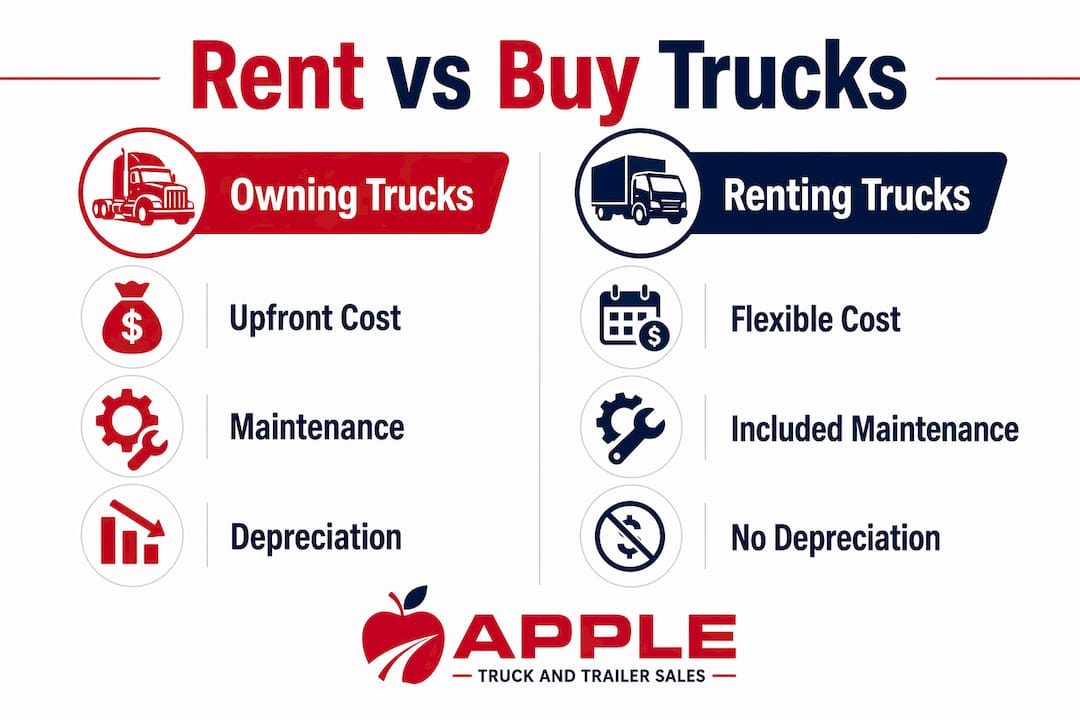
Renting eliminates the single biggest barrier to fleet expansion: the upfront capital requirement. A Class 8 tractor costs between $150,000 and $200,000 to purchase outright. Even financed, ownership typically demands a 20–30% down payment, which locks up $30,000 to $60,000 in capital that could fund operations, payroll, or growth.
Rental payments are classified as operating expenses on the income statement. That classification matters because it keeps large asset liabilities off the balance sheet, which improves liquidity ratios and makes the business more attractive to lenders. A construction company scaling up for a six-month highway project, for example, can add three flatbeds to its fleet without triggering a capital approval process or drawing down a credit line.
The cash flow impact compounds in seasonal businesses. A landscaping company in New England runs at full capacity from april through november and idles trucks through winter. Owning those trucks means paying insurance, registration, and depreciation year-round on assets that sit unused for four months. Renting for peak season eliminates that dead weight entirely.
- No down payment required: Rental agreements require no 20–30% upfront capital, freeing cash for operations.
- OPEX classification: Rental costs appear as operating expenses, not long-term liabilities, improving balance sheet health.
- No depreciation exposure: Owned trucks lose value the moment they leave the lot. Rental users carry zero depreciation risk.
- Predictable monthly costs: Rental agreements fix costs for the term, removing surprise repair bills from the budget.
- Loan interest avoided: Financing a $175,000 truck at 7% over five years adds roughly $34,000 in interest alone.
Pro Tip: Before your next budget cycle, ask your CFO to model the same fleet expansion as both a CAPEX purchase and an OPEX rental. The balance sheet impact often changes the decision entirely, especially if your company is approaching a financing event or covenant threshold.
When does owning trucks beat renting? the utilization threshold
Ownership becomes more economical only when truck utilization consistently exceeds the industry benchmark. Utilization above 65% is the threshold at which fixed ownership costs spread across enough productive miles to undercut rental rates on a per-mile basis. Below that threshold, renting is the more cost-efficient model.
The logic is straightforward. A truck that runs five days a week, 50 weeks a year, generates enough revenue to absorb depreciation, insurance, and maintenance costs. A truck that runs three days a week generates the same fixed costs but far less revenue to cover them. Utilization below 60% consistently favors renting because rental costs scale with actual use while ownership costs do not.
The table below compares the two models across key cost metrics at different utilization levels.
| Cost Metric | Owned Truck (50% Utilization) | Rented Truck (50% Utilization) |
|---|---|---|
| Upfront capital required | $30,000–$60,000 down payment | $0 |
| Monthly fixed cost | High (depreciation + insurance + loan) | Predictable rental rate only |
| Maintenance exposure | Full owner responsibility | Covered by rental provider |
| Depreciation risk | Owner absorbs full loss | None |
| Flexibility to scale down | Low (asset is owned) | High (return or extend) |
| Break-even utilization | Above 65% | Below 65% |
The hidden trap in this analysis is that most businesses overestimate their utilization when they run the numbers. They count planned workdays but forget scheduled maintenance windows, driver availability gaps, and slow seasons. A realistic utilization audit almost always produces a lower number than the initial estimate, which shifts the economics toward renting more often than fleet managers expect.
How does renting trucks support operational flexibility?
Operational flexibility is the second major reason why companies choose rentals over ownership. Fleet size needs change. Projects start and end. Demand spikes without warning. Ownership locks you into a fixed fleet that either falls short during surges or sits idle during slow periods.
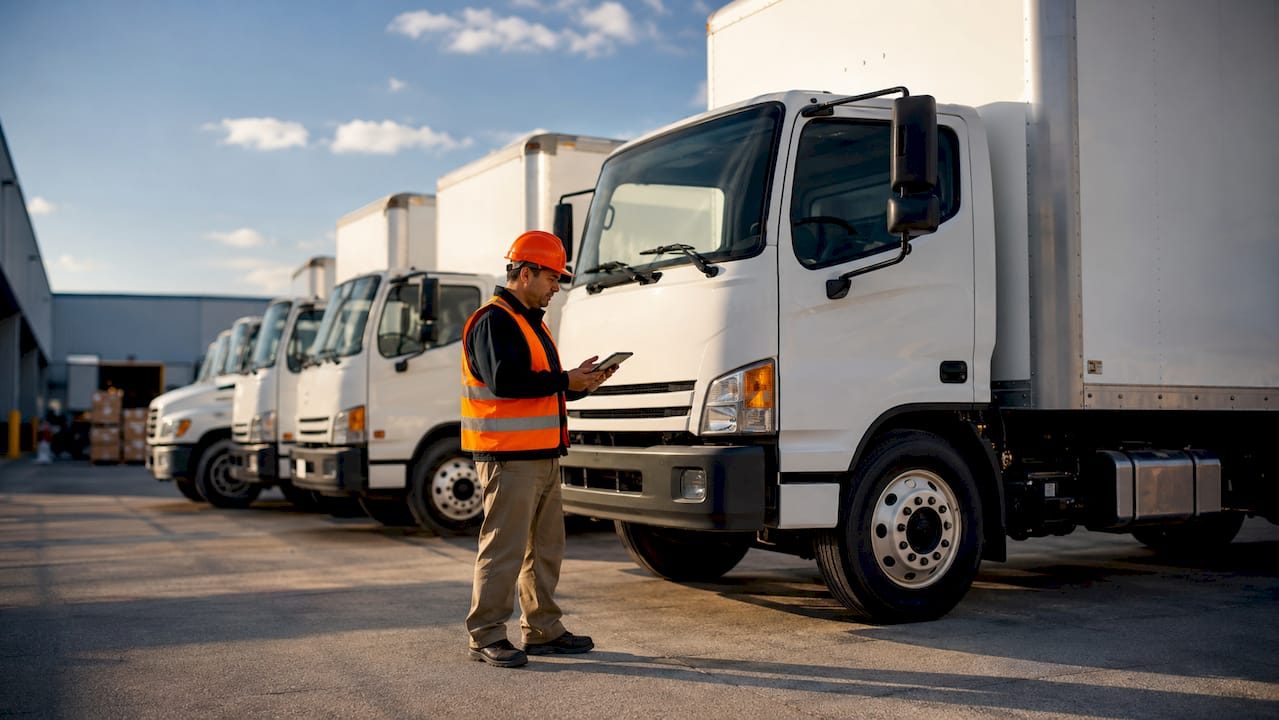
Short-term rental agreements, available on terms from daily to monthly, let fleet managers match capacity to actual demand. A logistics provider that wins a temporary contract to move goods for a retail client during the holiday season can add trucks for 60 days and return them when the contract ends. No residual asset, no ongoing cost.
Downtime risk is where rental flexibility delivers its clearest financial value. Replacement units are available within 24–48 hours when a truck breaks down, which means revenue loss from downtime is minimized. The cost of a short-term rental replacement is almost always lower than the revenue lost from a stopped route. For businesses in construction and renewable energy, where project timelines are fixed and delays are expensive, this flexibility is a direct competitive advantage.
- Scale up fast: Add trucks within 24–48 hours to cover demand surges or new contracts.
- Scale down without penalty: Return trucks at the end of a rental term with no residual liability.
- Bridge breakdowns: Replace a downed truck immediately to keep routes running.
- Test new routes: Pilot a new delivery corridor with a rented truck before committing to ownership.
- Manage seasonal peaks: Add capacity for Q4 or summer construction season without year-round overhead.
Pro Tip: Verify your hired auto liability coverage before signing any rental agreement. Most standard commercial auto policies do not automatically extend to rented trucks. A specific hired auto endorsement is required, and the gap in coverage can expose your business to significant liability if an accident occurs in a rented vehicle.
What are the hidden costs of owning trucks?
The most common mistake in a truck rental vs purchase analysis is comparing monthly rental rates directly to monthly loan payments. That comparison ignores the full cost of ownership, and it almost always makes buying look cheaper than it actually is.
A proper total cost of ownership analysis includes costs that never appear in a financing quote. These are the expenses that erode profitability quietly over time, and they are the primary reason why a rent-vs-buy analysis often fails when it ignores idle asset costs and unpredictable maintenance burdens.
The hidden costs of truck ownership fall into five categories:
Maintenance unpredictability. Repair costs on commercial trucks are not linear. A truck can run cleanly for two years and then require a $15,000 engine repair in month 25. Rental agreements typically include scheduled maintenance, shifting that repair risk to the provider rather than the operator.
Administrative overhead. Owned trucks require active management: parts sourcing, warranty tracking, DOT registration renewals, and compliance documentation. Each task consumes staff time that has a real dollar cost, even if it never appears on a maintenance invoice.
Insurance premium exposure. Commercial truck insurance premiums vary by vehicle age, driver history, and coverage type. Older owned trucks often carry higher premiums than newer rental units, and coverage gaps in owned-fleet policies can create liability exposure that is expensive to resolve after an incident.
Depreciation and resale uncertainty. A Class 8 truck depreciates significantly in its first three years. Resale value depends on market conditions, mileage, and maintenance history. Businesses that need to exit a truck position in a soft used-truck market can take a substantial loss on the asset.
Idle asset drag. A truck that sits unused still costs money every day through insurance, registration, and depreciation. The hidden overhead of idle assets raises the true cost of ownership well above what a simple loan payment comparison suggests.
For a deeper look at how these costs stack up, the commercial truck leasing costs guide from Apple Truck & Trailer breaks down the full ownership expense picture for fleet managers.
Key takeaways
Renting trucks is the stronger financial and operational choice when utilization is below 65%, demand is seasonal or unpredictable, or capital preservation is a priority.
| Point | Details |
|---|---|
| Utilization drives the decision | Ownership only beats renting when truck utilization consistently exceeds 65%. |
| OPEX vs. CAPEX matters | Rental payments improve balance sheet health by keeping assets off the liability column. |
| Hidden ownership costs are real | Maintenance, depreciation, admin overhead, and idle asset drag raise true ownership costs significantly. |
| Flexibility has financial value | Short-term rentals let businesses scale fleet capacity without long-term financial commitments. |
| Insurance gaps are a serious risk | Renting requires a hired auto liability endorsement; standard commercial policies often do not cover rented trucks. |
The fleet decision most managers get wrong
From where I sit, the biggest mistake I see fleet managers make is treating the rent-vs-buy question as a math problem with one right answer. It is not. It is a capital strategy question, and the answer changes depending on your revenue visibility, your utilization patterns, and how much risk your balance sheet can absorb.
The principle I have come to rely on is simple: own what runs consistently, rent what fluctuates. If you have a truck that runs five days a week, 48 weeks a year, on a predictable route with a durable customer contract behind it, ownership probably makes sense. If you are adding capacity to chase a project, cover a breakdown, or test a new market, renting is almost always the smarter move.
What I find most businesses get wrong is the utilization estimate. They build the ownership case on optimistic assumptions and then live with the reality of a truck that sits idle two days a week. That gap between projected and actual utilization is where ownership decisions quietly destroy profitability.
The fleet capital strategy framework that resonates most with me treats rental capacity as a deliberate buffer, not a fallback. The best-run fleets I have seen blend owned trucks for their core, predictable workload with rental agreements for surge capacity and seasonal demand. That blend keeps capital deployed efficiently and keeps the balance sheet clean.
One more thing: do not skip the insurance review. The hired auto coverage gap is not a technicality. It is a real exposure that can cost more in a single incident than a year of rental premiums.
Build a smarter fleet with Apple Truck & Trailer
Whether you are ready to own or need flexible capacity now, Apple Truck & Trailer has served fleet operators across Massachusetts, Rhode Island, Connecticut, and New Hampshire since 1986.
If ownership makes sense for your core routes, browse the used commercial truck inventory for cost-effective options across a range of classes and configurations. For businesses that need flexible scaling without long-term commitments, truck leasing in Massachusetts offers structured terms that match fleet capacity to actual demand. Short-term rental options are also available for downtime coverage and quick capacity additions. Contact Apple Truck & Trailer directly to discuss which combination fits your fleet strategy.
FAQ
Why do businesses rent trucks instead of buying them?
Businesses rent trucks to preserve working capital, avoid large down payments, and keep costs classified as operating expenses rather than long-term liabilities. Renting is especially advantageous when truck utilization falls below 60–65%.
What is the utilization threshold that favors truck ownership?
Ownership becomes more economical when utilization consistently exceeds 65%. Below that level, rental agreements spread costs more efficiently and reduce risk exposure from idle assets.
Does renting trucks include maintenance coverage?
Most commercial rental agreements include scheduled maintenance, shifting repair risk to the rental provider. This removes unpredictable repair costs from the renter’s budget and reduces administrative overhead.
What insurance do i need when renting a commercial truck?
Standard commercial auto policies typically do not cover rented trucks. Fleet managers must add a hired auto liability endorsement to their policy before operating a rented vehicle to avoid coverage gaps.
Is it cheaper to rent or buy a truck for seasonal work?
Renting is almost always cheaper for seasonal operations. Owning a truck means paying insurance, registration, and depreciation year-round, even during months when the truck sits idle. Renting limits costs to the active season only.
Recommended
- Short-Term Truck Rental: Smarter Logistics Choices – Apple Truck & Trailer
- How Much Does It Cost To Lease A Box Truck: Buyer’s Guide for Best Deals in 2024 – Apple Truck & Trailer
- How to Lease a Box Truck: Your Powerful Guide with Tips and Tricks – Apple Truck & Trailer
- How to choose used trucks: a fleet manager’s guide – Apple Truck & Trailer