
TL;DR:
- A 53 dry van trailer is an enclosed, non-refrigerated vehicle measuring 53 feet in length used for general freight. Its operational value lies in maximizing cargo volume while providing weather-resistant security, but interior dimensions and axle load limits are critical for compliance and efficiency. Effective fleet management requires detailed knowledge of trailer specs, seasonal restrictions, and proper load planning to optimize capacity and avoid costly errors.
When fleet operators and logistics managers in New England hear “53 dry van,” many assume it simply means a 53-foot trailer. But that single phrase hides a dense layer of operational considerations: cargo weight limits, interior dimension variations, axle distribution requirements, and load planning constraints that can make or break a shipment. Getting these details wrong costs real money in refused loads, compliance violations, and wasted capacity. This guide breaks down everything you need to know about the 53 dry van trailer, from hard specifications to strategic fleet planning.
Table of Contents
- What is a 53 dry van trailer?
- Specifications: Dimensions and cargo capacity
- Operational advantages and limitations for fleets
- Planning shipments: Making the most of 53 dry van capacity
- A fleet manager’s perspective: What most guides miss about 53 dry vans
- Find your 53 dry van solution with Apple Truck & Trailer
- Frequently asked questions
Key Takeaways
| Point | Details |
|---|---|
| Standard 53-foot length | A 53 dry van is an enclosed, non-refrigerated trailer commonly used for general freight in the U.S. |
| Weight capacity range | Typical cargo capacity is 42,000–45,000 pounds, dependent on axle limits and trailer design. |
| Fleet operational benefits | Fleets prefer 53 dry vans for maximizing cargo volume and securing loads. |
| Cargo planning considerations | Usable interior space and pallet counts can vary by manufacturer, affecting logistics efficiency. |
What is a 53 dry van trailer?
A 53 dry van is, at its core, an enclosed freight trailer that measures 53 feet in length and carries non-perishable general freight without any temperature control. As Kuehne+Nagel notes, a “53 dry van” generally means a 53-foot enclosed dry (non-refrigerated) trailer used for general freight. That definition sounds simple, but the operational implications go much deeper than a single measurement.
Dry van trailers are the workhorses of American logistics. They account for the majority of over-the-road freight movement in the United States, carrying everything from packaged consumer goods and automotive parts to industrial equipment and retail inventory. Their fully enclosed box design protects cargo from weather, road debris, and unauthorized access, making them far more versatile than open options like flatbeds.
Here is what defines a standard 53 dry van trailer:
- Length: 53 feet (the nominal external measurement)
- Trailer type: Fully enclosed box, also called a “box trailer” or “van trailer”
- Temperature control: None. Dry vans carry non-perishable, ambient-temperature freight only.
- Loading method: Standard rear door access, though some configurations include side doors
- Primary use: General freight including retail goods, packaged food, electronics, and manufactured parts
Understanding the different utility trailer types helps clarify where the 53 dry van fits in a broader fleet. It is neither a refrigerated reefer unit nor an open flatbed. Its value lies in its enclosed, weather-resistant design combined with maximum cargo volume at the standard legal road length.
The 53 dry van is the default choice for most general freight in North American logistics precisely because it maximizes enclosed cargo space at the legal road limit, balancing capacity, security, and operational simplicity.
For New England fleet operators, this matters especially because regional roads, dock configurations, and freight patterns heavily favor this standard format. Understanding its specs thoroughly before committing to purchases, leases, or load planning decisions is not optional. It is essential.
Specifications: Dimensions and cargo capacity
Knowing the nominal 53-foot length is just the starting point. The specifications that actually drive operational decisions are interior dimensions, cargo weight capacity, and axle load distribution. These numbers determine how many pallets you can load, what freight lanes you can service, and whether you stay compliant on every run.

Key dimensions for a standard 53 dry van
| Dimension | Typical measurement |
|---|---|
| Exterior length | 53 feet (636 inches) |
| Interior length | 52 feet 6 inches (630 inches, approx.) |
| Interior width | 98 to 100 inches |
| Interior height | 108 to 110 inches |
| Door opening width | 94 to 96 inches |
| Door opening height | 102 to 109 inches |
These figures vary slightly by manufacturer and trailer model year, which matters more than many shippers realize. A difference of a few inches in interior height can determine whether double-stacked pallets fit cleanly. A narrower door opening affects forklift access and loading speed.
Cargo weight capacity for dry vans is commonly in the 42,000 to 45,000 lb range, subject to axle and load limits and tractor tare weight. That range is not fixed. The actual cargo payload you can carry depends on the gross vehicle weight rating (GVWR, the maximum total weight of the fully loaded truck), the tare weight of the tractor, and how that weight distributes across the axles.
Federal regulations set a maximum gross vehicle weight of 80,000 pounds for a standard five-axle tractor-trailer combination on interstate highways. That number gets consumed by the tractor itself (typically 15,000 to 20,000 lbs) and the trailer’s own tare weight (typically 13,000 to 15,000 lbs), leaving you with a payload window that can shrink fast if you are not calculating carefully.
Axle distribution is equally critical. Even if your total gross weight stays under 80,000 lbs, improper axle loading can put you out of compliance with bridge laws and state weight restrictions, both of which are strictly enforced across Massachusetts, Connecticut, Rhode Island, and New Hampshire.
Pro Tip: Never plan your load purely based on the trailer’s rated capacity. Always factor in the tractor’s tare weight and confirm your axle loads with a scale ticket before departing. A trailer rated for 45,000 lbs of cargo does not guarantee 45,000 lbs of legal payload on every tractor configuration.
Practically, plan around usable interior space and the shipment’s weight and axle constraints, not just the nominal 53-foot length. Manufacturers vary slightly, and interior dimensions are reduced from the exterior measurement, which can affect tight pallet counts on high-density loads.
Standard 53-foot dry vans typically accommodate 26 standard 48×40 inch pallets in a single-tier configuration. Double-stacking opens additional volume, but only if freight density, height restrictions, and pallet integrity support it.
Operational advantages and limitations for fleets
Understanding the specs is only half the picture. The other half is knowing how those specs translate into daily fleet operations, cost per mile, and shipment reliability. The 53 dry van offers powerful advantages, but it also comes with real constraints worth planning around.
Top advantages of the 53 dry van for fleet operators
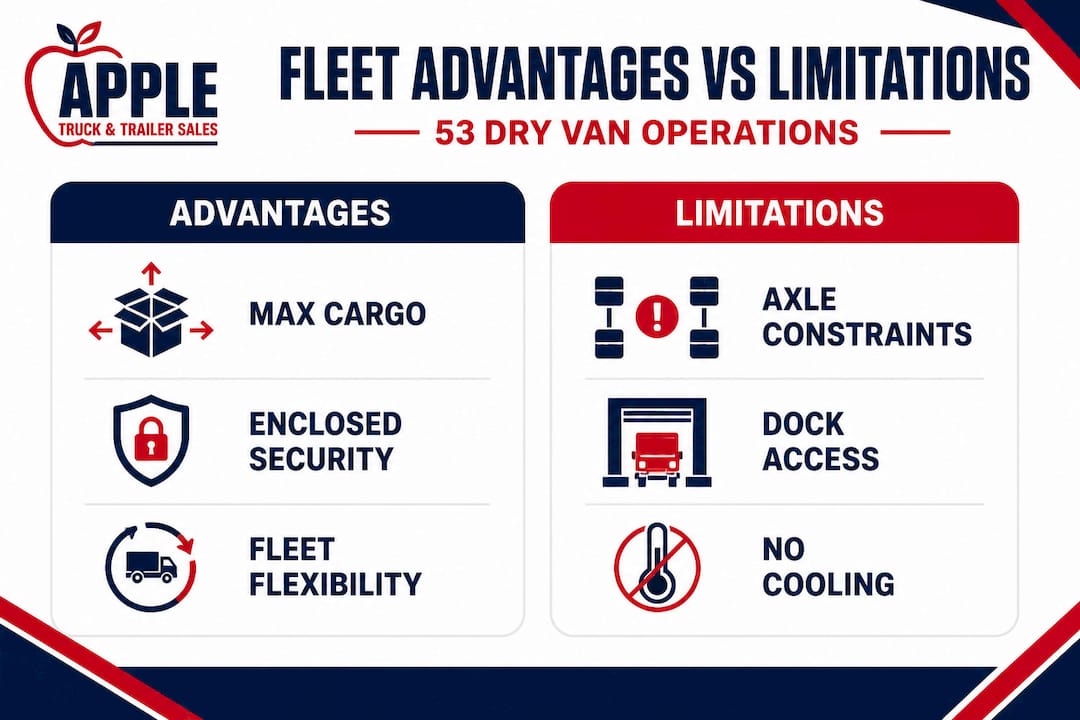
- Maximum cargo volume per trip. The 53-foot length is the longest standard trailer permitted on most U.S. interstate highways, meaning you are pulling the most freight legally possible on a single run.
- Enclosed, secure cargo environment. The fully enclosed box protects freight from weather, dust, and theft. This matters especially for retail goods, electronics, and high-value consumer products.
- Standardized loading and unloading. Rear door loading works with virtually every dock setup, reducing complexity when dealing with multiple customers and delivery locations.
- Flexibility across freight types. Non-perishable general freight covers an enormous range of commodities, giving fleet managers the ability to accept diverse loads without specialized equipment.
- Resale value and market liquidity. Because 53 dry vans are so widely used, the used trailer market is active and predictable. Selling or trading equipment is straightforward compared to specialized units.
Limitations to plan around
The dominant operational advantage of a 53-foot dry van is maximizing standardized cargo volume while maintaining an enclosed, secure box format. But the limitations are equally real: cargo fit challenges with oversized or irregularly shaped freight, rear-only loading restrictions on certain dock configurations, and the complete absence of temperature control.
| Feature | 53 dry van | Reefer trailer | Flatbed |
|---|---|---|---|
| Cargo volume | Maximum standard | Slightly reduced (insulation) | Open, unlimited height |
| Temperature control | None | Yes (refrigerated/heated) | None |
| Loading access | Rear door standard | Rear door standard | All sides, top |
| Freight type | General, non-perishable | Perishable, temperature-sensitive | Oversized, heavy, flatwork |
| Operating cost | Lower | Higher (fuel for refrigeration) | Variable |
| Dock compatibility | Very high | High | Lower (needs open areas) |
When your freight requires temperature control, a reefer trailer is the right tool. When you are moving oversized or heavy equipment that cannot fit in an enclosed box, a flatbed wins. But for the vast majority of general freight moving through New England’s distribution network, the dry van is the most cost-effective and operationally efficient choice.
If you need short-term access rather than ownership, dry van storage options and rental programs offer fleet flexibility without long-term capital commitment. Understanding exactly what a reefer trailer is also helps clarify why the dry van’s lower operating cost is a real competitive advantage on ambient-temperature freight lanes.
Pro Tip: Choose a dry van over a reefer any time your freight does not require temperature control. The fuel and maintenance savings on refrigeration units over a full year are significant, often exceeding $15,000 per trailer depending on run frequency.
Planning shipments: Making the most of 53 dry van capacity
Knowing your trailer’s specs is worthless without translating that knowledge into precise load planning. The most common and costly mistakes fleet operators make with 53 dry vans come from assuming that nominal capacity equals usable capacity on every load. It does not.
Practical load planning requires working from the trailer’s usable interior space and the shipment’s weight and axle constraints, not just the nominal 53-foot length. Manufacturer variations in interior dimensions and wall thickness can tighten pallet counts on high-density loads in ways that catch shippers off guard.
Pallet configuration strategies
- Standard 26-pallet single-tier configuration: Works for most palletized general freight with standard 48×40 inch pallets on a floor-loaded trailer.
- Double-stacking: Increases effective volume but requires freight that can bear weight from above, consistent pallet heights, and interior clearance.
- Floor loading (no pallets): Used for bulk freight like bags or rolls. Maximizes volume but slows unloading and requires more labor.
- Mixed commodity loads: Require careful weight distribution planning to avoid front or rear axle overloading.
Shipment planning checklist for fleet managers
- Confirm the trailer’s interior dimensions, not just the exterior length.
- Calculate the tractor tare weight before finalizing cargo weight.
- Plan axle load distribution with actual freight weights, not estimates.
- Account for dock height compatibility at both origin and destination.
- Verify height clearance for double-stacked loads against interior height specs.
- Check state-specific weight restrictions on your planned route, especially in New England where spring weight postings affect payload windows seasonally.
- Document load plans and scale tickets for compliance on every run.
Common mistakes that cost money include overloading rear axles by pushing freight too far back, miscounting pallets based on nominal interior length without accounting for wall thickness, and ignoring seasonal weight posting restrictions that reduce legal payload on certain New England roads in spring.
For fleet managers evaluating equipment purchases, reviewing dry van buying tips helps align trailer selection with actual operational requirements before committing capital.
Understanding how your trailer specs interact with trailer sizes and uses across different configurations also strengthens fleet-wide planning decisions.
A fleet manager’s perspective: What most guides miss about 53 dry vans
Most articles about 53 dry vans stop at dimensions and capacity tables. That is useful, but it misses the operational reality that fleet managers in New England deal with every single day.
True capacity is not a fixed number. It shifts with the seasons, the freight mix, and the regulatory environment. In spring, Massachusetts posts seasonal weight restrictions that reduce legal payload by thousands of pounds on certain road classes. A load plan that works in November may be out of compliance in April. Fleet managers who do not build this into their annual planning cycles get caught off guard repeatedly.
Rear loading sounds straightforward until you are scheduling 15 drops across a busy metro area and half your delivery appointments have docks that are occupied, misaligned, or structurally incompatible with your trailer’s floor height. The 53-foot length also creates real maneuverability constraints in urban environments and older industrial parks, which are common throughout Massachusetts and Rhode Island. Knowing your trailer’s turning radius matters as much as knowing its cargo capacity.
The fit-for-purpose conversation is one we have constantly with fleet operators who come to us after a costly shipment error. The most expensive mistake is using a dry van for freight that genuinely needed a reefer or a specialized unit, not because the load was refused at destination, but because product damage claims and lost accounts follow.
Smart fleet operators build a decision matrix before procurement: what freight types, what lanes, what dock environments, what seasonal constraints. That matrix should drive trailer selection. If you are running truck leasing options rather than outright purchases, it also gives you the flexibility to match trailer type to seasonal demand without overcommitting capital.
The 53 dry van is an exceptional piece of equipment for the right application. The operators who extract the most value from it are the ones who understand not just what it can carry, but exactly what it should carry on every lane they run.
Find your 53 dry van solution with Apple Truck & Trailer
Apple Truck & Trailer has been serving New England fleet operators since 1986, and our team understands the specific operational demands of running dry van equipment across Massachusetts, Rhode Island, Connecticut, and New Hampshire. Whether you are looking to expand your fleet, replace aging equipment, or right-size your trailer mix, we bring hands-on experience to every transaction.
We stock quality used commercial truck and trailer inventory, and our specialists can walk you through trailer specifications in detail so you buy the right equipment for your actual freight lanes, not just the most common option. Visit our truck and trailer sales location or reach out today to discuss your fleet’s dry van requirements. We make it straightforward to find equipment that works hard for your operation from day one.
Frequently asked questions
What is the standard cargo weight capacity for a 53 dry van?
The typical cargo weight capacity for a 53 dry van trailer is between 42,000 and 45,000 pounds, depending on axle arrangements and trailer tare weight. Always confirm your specific tractor-trailer combination before finalizing load plans.
Can a 53 dry van carry perishable goods?
No, 53 dry van trailers are designed strictly for non-perishable freight and offer no temperature control whatsoever. Perishable or temperature-sensitive freight requires a reefer trailer instead.
How do interior dimensions affect fleet logistics for 53 dry vans?
Interior dimensions vary slightly by manufacturer and affect pallet configuration and precise cargo planning, particularly on high-density loads where even a few inches of wall thickness can change the pallet count. Always work from actual interior measurements, not just the nominal exterior length.
What are the main operational advantages of a 53 dry van?
53 dry vans maximize standardized cargo volume while providing a fully enclosed, secure transport environment, making them the dominant choice for general freight across North American logistics networks.