
A trailer passes its DOT annual inspection only if every component on the federal minimum list passed an inspection at least once during the preceding 12 months, and the proof rides with the unit. Brakes, coupling devices, lights, tires, wheels, suspension, frame and the rear impact guard all have to meet the numbers in the federal standard. This DOT inspection trailer checklist walks through each item the way an inspector looks at it.
It is written for fleet managers, owner-operators and maintenance leads in Massachusetts and the rest of New England. You will get the federal rule in plain words, the measurements that fail a trailer, how the Massachusetts inspection fits in, and a prep plan you can run in your own yard.
TL;DR:
- Under 49 CFR 396.17, every trailer in a combination needs its own periodic inspection at least once during the preceding 12 months, checked against Appendix A to Part 396.
- On a trailer, the annual DOT inspection checks brakes, coupling devices, lighting, safe loading, suspension, frame, tires, wheels and rims, and the rear impact guard.
- Massachusetts says its Commercial Motor Vehicle Inspection is equivalent to the annual FMCSA DOT inspection, and Apple Truck & Trailer in Auburn, just outside Worcester, handles Federal DOT and Massachusetts state inspections.
Table of Contents
What Does a DOT Inspection Check on a Trailer?
The federal list lives in Appendix A to Part 396, the Minimum Periodic Inspection Standards. It opens with one blunt line: a vehicle does not pass if it has any one of the listed defects. There is no partial credit.
The appendix has 15 categories. A few, such as windshield wipers and the steering-axle tire rules, apply only to power units. These are the ones that land on a dry van, flatbed or storage trailer that still goes down the road.
| Appendix A category | What fails a trailer |
|---|---|
| 1. Brake system | Missing or broken parts, audible air leaks, thin lining, pushrod stroke past the limit, ABS and breakaway faults |
| 2. Coupling devices | Kingpin not properly engaged, worn drawbar or towbar parts, missing or unattached safety devices |
| 5. Lighting devices | Any lamp or reflector required by Part 393 that does not work |
| 6. Safe loading | Cargo or equipment not secured |
| 8. Suspension | Cracked, loose or missing U-bolts and hangers, broken leaves, a deflated air suspension |
| 9. Frame | Cracked, broken or sagging members, loose or missing fasteners, slider locking pins not engaged |
| 10. Tires | Under 2/32 inch tread, exposed ply or belts, cuts, separations, flats and leaks |
| 11. Wheels and rims | Cracks, elongated bolt holes, damaged lock rings, ineffective fasteners |
| 15. Rear impact guard | Missing or damaged on trailers built on or after January 26, 1998 |
Paint, dents and floor wear are not on the list. They matter for resale, but they do not fail a DOT annual on their own. Brakes and tires are where most trailers come up short.
How Often Does a Trailer Need a DOT Inspection?
Once a year, per unit. FMCSA’s periodic inspection rule, 49 CFR 396.17, says a carrier may not use a commercial motor vehicle unless each Appendix A component has passed an inspection at least once during the preceding 12 months. Each vehicle in a combination counts, so the tractor, the semitrailer and any full trailer or converter dolly each need their own inspection.
- Keep the report. The original or a copy stays on file for 14 months from the report date, where the vehicle is housed or maintained, ready for officials who ask.
- Carry proof on the trailer. Either the report or a decal based on it. A decal shows the inspection date, the name and address of whoever keeps the report, vehicle identification if the unit is not clearly marked, and a certification that it passed.
- State programs count. A pass under a state periodic inspection that meets the Appendix A minimums is good for 12 months from the last day of the month it was performed.
This is general information, not legal advice; check the regulation for your operation.
Pro Tip: Put every trailer’s inspection month in the same calendar you use for registrations. A trailer that sat in a storage yard all season still needs a current annual before it goes back on the road.
The DOT Inspection Trailer Checklist, Item by Item
Use this as a pre-inspection walk-around. It follows the federal appendix and uses its numbers, so what you find in the yard matches what the inspector will measure. Do it with the trailer coupled, the air system charged and someone in the cab to work the lights.
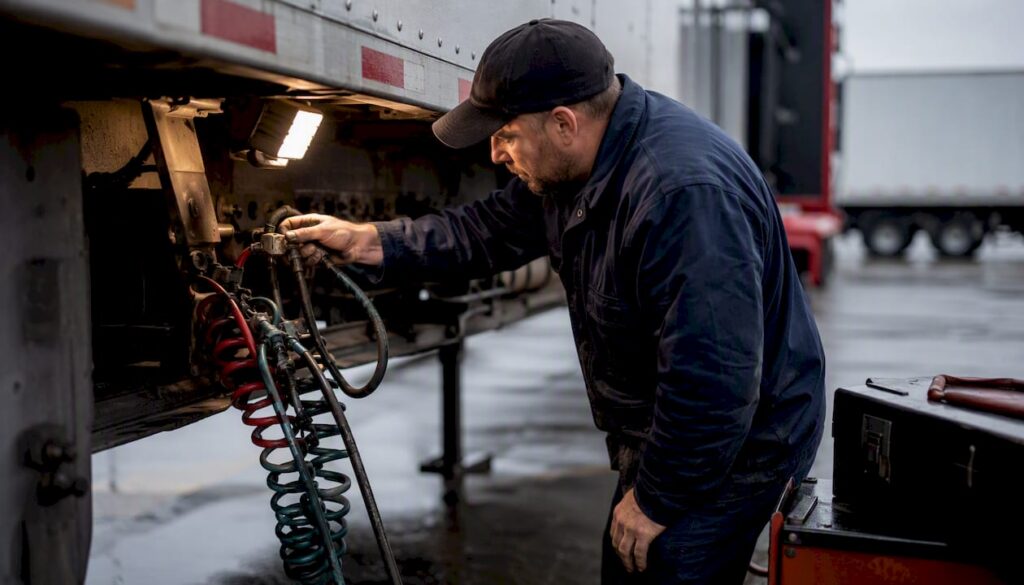
Brakes
- Parts: missing or broken shoes, linings, springs, anchor pins, spiders, cam rollers, pushrods or chamber mounting bolts fail.
- Leaks: any audible leak at a chamber, hose or tubing fails.
- Lining: on trailer axles, air drum lining under 1/4 inch at the shoe center fails, and air disc lining under 1/8 inch fails.
- Stroke: any pushrod stroke past the readjustment limit fails, measured with reservoir pressure at 80 to 90 psi and the brakes fully applied.
- ABS and breakaway: a trailer ABS warning lamp that does not cycle when power is applied fails, as does a missing or inoperable breakaway device on electric brakes.
Pro Tip: Measure stroke on every chamber, not just the one that looks long. Slack adjusters that keep drifting out of adjustment are a symptom, so have a technician find the cause instead of backing them off by hand.
Tires and wheels
A trailer tire fails with less than 2/32 inch of tread at any point on a major groove. It also fails if it is flat or leaking, shows ply or belt material, has a separation or a cut into the ply, rubs the vehicle, or is marked “Not for highway use.” On the wheel, cracks, elongated bolt holes, a bent or poorly seated lock ring, or loose, broken or stripped fasteners fail.
Coupling devices
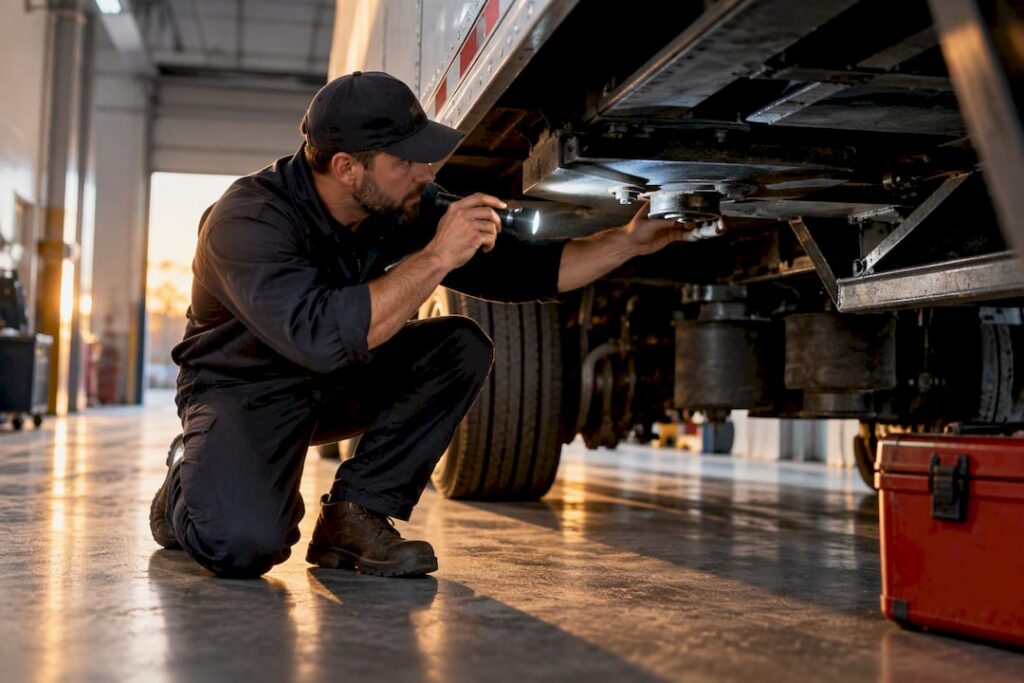
Inspect the combination together. A kingpin not properly engaged fails, as does more than 1/2 inch of horizontal movement between the fifth wheel halves. On a drawbar or towbar, cracks, missing fasteners, an eye worn more than 20% or more than 1/4 inch of slider movement fail. Safety chains and hooks fail once wear measurably reduces the link, and repairs made with welding, wire, rope or tape are rejected.
Lighting and reflectors
Every lighting device and reflector required by Part 393 must work. Walk the trailer with the stop lamps, turn signals, four-ways, clearance and marker lamps on, and look at the reflectors while you are there.
Suspension, frame and rear impact guard
Cracked, loose or missing U-bolts, spring hangers or axle positioning parts fail, along with broken spring leaves and a deflated air suspension. On the frame, cracked or sagging members and loose fasteners fail. Check sliding tandems closely: locking pins missing or not engaged is a listed defect. Trailers built on or after January 26, 1998 also need a sound rear impact guard.
The numbers that fail trailers most often, in one place:
| Check | Fails when |
|---|---|
| Air drum brake lining | Under 1/4 inch at the shoe center |
| Air disc brake lining | Under 1/8 inch |
| Type 30 clamp chamber, standard stroke | Past the 2 inch readjustment limit |
| Type 24 clamp chamber, standard stroke | Past the 1 3/4 inch readjustment limit |
| Trailer tire tread | Less than 2/32 inch in a major groove |
| Chamber, hose or tubing | Any audible air leak |
Does the Massachusetts Inspection Count as the DOT Annual?
According to the Mass.gov vehicle inspections page, every vehicle registered in Massachusetts must pass a yearly inspection, and the Massachusetts Commercial Motor Vehicle Inspection is equivalent to the annual FMCSA DOT inspection. The vehicle is tested against state and federal requirements at the same time. The state rule, 540 CMR 4.00, names trailers, semi-trailers and converter dollies in its title.
The same page notes that fleets can be tested by mobile inspectors at company lots or by a licensed company employee. Trailers registered in other states still need a current federal annual or a qualifying state inspection. This is general information, not legal advice; the RMV has the final word. Our post on commercial trailer requirements in Massachusetts covers registration and required equipment.
Who Can Perform a DOT Trailer Inspection?
A carrier can inspect its own trailers or use a commercial garage, fleet leasing company or similar business as its agent. Either way, FMCSA’s inspector qualification rule, 49 CFR 396.19, says the inspector must understand Part 393 and Appendix A, know the methods and tools, and qualify through a federal- or state-sponsored program or a combination of training or experience totaling at least one year. The carrier keeps evidence of those qualifications while the person inspects and for one year after, except for inspections done under a state program.
If you cannot document that, a shop that does inspections every week takes the paperwork off your desk. Our look at truck and trailer inspections and why compliance matters covers the roadside side of the picture.
How Do You Prepare a Trailer for Its Annual Inspection?
Most failed annuals are small items nobody fixed because the trailer kept running. A short routine a week or two before the due date catches them.
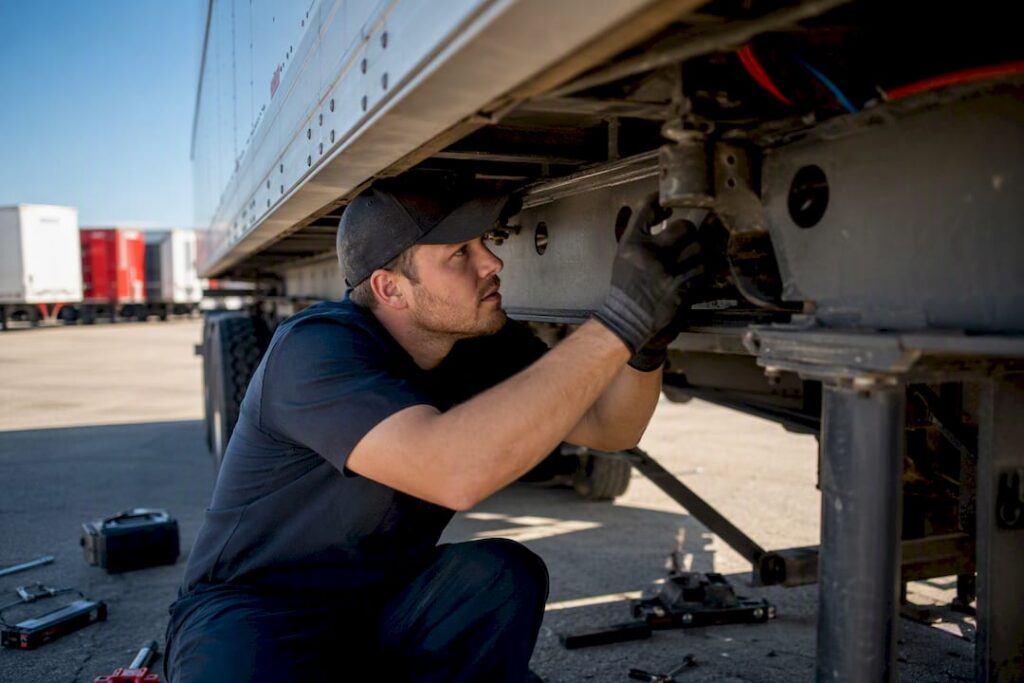
- Pull last year’s report and note anything that was close to the limit.
- Wash the undercarriage. New England road salt hides cracks and corrosion.
- Check brakes at 80 to 90 psi: listen for leaks, measure every stroke, look at lining.
- Gauge every tire in a major groove and check both sidewalls.
- Test every lamp and look at the 7-way plug, where salt and slush cause most lighting faults.
- Walk the frame and suspension for cracks, missing fasteners and slider pins.
- Fix, then inspect, so the trailer passes on the first visit.
Our tractor-trailer maintenance schedule and the guide to keeping trailers roadworthy cover what to check between annuals.
Pro Tip: Schedule annuals for trailers that run all winter in late fall or early spring, when you can see the undercarriage. A trailer caked in February slush is how cracks get missed.
When Should You Call a Technician Instead of Inspecting In-House?
An in-house walk-around is the right first step for every trailer. It is the wrong final step when:
- Nobody on staff meets 396.19. Without documented training or experience, the inspection does not count.
- Brakes keep going out of adjustment. That points to worn cams, bushings or slack adjusters.
- You find a frame or crossmember crack. Structural repairs need the right welding procedure.
- The trailer was bought used or sat in long storage. Treat its first annual as a full baseline.
- You run many units on one cycle. An on-site maintenance program keeps inspections from stacking up.
Apple Truck & Trailer’s truck and trailer service department handles inspections, repairs and on-site fleet maintenance, with 24-hour emergency road service between inspections. To hand off the whole program, full-service truck leasing with contract maintenance is another route.
Key Takeaways
| Point | Details |
|---|---|
| Every unit needs its own annual | Tractor, semitrailer and any full trailer or dolly each need an inspection within the preceding 12 months. |
| Appendix A is the standard | Brakes, coupling, lights, loading, suspension, frame, tires, wheels and the rear guard all apply to trailers. |
| Keep the paper | Keep the report 14 months where the trailer is housed or maintained, and carry the report or a decal. |
| Massachusetts lines up with DOT | The state says its commercial inspection is equivalent to the annual FMCSA DOT inspection. |
| Prep beats re-inspection | Run a DOT inspection trailer walk-around and fix problems before the due date. |
What I’ve Learned From Years of Trailer Inspections
I have spent a long time around trailers on the lot and in the shop, and the pattern does not change much. The trailers that fail are rarely the ones in the worst shape. They are the ones nobody looked under since the last decal went on.
The annual is a floor, not a maintenance plan. Passing tells you the trailer met the minimum on that day. Fleets that treat it as one checkpoint in a regular program spend less time at the roadside and less money on surprise repairs.
How Apple Truck & Trailer Helps With Trailer Inspections
Apple Truck & Trailer has served New England fleets since 1986 from 510 Washington St. (Route 20) in Auburn, just outside Worcester. Our truck service team in Massachusetts handles DOT inspection trailer work, Massachusetts state inspections and the repairs that come out of them.
We also offer on-site mobile fleet maintenance, captive shop programs, CNG-experienced technicians and 24-hour emergency road service, and we are an authorized repair agent for GE Fleet, LeasePlan, ARI, Fleet Net, Donlen, Voyage and Enterprise. We serve Massachusetts, Rhode Island, Connecticut and New Hampshire, and if a trailer is past saving, our used truck and trailer sales inventory is right here.
FAQ
Does a trailer need its own DOT inspection?
Yes. Under 49 CFR 396.17, each vehicle in a combination counts, so the tractor, the semitrailer and any full trailer or converter dolly each need their own periodic inspection. An inspection on the tractor does not cover the trailer behind it.
How long is a DOT trailer inspection good for?
Each component must have passed an inspection at least once during the preceding 12 months. Under a qualifying state program, the inspection counts for 12 months from the last day of the month it was performed. Keep the report for 14 months.
What is the minimum tread depth on a trailer tire?
Under the federal periodic inspection standards, a trailer tire fails with less than 2/32 inch of tread at any point on a major tread groove. The 4/32 inch minimum applies to the steering axle of a power unit, not to trailer tires.
Does the Massachusetts inspection replace the DOT annual?
Mass.gov says the Massachusetts Commercial Motor Vehicle Inspection is equivalent to the annual FMCSA DOT inspection, testing the vehicle against state and federal requirements at once. This is general information, not legal advice, so confirm details with the RMV.
Where can I get a DOT trailer inspection near Worcester?
Apple Truck & Trailer in Auburn, MA, on Route 20 just outside Worcester, handles Federal DOT and Massachusetts state inspections for trucks and trailers. We also offer on-site fleet maintenance for fleets with several units. Call (508) 832-0515 to set up a time.
Want your trailers inspected before the due dates stack up? Contact Apple Truck & Trailer or call (508) 832-0515, and our service team will help you plan inspections and repairs for your fleet.