
TL;DR:
- Choosing the right freight container size is crucial to avoid costly operational inefficiencies in Massachusetts fleets. Understanding ISO versus domestic containers and verifying their actual interior dimensions ensures optimal cargo fit and routing flexibility. Accurate assessment of cargo volume, weight, and infrastructure compatibility helps fleet managers make precise container decisions for cost-effective shipping and storage.
Choosing the wrong freight container size is one of the most expensive mistakes a logistics manager can make, yet it happens constantly across fleets in Massachusetts and throughout New England. Most operators assume containers come in a handful of standard sizes that work interchangeably across every shipment and route. That assumption is wrong, and the consequences range from wasted cargo space to missed delivery windows to containers that physically cannot board the rail or ship you planned. This guide breaks down every major container size, explains the critical differences between ISO and domestic units, and gives you a clear framework for matching the right box to the right job.
Table of Contents
- Understanding standard freight container sizes
- ISO versus non-ISO containers: Key differences
- How container size impacts your shipping and storage costs
- Best practices for selecting the right container for your fleet
- What most fleet managers miss about container sizes
- Ready to optimize your fleet’s shipping and storage?
- Frequently asked questions
Key Takeaways
| Point | Details |
|---|---|
| Know major types | ISO and US domestic containers serve different transport needs and routes. |
| Check compliance | ISO containers support international shipping, while domestic 53’s stay within North America. |
| Size impacts cost | Choosing the wrong size can create inefficiency and increased freight costs. |
| Measure and verify | Always check both exterior and interior dimensions for compatibility before booking. |
| Leverage expert advice | Consult logistics professionals and up-to-date resources to optimize your fleet’s container choices. |
Understanding standard freight container sizes
The phrase “standard container” is technically accurate but practically misleading. Yes, the shipping industry uses established measurements, but there are multiple standards at play depending on whether you are moving freight across an ocean, through a rail yard, or down a Massachusetts highway.
The most widely recognized sizes come from the International Organization for Standardization, specifically ISO standards 668 and 1496-1, which define precise exterior dimensions to guarantee global interoperability. These exact external measurements make it possible to stack containers, lock them with twistlocks, and load them onto ships, trucks, and rail cars anywhere in the world. Interior dimensions, however, vary slightly between manufacturers based on wall thickness, flooring material, and corner reinforcement design.
Here is a breakdown of the most common sizes you will encounter:
| Container type | Exterior length | Exterior width | Exterior height | Interior volume (approx.) |
|---|---|---|---|---|
| ISO 20’ standard | 20’ | 8’ | 8’6″ | 1,172 cu ft |
| ISO 40’ standard | 40’ | 8’ | 8’6″ | 2,385 cu ft |
| ISO 40’ high cube | 40’ | 8’ | 9’6″ | 2,660 cu ft |
| ISO 45’ high cube | 45’ | 8’ | 9’6″ | 3,040 cu ft |
| US domestic 53’ | 53’ | 8’6″ | 9’6″ | ~3,400 cu ft |
That last row is where fleet managers operating in North America need to pay close attention. US domestic 53-foot containers have an internal space of roughly 52’6″ x 8’6″ to 9’2″ x 9’ to 9’6″ and are purpose-built for trucking and rail transport within North America. They are not ocean-capable and are not ISO-compliant, but they are incredibly common in Massachusetts intermodal operations.
“Knowing your container’s interior dimensions is just as important as knowing the exterior. A 40-foot high cube and a 40-foot standard container look nearly identical from the outside but can mean the difference between fitting your pallet configuration or not.”
If you are curious about how cargo actually fits inside these units, the details on what fits in a 20-foot container offer a practical starting point for smaller shipment planning.
Another often overlooked factor is freight class determination, which interacts directly with container size. The density and dimensions of your cargo affect freight class, and freight class affects cost. Choosing a container size without understanding your freight class can send your shipping budget in the wrong direction.
ISO versus non-ISO containers: Key differences
With the basics defined, let’s look at the practical differences between ISO and domestic containers and what those differences mean when you are managing a fleet in Massachusetts or shipping goods through Rhode Island, Connecticut, or New Hampshire ports.
ISO containers were designed with a single overarching goal: to move the same physical box from a factory in one country to a warehouse in another without ever unloading the cargo. That requires exact external dimensions that fit ship cell guides, crane spreaders, and chassis twistlock positions worldwide. The ISO 668 and 1496-1 standards govern these dimensions with tolerances measured in millimeters.

Non-ISO domestic containers, particularly the 53-foot units dominant in North American logistics, were designed to a different goal entirely. They maximize capacity within the constraints of US highway width limits and North American rail infrastructure. The extra width (8’6″ versus the 8’ ISO standard) and length give you significantly more usable floor space.
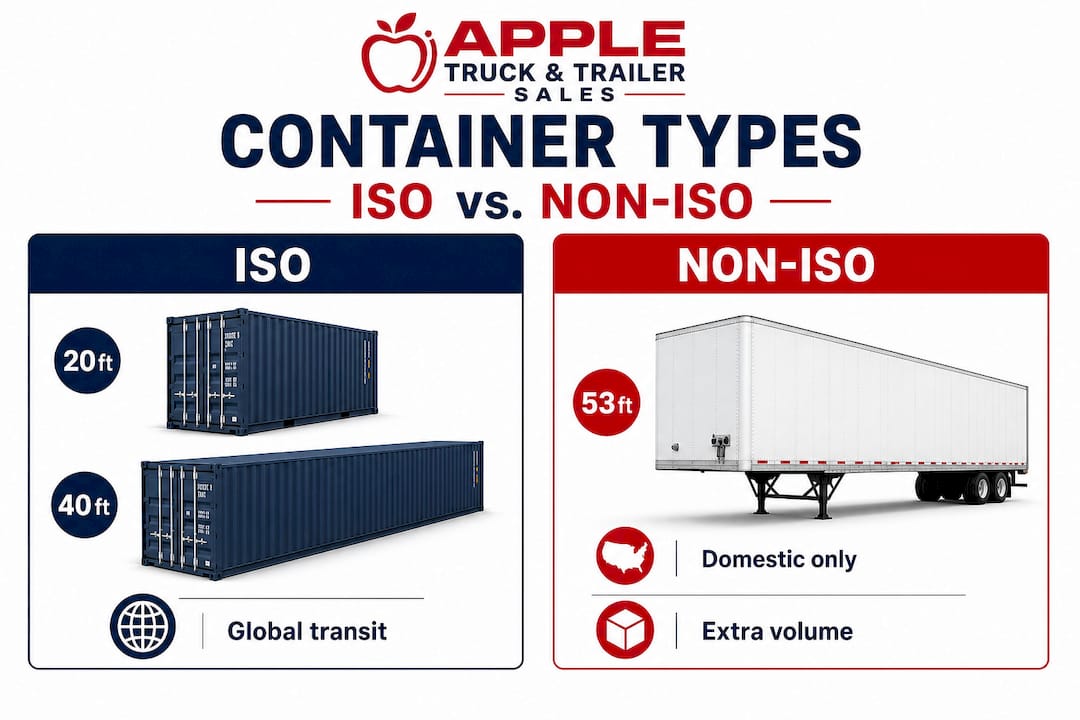
Here is a side-by-side comparison:
| Feature | ISO containers | US domestic 53’ containers |
|---|---|---|
| Ocean-capable | Yes | No |
| Max exterior width | 8’ (or 8’6″ high cube) | 8’6″ |
| Standard lengths | 20’, 40’, 45’ | 53’ |
| Rail-compatible | Yes (specific rail types) | Yes (North American rail) |
| Highway use | Yes | Yes |
| International interoperability | Full | North America only |
| Common New England use | Port of Boston imports/exports | Regional intermodal, distribution |
Key points for Massachusetts fleet operators:
- Port of Boston shipments almost always require ISO-compliant containers when goods are moving internationally
- Regional distribution across New England typically favors 53-foot domestic containers for maximum load efficiency
- Transloading operations, where goods transfer from ocean containers to domestic units, require coordination at facilities like those near Worcester or Springfield
- High cube containers (9’6″ tall) are often overlooked but add meaningful volume for lightweight, bulky cargo like furniture, textiles, or packaged goods
The decision between ISO and non-ISO is not just a size decision; it is a logistics architecture decision. Getting it wrong at the planning stage can mean your container sits at a facility unable to connect to the next leg of its route.
For a deeper look at the practical tradeoffs between different storage and transport units, the container vs trailer storage guide walks through real-world considerations that apply to both short-term storage and active shipping operations.
Following shipping tips for efficiency is especially valuable once you have made the ISO versus domestic decision, since efficiency gains at each stage compound quickly across a full fleet operation.
How container size impacts your shipping and storage costs
Now let’s turn to the heart of the matter. Container size directly affects your costs in at least five concrete ways, and most fleet managers are only tracking one or two of them.
1. Cubic capacity and load optimization
Underloading a container is as expensive as overloading one. A 20-foot ISO container holds roughly 1,172 cubic feet of cargo space. If your shipment only fills 600 cubic feet, you are paying for air. Consolidating two partial 20-foot loads into a single 40-foot unit often reduces cost per unit of cargo significantly.
2. Per-move handling fees
Every time a container is lifted, moved, or repositioned at a terminal, you pay a handling fee. Fewer, larger containers mean fewer handling events. US domestic 53-foot containers, with their expanded interior volume, allow Massachusetts distribution operations to consolidate freight that would otherwise require multiple smaller units.
3. Route flexibility and surcharges
Larger containers can limit your routing options. A 53-foot domestic container cannot go on a ship, period. If your cargo might need to move internationally, locking into non-ISO units creates a hard constraint that can force expensive transloading later.
4. Storage footprint costs
When containers sit on your property or at a third-party yard, you pay by the square foot or by the unit. A 40-foot container takes up twice the footprint of a 20-foot unit, but may hold three times more usable cargo with smart loading. Understanding Massachusetts container storage options helps you plan footprint costs before committing to a container mix.
5. Drayage and last-mile costs
Drayage refers to the short-distance trucking that moves containers between ports, rail yards, and final destinations. Longer containers require specialized chassis and sometimes route approvals for certain roads. In dense urban areas like Boston or Providence, a 53-foot container can create serious last-mile complications that a 40-foot ISO unit avoids entirely.
Pro Tip: Before committing to a container size for a recurring shipping lane, run a 90-day cost analysis comparing total per-unit cost across at least two container size options. Include handling fees, drayage, and any transloading costs, not just the base freight rate.
Studies in North American freight operations consistently show that cargo that is poorly matched to container size can inflate per-unit shipping costs by 15 to 30 percent, simply through wasted volume and extra handling. Reviewing strategies to cut costs in freight can reveal additional savings once your container sizing is dialed in.
Looking at shipping container storage solutions can also help you find temporary or long-term storage options that reduce drayage frequency by keeping inventory closer to your distribution points.
Best practices for selecting the right container for your fleet
Armed with cost and operations insights, here is a practical framework for making better container decisions consistently.
Assess cargo before choosing the box
The most common mistake is choosing a container based on what you have available rather than what your cargo actually needs. Before ordering or reserving any container, answer these questions:
- What is the total cubic volume of this shipment?
- What is the weight per pallet, and how many pallets are there?
- Does the cargo require special clearance height (think HVAC units, machinery, or racked goods)?
- Will this container need to move internationally at any point during its lifecycle?
Check regional infrastructure compatibility
Massachusetts, Rhode Island, Connecticut, and New Hampshire each have specific port facilities, rail yards, and road regulations that affect container size choices. Not every terminal in the region accepts 53-foot containers, and some rural routes have bridge or weight restrictions that favor 40-foot ISO units. Always verify compatibility with your carrier before booking.
Verify twistlock and chassis compatibility
ISO containers use standardized corner castings that fit twistlock mechanisms universally. Domestic containers use different configurations. If your fleet uses a mix of ISO and domestic equipment, confirm that your chassis inventory matches the container type you plan to move.
Plan for loading and unloading conditions
A high cube container is ideal for volume, but if your receiving dock has a fixed height clearance, that extra foot of container height becomes a problem. Measure dock heights, door widths, and turning radii at both origin and destination before finalizing your container type.
Build in a dimensional margin
ISO standard dimensions define exterior specs precisely, but interior dimensions can vary by up to two or three inches depending on manufacturer and flooring type. If your pallet configuration requires exact fit, always verify interior specs with your equipment provider rather than assuming.
Pro Tip: Ask your container supplier for the actual interior dimensions of the specific units you are receiving, not just the nominal size. This is especially important for maximizing storage space when you are running a tight pallet layout.
For fleet operations that need flexible positioning across multiple job sites or seasonal storage needs, mobile storage for fleets offers options that bring the container to your cargo rather than the other way around.
What most fleet managers miss about container sizes
Here is something that manufacturer spec sheets will not tell you. The real risk in container sizing is not picking the wrong length. It is underestimating how small dimensional differences cascade into operational failures.
We have seen this pattern repeatedly over decades in the New England freight market. A logistics manager specifies a 40-foot high cube for a shipment of industrial shelving. The container arrives, and the shelving units are half an inch too tall to fit through the door opening (which is shorter than the container’s internal height). The entire load has to be broken down and repacked. That half-inch difference costs eight hours of labor and a missed delivery window.
Floor thickness is another underestimated variable. Bamboo flooring, steel flooring, and composite flooring can vary by an inch or more in thickness, reducing usable internal height for floor-level cargo. Nobody mentions this until a forklift cannot clear a load.
Door width matters more than people realize too, particularly for any cargo that moves on pallets wider than standard grocery pallets. If you are shipping oversized industrial goods or equipment components, verify door opening dimensions, not just internal width.
The most experienced fleet operators we work with treat container specs the way pilots treat preflight checklists. Every single shipment gets verified against actual container specs, not assumed standard dimensions. For practical guidance on 40-foot container use, including tips that account for these real-world variances, it is worth reviewing before your next booking.
The uncomfortable truth is that treating containers as commodities is a management shortcut that consistently produces expensive exceptions. The operators who run the tightest, most cost-efficient fleets are the ones who treat container selection as a precision decision, every time.
Ready to optimize your fleet’s shipping and storage?
With a better understanding of freight container sizes, you are equipped to make smarter decisions for every shipment and storage need across your operation.
At Apple Truck & Trailer, we have been helping fleet owners and logistics managers across Massachusetts, Rhode Island, Connecticut, and New Hampshire find the right equipment since 1986. Whether you need to review available truck and trailer sales options, source secure storage containers for your yard, or get guidance on buying a used commercial truck that fits your routes and load requirements, our team brings real regional expertise to every conversation. Reach out today and let’s match the right equipment to your actual operational needs, not a generic catalog spec.
Frequently asked questions
What are the most common freight container sizes used in Massachusetts?
The most common are ISO 20-foot, 40-foot, and domestic 53-foot containers, with 53-foot units especially prevalent for rail and truck intermodal transport across the region.
Can I use US domestic 53’ containers for international shipping?
No, US domestic 53-foot containers are not ISO-compliant and are designed exclusively for North American rail and road transport, not ocean shipping.
Why do interior dimensions vary between containers of the same type?
Interior sizes differ slightly due to manufacturer-specific wall thickness, flooring material, and corner reinforcement, even when exterior measurements fully comply with ISO standards.
How do I determine the right container size for my cargo?
Match container size to your cargo’s total cubic volume, weight distribution, pallet configuration, and intended transport mode, then verify actual interior specs with your equipment provider before committing.