
TL;DR:
- Regular, detailed maintenance checklists prevent costly breakdowns, especially in harsh New England winters.
- Oversights like air filters, brake lines, and lighting are common causes of preventable failures.
- Proper documentation and proactive inspections are essential for regulatory compliance and fleet reliability.
A single overlooked air filter or a corroded brake line can sideline an 80,000-pound rig, costing your operation thousands in towing fees, missed loads, and rushed repairs. For fleet operators running routes through Massachusetts, Rhode Island, Connecticut, and New Hampshire, the stakes are even higher. Road salt, freeze-thaw cycles, and brutal nor’easters punish every component on your trucks far faster than in milder climates. Overlooked items like air filters, brake lines, fluids, suspension, and lighting are consistently responsible for preventable failures. A solid semi truck maintenance checklist is your first and most reliable line of defense.
Table of Contents
- Why a comprehensive maintenance checklist matters
- Core daily and weekly maintenance: What to check
- Monthly and seasonal tasks: Preparing for New England weather
- Tracking and documenting maintenance for compliance and uptime
- The uncomfortable truth: Most fleets overlook crucial details
- Boost your fleet’s reliability with expert support
- Frequently asked questions
Key Takeaways
| Point | Details |
|---|---|
| Checklists prevent breakdowns | A consistent maintenance checklist catches overlooked issues before they become costly failures. |
| Salt and weather accelerate wear | New England conditions demand more frequent inspection of suspension, air systems, and lighting. |
| Document for compliance | Proper record-keeping ensures legal compliance and keeps fleets running efficiently. |
| Automate alerts | Digital reminders and logbooks help fleets stay ahead of maintenance deadlines. |
Why a comprehensive maintenance checklist matters
Most fleet operators understand that maintenance is important. What too many underestimate is just how specific and structured that maintenance needs to be. A semi truck maintenance checklist is not simply a reminder to change the oil. It is a systematic document that covers every critical system on the vehicle, from the engine and drivetrain to lighting, tires, suspension, and frame integrity. When used consistently, a checklist turns reactive fire-fighting into proactive fleet management.
The risks of skipping or rushing through inspections are significant. A brake system that is checked only when a driver reports a problem is a brake system waiting to fail on I-93 during rush hour. Suspension components that are never inspected for cracks or wear will eventually fail under heavy load, especially on Massachusetts roads that absorb brutal winters year after year. Understanding preventive maintenance benefits is not just about avoiding breakdowns; it directly affects your insurance costs, driver safety records, and customer satisfaction.
New England presents challenges that fleet operators in warmer states simply do not face at the same frequency or severity. Road salt is the silent killer of truck components. From October through April, state and municipal crews apply thousands of tons of salt across highways and secondary roads in Massachusetts alone. That salt works its way into undercarriage components, brake lines, electrical connectors, and frame welds. Over time, it accelerates rust and corrosion at a pace that can be startling if you are inspecting a truck that was never properly cleaned and treated. New England roads and salt accelerate wear and tear, making regular maintenance not just a best practice but an operational necessity.
Here is what a well-structured checklist protects against:
- Unexpected roadside breakdowns that disrupt delivery schedules
- Federal Motor Carrier Safety Administration (FMCSA) violations from out-of-service defects
- Accelerated wear from salt, moisture, and pothole-damaged roads
- Insurance claim spikes from preventable accidents
- Costly engine or drivetrain failures caused by fluid neglect
“Consistent, documented inspections are what separate fleets that run efficiently for years from those that are constantly fighting fires. In New England, the margin for neglect is even thinner than in other regions.”
The financial math is also straightforward. A thorough pre-trip inspection costs your team perhaps 30 minutes per truck per day. A blown turbocharger from dirty oil, or a wheel-off incident from worn hub components, can cost tens of thousands of dollars and take a truck out of service for weeks. Understanding the value of regular truck service and building it into your operation is one of the most profitable decisions any fleet manager can make.
Core daily and weekly maintenance: What to check
Now that the value of a checklist is clear, what does an effective daily and weekly routine actually look like in practice? The answer involves more than a quick walk-around. It requires a structured approach that covers the systems most likely to fail and most likely to go unnoticed until they cause a problem.
Air filters, brake lines, and lighting are among the most overlooked daily and weekly items, contributing to a significant portion of preventable failures. A clogged air filter alone can reduce engine performance and fuel efficiency by measurable margins. Dimmed or failed marker lights are a citation waiting to happen at any weigh station in Massachusetts.
Here is a prioritized list of what your drivers and maintenance team should check on a daily and weekly basis:
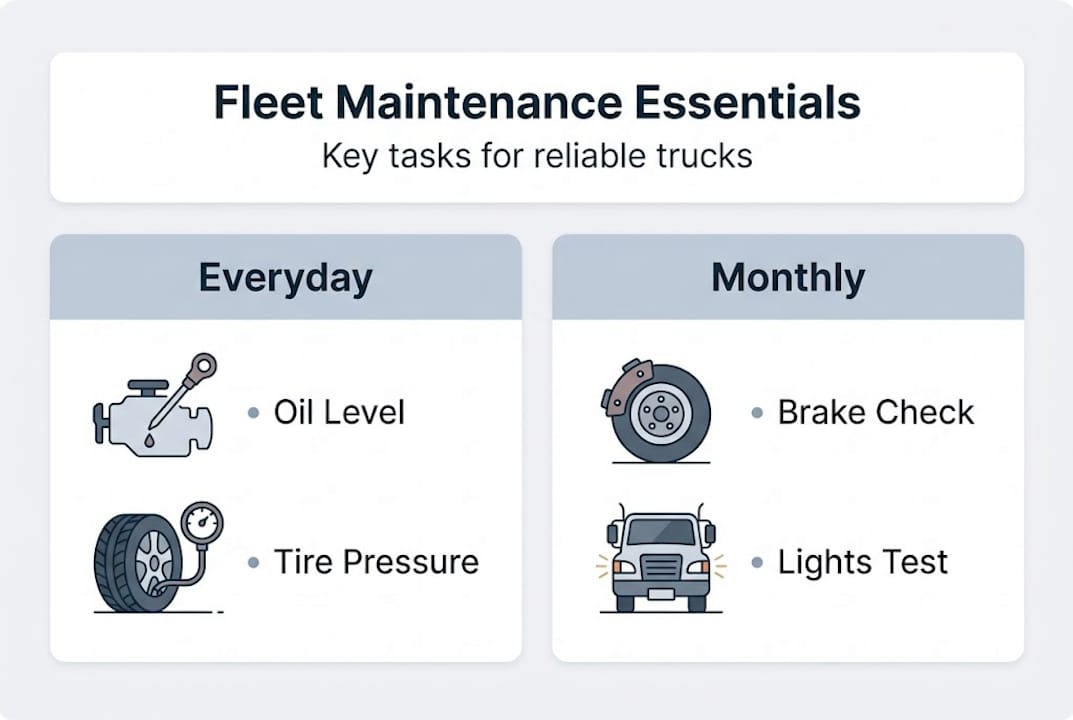
- Engine oil level and color — Check daily before startup. Dark, gritty oil is a red flag even between scheduled changes.
- Coolant level — Low coolant is one of the fastest paths to catastrophic engine damage. Check daily in cold weather.
- Brake fluid reservoir — A low reservoir indicates either a leak or worn brake pads. Never ignore this.
- Tire pressure and tread depth — Pressure fluctuates with temperature, especially in New England winters. Check every morning.
- Air filter condition — A visual inspection weekly is the minimum; replace when restriction indicators show.
- All lighting systems — Headlights, brake lights, turn signals, and marker lights. Failed lights are one of the top FMCSA out-of-service violations.
- Windshield wipers and washer fluid — Critical for visibility in New England rain, snow, and sleet conditions.
- Fifth wheel connection — Inspect daily for proper lubrication, locking, and wear.
- Belts and hoses — Weekly visual checks for cracking, fraying, or swelling.
- Suspension components — Look for visible cracks, worn bushings, and leaking shock absorbers weekly.
| Task | Daily | Weekly |
|---|---|---|
| Engine oil level | Yes | Yes |
| Coolant check | Yes | Yes |
| Tire pressure | Yes | Yes |
| Lighting inspection | Yes | Yes |
| Air filter inspection | No | Yes |
| Belts and hoses | No | Yes |
| Brake fluid | Yes | Yes |
| Fifth wheel lubrication | Yes | Yes |
| Suspension visual | No | Yes |
| Wiper condition | No | Yes |
Pro Tip: Use a fleet management app like Fleetio or a simple shared spreadsheet to log daily inspections. Set automated reminders for weekly tasks so nothing slips through the cracks during busy periods. Digital records also protect you during FMCSA audits.
For a more thorough breakdown with printable formats, the detailed maintenance checklist at Apple Truck and Trailer covers each system with the specificity your team needs. Pairing it with a solid maintenance schedule ensures nothing falls through the cracks week to week.
Monthly and seasonal tasks: Preparing for New England weather
Beyond daily and weekly tasks, monthly and seasonal maintenance is your defense against the region’s toughest conditions. This is where many fleets fall short because monthly tasks feel less urgent until the moment they become emergencies.
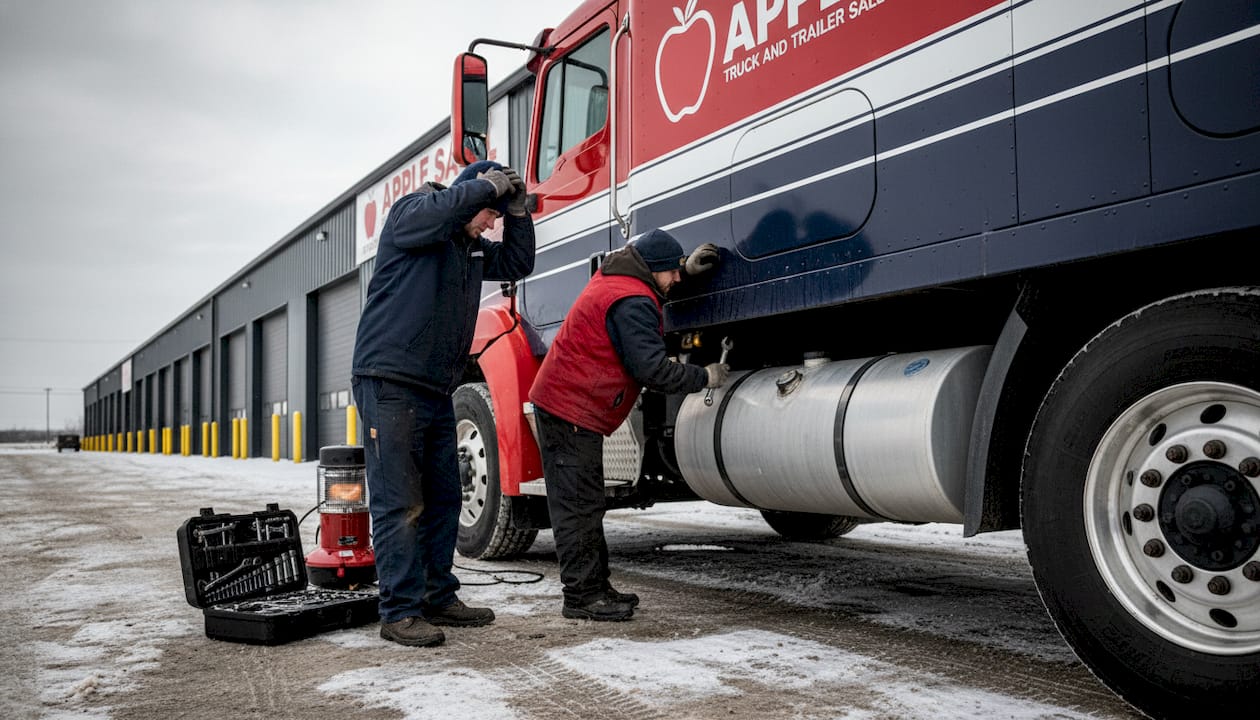
Salt and variable weather in New England require more frequent inspection of suspension, undercarriage, and lighting systems than the standard manufacturer schedule recommends. Manufacturers typically design maintenance intervals for average conditions. Massachusetts in February is not average conditions.
Monthly and seasonal priorities should include:
- Undercarriage wash and inspection — Salt accumulation on frame rails, crossmembers, and brake lines is a serious corrosion risk. Power wash the undercarriage monthly during winter and inspect every surface for rust formation.
- Brake system inspection — Go beyond fluid levels. Check brake drums or rotors, brake shoes or pads, S-cams, and slack adjusters every month.
- Frame and body integrity — Look for cracked welds, loose fasteners, and rust-through spots, especially in areas where water tends to pool.
- Electrical connectors and wiring harnesses — Moisture and salt attack connectors throughout the undercarriage. Inspect for corrosion, bare wiring, and loose connections monthly.
- Battery and charging system — Cold temperatures dramatically reduce battery capacity. Test batteries and alternators before winter and again in early spring.
- Exhaust system — Check for cracks, leaks, and mounting integrity, especially after rough winter roads.
| Interval | Task | Notes |
|---|---|---|
| Monthly | Undercarriage wash and inspection | Critical from October through April |
| Monthly | Brake system detailed check | Drums, shoes, cams, adjusters |
| Monthly | Electrical connector inspection | Focus on undercarriage harnesses |
| Monthly | Battery and charging system test | Test before and after winter |
| Seasonal (fall) | Coolant freeze point check | Use a refractometer |
| Seasonal (fall) | Winter tire changeover or inspection | Check tread depth against winter minimums |
| Seasonal (spring) | Frame rust and weld inspection | Assess winter salt damage |
| Seasonal (spring) | Complete suspension overhaul inspection | Leaf springs, air bags, bushings |
Pro Tip: Apply dielectric grease to all lighting connectors and junction boxes during fall seasonal prep. This simple step, which takes less than an hour per truck, dramatically reduces moisture intrusion and corrosion in wiring harnesses over the winter months.
Getting ahead of winter conditions is not optional for New England fleets. Detailed guidance on winter fleet preparedness can help you build a complete pre-season protocol. For operators managing multiple trucks, region-specific fleet efficiency advice is equally valuable for planning your seasonal transitions.
Tracking and documenting maintenance for compliance and uptime
Every checklist task is only as powerful as its documentation. Here is where many otherwise disciplined fleets stumble. A driver might perform a thorough pre-trip inspection every single morning, but if there is no record of it, it effectively did not happen in the eyes of a federal auditor or an insurance adjuster.
Systematic record-keeping prevents missing overlooked items and supports compliance with both FMCSA regulations and Massachusetts Department of Transportation requirements. Under FMCSA rules, motor carriers must retain driver vehicle inspection reports (DVIRs) for at least three months. Maintenance records must be kept for the period of vehicle operation plus six months. These are minimums; most compliance experts recommend keeping detailed records for two to three years.
Effective documentation tools and strategies include:
- Electronic logging devices (ELDs) — Many modern ELDs integrate with maintenance tracking modules that automatically flag upcoming service intervals based on mileage or engine hours.
- Fleet management software — Platforms like Samsara, Fleetio, or KeepTruckin allow you to build digital checklists, assign tasks to specific drivers or mechanics, and generate reports for audits.
- Paper DVIRs with digital backup — Some smaller fleets use paper forms and scan them into a shared cloud folder. It is not as seamless but works if done consistently.
- Maintenance work order systems — Every repair, inspection, and service should generate a work order with the date, technician, parts used, and mileage at time of service.
- Scheduled review meetings — Monthly reviews of maintenance records across the fleet help identify patterns, like a specific truck that keeps burning through brake shoes, before they escalate.
Pro Tip: Set calendar-based automated alerts in your fleet software for every recurring maintenance interval across your entire fleet. Instead of relying on someone remembering that a specific truck is due for its monthly brake inspection, the system surfaces it automatically. This single habit has measurable impact on reducing fleet downtime across operations of all sizes.
Understanding what records to keep and how to structure them is a foundational piece of sound operations. If you are building or rebuilding your documentation system, starting with a clear fleet maintenance guide gives you a framework that scales as your fleet grows.
Compliance is not just about avoiding fines, though those can be substantial. Well-documented maintenance history also adds real monetary value to your trucks when you sell or trade them. A truck with complete service records commands a meaningfully higher resale price than one with spotty paperwork.
The uncomfortable truth: Most fleets overlook crucial details
Here is something we see consistently after decades of working with fleet operators across Massachusetts and New England. Most breakdowns are not caused by exotic failures or unpredictable mechanical events. They are caused by the same handful of systems that get deprioritized when schedules are tight and drivers are under pressure to keep moving.
Lighting, suspension, and air and brake lines consistently go unchecked, leading to the majority of preventable breakdowns in the region. Every fleet manager we talk to knows this. The problem is rarely knowledge. It is culture and accountability.
When a checklist is just a form drivers sign at the end of a shift, it becomes meaningless paperwork fast. The fleets that actually avoid breakdowns are the ones where maintenance culture is built into every level of the operation, from ownership down to the shop floor. Drivers who feel ownership over their pre-trip routine actually do the inspection. Mechanics who have clear expectations and the right tools actually flag problems before they become failures.
Our candid advice: check your lighting and suspension far more often than you currently do. Then check who is actually doing the inspection versus who is signing the form. Those two things are not always the same person doing the same job. Building on semi trailer basics knowledge is a good starting point for any operator looking to strengthen their team’s mechanical awareness.
Boost your fleet’s reliability with expert support
At Apple Truck and Trailer, we have supported fleet operators across Massachusetts, Rhode Island, Connecticut, and New Hampshire since 1986. We understand that keeping your trucks on the road is your business, and we have built our services around that reality.
Whether you are looking to upgrade aging equipment through truck and trailer sales, research the right vehicle with our guide on buying a used commercial truck, or build a reliable maintenance schedule for your existing fleet, we are here to help you make smarter decisions. Our team brings real-world experience to every conversation, and our inventory and resources are built specifically for operators in this region.
Frequently asked questions
What are the most commonly overlooked items on a semi truck checklist?
Fleet operators most frequently miss air filters, brake lines and fluids, suspension components, and lighting systems, particularly in New England where salt and harsh weather accelerate wear on these exact components.
How does New England weather affect semi truck maintenance?
Road salt, moisture, and temperature swings cause accelerated corrosion and wear on undercarriage components, wiring, and brake systems, making monthly inspections essential rather than optional in this region.
What documentation is needed for semi truck maintenance compliance in Massachusetts?
Federal and state regulations require organized logs of all driver vehicle inspection reports and maintenance activities, with systematic record-keeping being essential for both FMCSA audits and commercial liability defense.
How can fleets reduce downtime due to maintenance issues?
Routine daily and weekly checks, timely repairs, and digital tracking tools help fleets catch overlooked items early, preventing the kind of catastrophic failures that pull trucks out of service for days or weeks at a time.
Recommended
- 2025 Truck Maintenance Checklist for Businesses and Fleets – Apple Truck & Trailer
- How to Reduce Downtime for Commercial Truck Fleets – Apple Truck & Trailer
- Benefits of Preventive Maintenance for Truck Fleets – Apple Truck & Trailer
- Tractor Trailer Maintenance Schedule: Maximizing Uptime – Apple Truck & Trailer