
TL;DR:
- Choosing the correct trailer type depends on cargo height, weight, route, and site conditions.
- Massachusetts regulations require careful planning to avoid permits, fines, and delays during transport.
- Operational efficiency benefits from cargo-based trailer selection, early route consultation, and driver training.
Picking the wrong trailer type doesn’t just create a logistical headache. It can trigger permit violations, generate costly fines, delay delivery schedules, and put your drivers at risk on Massachusetts roads. Fleet operators and logistics managers in New England face a layered set of challenges: variable cargo dimensions, strict state weight limits, dense urban corridors, and a wide variety of specialized trailer configurations. This guide cuts through the confusion, breaking down the most important 18 wheeler trailer types and giving you a clear, actionable framework for matching each trailer to your cargo, route, and compliance requirements.
Table of Contents
- Common 18 wheeler trailer types explained
- When to choose flatbed, step deck, or lowboy trailers?
- Massachusetts regulations: dimensions, legal limits, and permit triggers
- Practical tips for optimizing trailer selection
- A fleet manager’s take: What we’ve learned from thousands of hauls
- Explore smart trailer solutions for Massachusetts fleets
- Frequently asked questions
Key Takeaways
| Point | Details |
|---|---|
| Know your trailer types | Flatbed, step deck, and lowboy each serve specific cargo and compliance needs. |
| Watch state legal limits | Massachusetts trailer rules dictate when you need a permit or special planning. |
| Choose the right fit | The best trailer type depends on your load’s height, weight, and route. |
| Plan for real-world conditions | Situational factors often matter more than technical specs or standard checklists. |
Common 18 wheeler trailer types explained
With the importance of choosing the right trailer established, let’s break down the major types and their core features.
The three workhorses of heavy freight transport are flatbeds, step decks, and the lowboy family (which includes double-drops and removable gooseneck trailers, or RGNs). Each has a distinct physical design that determines what cargo it can carry, how that cargo gets loaded, and whether a particular route will require special permits.
Flatbed trailers are the most recognized open-deck option in the industry. Flatbed trailers are open-deck, meaning they have no sides or roof, which makes multi-directional loading possible using forklifts, cranes, or side loaders. This design shines when you’re moving structural steel, lumber, precast concrete, or agricultural equipment. The tradeoff is exposure. Without sidewalls or a roof, cargo must be secured with straps, chains, and tarps, adding labor time and requiring a properly trained crew. Flatbeds also sit at a deck height of roughly 58 to 62 inches above the ground, which limits the total freight height you can legally transport without a permit.
Step deck trailers, also called drop deck trailers, solve the height problem that limits flatbeds. Step deck trailers have two deck levels; the lower rear deck allows taller freight than a standard flatbed can accommodate while still targeting legal height constraints. The upper front deck sits over the tractor’s fifth wheel, while the rear deck drops down to approximately 35 to 40 inches off the ground. That lower rear deck creates critical clearance for cargo that would otherwise exceed the 13-foot-6-inch legal height limit. Think of machinery with protruding components, industrial HVAC units, or modular construction panels.
Lowboy trailers take the concept even further. Within this category, you have standard lowboys, double-drops, and the RGN configuration. Lowboys, double-drops, and RGNs are the ultra-low deck family used for very tall and heavy equipment. An RGN is particularly valuable because it features a removable, detachable gooseneck that enables drive-on loading directly from ground level. That means a bulldozer, excavator, or large generator can simply roll onto the trailer bed without cranes or ramps. The double-drop lowboy gets its ultra-low center deck by dropping in front of and behind the rear axle group, maximizing vertical clearance for freight that towers above everything a flatbed or step deck can handle.
You can explore available trailer options in Massachusetts to see current inventory across these categories.
| Trailer type | Deck height | Max freight height (approx.) | Best for |
|---|---|---|---|
| Flatbed | 58-62 inches | 8.5 feet | Lumber, steel, machinery |
| Step deck | 35-40 inches (rear) | 10+ feet | Tall equipment, construction materials |
| Lowboy/RGN | 18-24 inches | 11.5+ feet | Excavators, transformers, large structures |
Understanding flatbed trailer use cases helps contextualize why each configuration commands a different niche in heavy equipment logistics.
When to choose flatbed, step deck, or lowboy trailers?
Knowing what distinguishes each trailer, the next step is understanding which jobs fit which trailer and where operational details matter most.
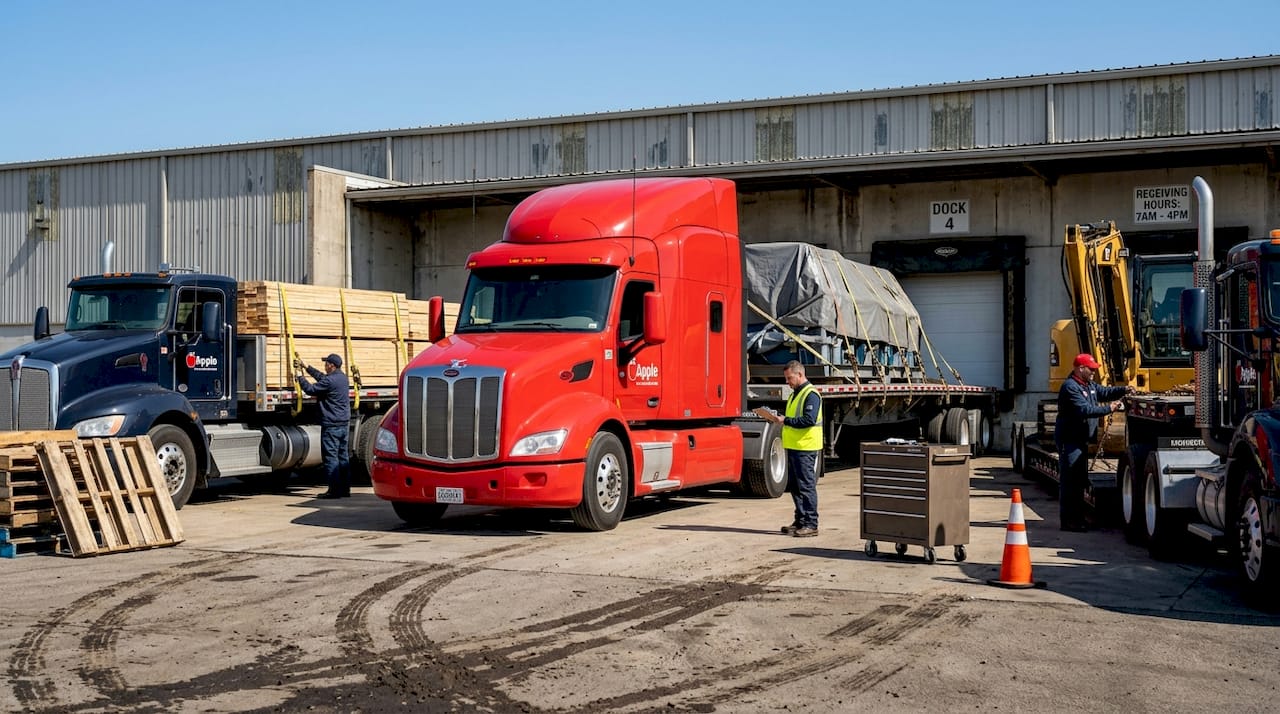
Matching trailer to cargo requires more than eyeballing the dimensions. You need to think about loading site conditions, route restrictions, and where your freight sits after it’s secured. Here’s a practical breakdown for real-world decision making.
Choosing between flatbed, step deck, and lowboy comes down to four variables:
Cargo height. Measure from the road surface to the highest point of your loaded cargo. If you’re near or above 13 feet 6 inches with a flatbed, a step deck will buy you back 18 to 24 inches of clearance. If even a step deck isn’t enough, you’re looking at lowboy territory.
Loading conditions at origin and destination. RGNs require space for the gooseneck to detach and a reasonably level approach so equipment can drive on. If your job site is tight, muddy, or elevated, a fixed-neck lowboy or even a step deck may be the smarter operational call.
Cargo weight distribution. Heavier loads shift the axle math significantly. Understand the safe loading capacity for each trailer before finalizing your equipment choice. An improperly distributed load on a lowboy can put excessive weight on a single axle group and trigger a violation at a weigh station.
Route constraints. Bridge heights, low overpasses, and urban corridors in Massachusetts create real-world limitations. Interstate 93 through Boston, for example, demands careful height planning for any step deck or lowboy load.
Pro Tip: Build a simple cargo spec sheet for every recurring freight type your fleet handles. Include weight, maximum height with securement gear, loading environment, and primary routes. This single tool eliminates most trailer selection errors before they ever become operational problems.
| Criterion | Flatbed | Step deck | Lowboy/RGN |
|---|---|---|---|
| Typical deck height | 58-62 in. | 35-40 in. (rear) | 18-24 in. |
| Max legal height (approx.) | ~8.5 ft | ~10 ft | ~11.5 ft |
| Drive-on loading | No | No | Yes (RGN only) |
| Permit likelihood | Low | Moderate | High |
| Best cargo type | Flat, stable loads | Tall machinery | Oversize heavy equipment |
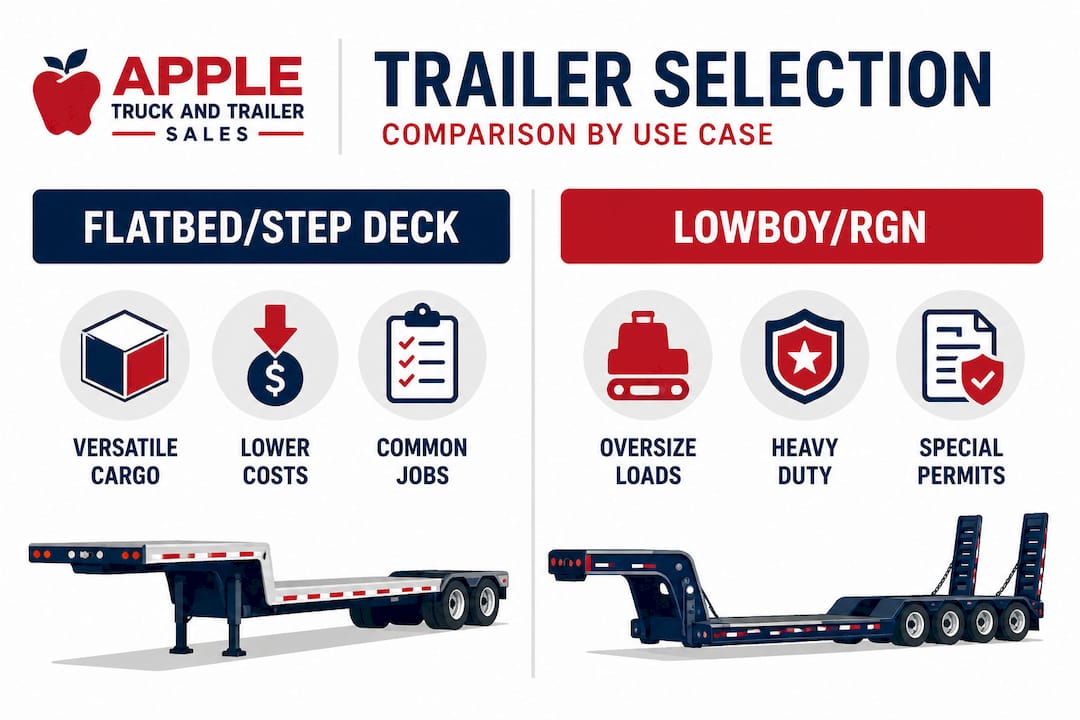
One edge case worth flagging: step deck trailers are often underused for loads that don’t justify the complexity of an RGN’s detachable gooseneck. If your cargo is tall but doesn’t need drive-on access, defaulting to an RGN adds operational steps without adding value. That’s a common and avoidable mistake.
Massachusetts regulations: dimensions, legal limits, and permit triggers
Since every trailer type interacts differently with state rules, understanding Massachusetts’ legal thresholds is critical before making any transportation decision.
Massachusetts has clearly defined legal limits for commercial vehicles operating on its highways. Massachusetts legal limits for interstate semi-trailers are:
- Length: 53 feet (semi-trailer)
- Width: 8 feet 6 inches
- Height: 13 feet 6 inches
- Gross vehicle weight (GVW): 80,000 pounds
Exceed any of these benchmarks and you’re in permit territory. But permits aren’t just paperwork. They require route surveys, pre-approved travel windows, and in some cases, police escorts. Massachusetts oversize permit requirements depend heavily on size and weight thresholds, including specific rules for the Massachusetts Turnpike (I-90) that trigger police escorts when certain width, length, or weight levels are reached.
Here’s what pushes a load from routine to permitted:
- Width over 8 feet 6 inches: Requires an oversize permit. Loads wider than 14 feet typically require police escorts and may restrict movement to daylight hours only.
- Height over 13 feet 6 inches: Route surveys become mandatory. MassDOT must verify bridge and overhead clearances along the entire proposed route before any move is authorized.
- Weight over 80,000 lbs GVW: Axle-by-axle analysis is required. Spreader axles, additional axle groups, and specialized trailer configurations may be needed to keep individual axle weights legal.
- Length over 53 feet (semi-trailer): Generally requires a permit and may restrict nighttime movement or certain roadways.
“Massachusetts Turnpike has specific rules and police escort triggers for certain width, length, and weight levels. Understanding these triggers before dispatching is essential to avoid costly delays and violations.”
The fines for non-compliance are steep, and the ripple effects extend beyond the ticket. A load held at a weigh station while you scramble for an emergency permit means missed delivery windows, damaged client relationships, and potential cargo liability. Considering these compliance requirements in Massachusetts as part of your trailer selection process protects both your bottom line and your operating authority.
Pro Tip: Use the state’s baseline dimension and weight limits as a filter at the beginning of every job. Before you assign a trailer, ask: does this load stay within 53 feet, 8 feet 6 inches, 13 feet 6 inches, and 80,000 pounds? If the answer is no on any dimension, route planning and permit applications should begin immediately, not the day before the move. A well-thought-out safe trailer load strategy saves time, money, and headaches.
Practical tips for optimizing trailer selection
With the complexity of state rules in mind, let’s close out with tested strategies for hassle-free, cost-effective trailer selection in the real world.
Regulatory compliance and trailer performance are only two legs of the stool. The third is operational efficiency: getting the right trailer to the right job without wasted time, backhauls, or miscommunication. Here’s a practical approach to build that efficiency into your fleet operations.
Evaluate cargo, route, and regulations in sequence. Never start with the trailer. Start with the cargo specs, then check your route constraints, and only then select the trailer that satisfies both.
- Measure cargo with securement gear included, not just bare dimensions
- Identify the three most restrictive points along the route (bridges, overpasses, intersections with overhead utilities)
- Cross-reference cargo height plus trailer deck height against Massachusetts’ 13-foot-6-inch limit
- Confirm gross weight with axle distribution before any permit application
Know when to consult MassDOT directly. For non-standard moves, contacting the Massachusetts Department of Transportation early saves significant time. MassDOT can flag route issues before you commit to a schedule, confirm whether a police escort is required, and in some cases offer alternative routes that reduce permit complexity.
Invest in driver and dispatcher training on trailer types. The most expensive trailer mistakes in fleet operations aren’t made by fleet managers sitting at desks. They happen when a dispatcher assigns a flatbed to a job that needs a step deck, or a driver arrives at a job site with an RGN and realizes the approach conditions make drive-on loading impossible. Regular training on trailer capabilities closes that gap.
Build recurring route profiles. If your fleet regularly runs from Massachusetts to Connecticut or Rhode Island, catalog the dimensional restrictions along those corridors. Many New England routes have well-documented low clearance points. Knowing them in advance eliminates last-minute reroutes and keeps your drivers on schedule.
Local truck solutions specifically designed for New England corridors can also reduce operational friction by matching equipment to regional infrastructure from day one. Using the state’s legal baseline dimensions as a planning filter from the start of every job keeps your fleet well within safe operating parameters.
A fleet manager’s take: What we’ve learned from thousands of hauls
After covering regulations and operational best practices, here’s a seasoned perspective on what actually works in the field.
Compliance charts and trailer specification sheets are essential tools. But they don’t tell you the whole story. After years of working with fleet operators across Massachusetts and New England, the patterns we see most often aren’t about ignorance of the rules. They’re about overcomplicating the solution.
The most common mistake we see? Defaulting to RGNs. When a dispatcher or fleet manager knows a load is tall and heavy, the instinct is often to reach for the most capable trailer in the inventory. RGNs are impressive equipment, but they add logistical steps. The gooseneck detach and reattach process requires flat, stable ground at both ends of the move. Not every job site in Massachusetts has that. New England construction and industrial sites frequently present elevation changes, tight clearances, and soft ground conditions that make drive-on loading impractical.
For loads that can’t be safely driven onto a trailer, or where site conditions make drive-on access impossible, a fixed-neck lowboy or a step deck is often operationally simpler than an RGN, even when all three could technically solve the height limitation. The key word here is “operationally.” The best trailer for a job is the simplest one that gets the freight there legally and safely. Complexity is a cost.
Veteran fleet managers develop what we’d call a practical hierarchy. They start with the simplest trailer that fits legal dimensions. They move up to a step deck only when height demands it. They reach for a lowboy or RGN only when nothing else will work and when site conditions actually support that equipment. This mindset reduces driver stress, cuts permit costs, and keeps job site logistics predictable.
Our advice: build your trailer selection logic from the cargo up, not from the equipment down. Explore your options for regional trailer selection with that philosophy in mind, and you’ll make fewer expensive mistakes.
Explore smart trailer solutions for Massachusetts fleets
For those ready to upgrade their fleet or seeking personalized help, here’s how you can leverage local expertise and inventory.
At Apple Truck & Trailer, we’ve been helping Massachusetts fleet operators, logistics managers, and transportation companies make smart equipment decisions since 1986. Our team understands Massachusetts’ specific regulatory landscape, New England’s infrastructure challenges, and the real-world operational pressures you face every day.
Whether you need to understand trailer specifications before committing to a purchase, want to explore used commercial trucks and trailers in our current inventory, or are considering flatbed trailer leasing as a flexible alternative to ownership, our team is ready to help you find the right fit. Partnering with a local Massachusetts dealer means you get compliance-aware guidance, not generic national advice. Request a quote or contact us today to match your next load to exactly the right trailer.
Frequently asked questions
What is the legal length of an 18 wheeler semi-trailer in Massachusetts?
The legal semi-trailer length in Massachusetts is 53 feet for interstate routes. Exceeding this requires a special oversize permit before any move can be made.
When do I need a special permit for oversized loads in Massachusetts?
You need a special permit when your load exceeds any legal dimension or weight threshold. Massachusetts permit requirements are based on size and weight thresholds that also determine whether police escorts or specific travel windows apply.
How do flatbeds compare to step decks for tall cargo?
Step deck trailers allow taller freight than flatbeds because their lower rear deck reduces the total loaded height, keeping more loads within legal limits without requiring height permits.
What makes a removable gooseneck (RGN) trailer unique?
RGN trailers feature a detachable front gooseneck that allows heavy, self-propelled equipment to drive directly onto the trailer bed from ground level, eliminating the need for cranes or external ramps at job sites with suitable approach conditions.