
Many fleet managers believe trailer load capacity is simply the weight listed on a sticker, but this oversimplification leads to costly mistakes. Understanding true load limits requires knowledge of multiple rating systems, legal requirements, and operational factors that vary by state and trailer type. Getting it wrong risks safety incidents, regulatory fines, equipment damage, and operational downtime. This guide clarifies the essential concepts behind trailer load capacity, explains Massachusetts and regional compliance requirements, compares trailer types for optimal selection, and provides actionable best practices to keep your fleet safe, legal, and efficient.
Table of Contents
- Key takeaways
- Understanding trailer load capacity basics
- Legal and safety regulations for trailer loading in Massachusetts and neighboring states
- Comparing trailer types and their load capacities for optimal fleet selection
- Best practices for managing trailer load capacity effectively
- Optimize your fleet with the right trailers today
- Frequently asked questions
Key Takeaways
| Point | Details |
|---|---|
| GVWR and payload | GVWR is the primary capacity indicator, and payload equals GVWR minus the trailer’s curb weight. |
| Rating limit factors | Axle weight ratings, tire load ratings, hitch and coupling ratings, and frame or suspension limits all cap what you can haul, and the lowest applicable limit determines the safe capacity. |
| Weigh before hauls | Always weigh loaded trailers at certified scales to confirm real capacity under conditions such as uneven load distribution or worn components. |
| Regional compliance | Massachusetts and nearby states enforce weight limits and bridge formulas that require careful planning and can result in fines or out of service orders if ignored. |
Understanding trailer load capacity basics
Trailer load capacity represents the maximum weight a trailer can safely transport without exceeding its structural or legal limits. This capacity depends on several interconnected ratings and physical characteristics that work together to define safe operating parameters. The foundation starts with understanding how manufacturers rate trailers and what those numbers actually mean for your daily operations.
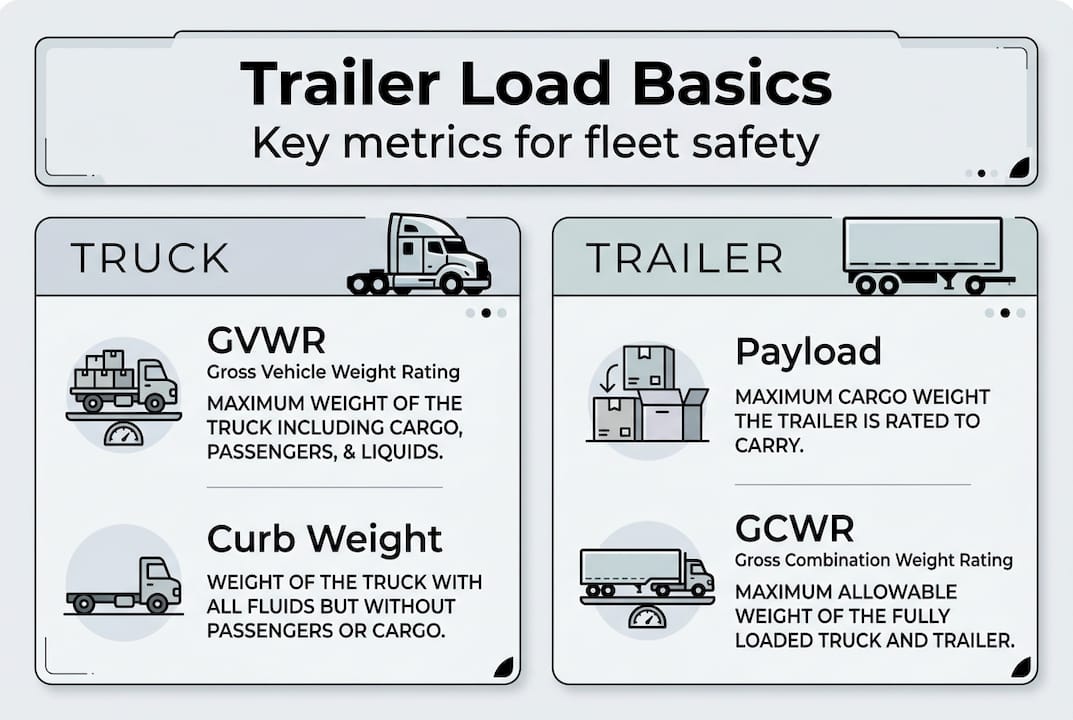
The gross vehicle weight rating (GVWR) serves as the primary capacity indicator. GVWR represents the maximum total weight of the trailer including its own structure plus the cargo it carries. To find actual payload capacity, subtract the trailer’s curb weight (empty weight) from its GVWR. For example, a trailer with a 20,000 pound GVWR that weighs 5,000 pounds empty has a 15,000 pound payload capacity.
Beyond GVWR, several other factors limit what you can safely haul:
- Axle weight ratings determine how much weight each axle assembly can support
- Tire load ratings specify maximum weight per tire at proper inflation
- Hitch and coupling ratings establish limits for tongue weight and pulling forces
- Frame and suspension specifications define structural capacity
The gross combination weight rating (GCWR) adds another layer when considering the towing vehicle. GCWR represents the maximum combined weight of the truck and loaded trailer together. Your truck’s GCWR minus its actual weight determines how much trailer and cargo it can safely pull. This distinction matters because you might have a trailer rated for 20,000 pounds, but if your truck’s GCWR only allows 15,000 pounds of trailer weight, the lower limit applies.
Pro Tip: Always weigh your loaded trailers at certified scales before long hauls. Posted ratings assume ideal conditions, but real world factors like uneven load distribution, worn components, or modified equipment can reduce actual safe capacity below rated limits.
Understanding these trailer specifications prevents the common mistake of loading based solely on cargo space rather than weight capacity. A trailer might have room for more pallets, but adding them could exceed axle ratings even if total weight stays under GVWR. Each rating serves as a potential limiting factor, and the lowest applicable limit determines your actual safe capacity.
Legal and safety regulations for trailer loading in Massachusetts and neighboring states
Operating commercial trailers across Massachusetts, Rhode Island, Connecticut, and New Hampshire requires navigating a complex web of weight regulations that vary by jurisdiction. These rules exist to protect road infrastructure, ensure public safety, and maintain fair competition among carriers. Violations carry serious consequences beyond fines, including out of service orders that strand your equipment and cargo.
Massachusetts enforces specific weight limits that fleet managers must observe:
- Maximum gross vehicle weight of 80,000 pounds on interstate highways
- Single axle limit of 22,400 pounds
- Tandem axle limit of 36,000 pounds
- Bridge formula calculations for axle spacing and weight distribution
Neighboring states maintain similar but not identical standards. Rhode Island matches federal limits but has specific bridge restrictions on certain routes. Connecticut enforces the same 80,000 pound maximum but applies stricter seasonal weight restrictions during spring thaw periods. New Hampshire allows higher weights on some state roads but requires special permits. These variations mean interstate operations demand careful route planning and load adjustment.
Overloading triggers escalating penalties. First violations typically result in fines calculated per pound over the limit, often starting at $0.10 per pound and increasing for repeat offenses. Exceeding limits by more than 10% can result in criminal charges rather than civil citations. Beyond financial penalties, overweight violations add points to your carrier safety rating, potentially triggering increased inspection frequency and affecting insurance rates.
Understanding and adhering to commercial trailer requirements in Massachusetts protects your business from operational disruptions and maintains your safety record for competitive advantage.
Federal Motor Carrier Safety Administration (FMCSA) regulations add another compliance layer. These rules require proper cargo securement regardless of weight, mandate regular vehicle inspections, and establish driver qualification standards. The intersection of state weight laws and federal safety regulations means compliance requires attention to both jurisdictions simultaneously.
Roadside inspections focus heavily on weight compliance. Portable scales allow enforcement officers to check weights anywhere, not just at fixed weigh stations. During Level 1 inspections, officers examine vehicle components for signs of overloading like compressed springs, tire bulging, or frame stress. Even if you pass the scale, visible overload indicators can trigger detailed mechanical inspections that find other violations.
Smart fleet managers build compliance buffers into their load planning. Rather than loading to exact legal limits, experienced operators stay 5 to 10% below maximums to account for scale variations, fuel weight, and measurement uncertainties. This buffer prevents violations from minor calculation errors or unexpected weight additions.
Comparing trailer types and their load capacities for optimal fleet selection
Selecting appropriate trailers for your fleet requires matching load capacity to operational demands while staying within legal and safety parameters. Different trailer designs offer varying capacity ranges, and understanding these differences helps optimize your equipment investment. The right choice balances payload capability, cargo type compatibility, and regulatory compliance.
| Trailer Type | Typical GVWR Range | Payload Capacity | Best Applications |
|---|---|---|---|
| Utility trailer | 2,990 to 14,000 lbs | 1,500 to 10,000 lbs | Equipment transport, landscaping, light construction |
| Flatbed trailer | 25,000 to 48,000 lbs | 20,000 to 45,000 lbs | Building materials, machinery, oversized cargo |
| Dry van trailer | 30,000 to 45,000 lbs | 22,000 to 42,000 lbs | Packaged goods, palletized freight, general cargo |
| Refrigerated trailer | 32,000 to 44,000 lbs | 20,000 to 40,000 lbs | Perishable foods, pharmaceuticals, temperature sensitive |
| Dump trailer | 14,000 to 25,000 lbs | 10,000 to 20,000 lbs | Aggregate, demolition debris, bulk materials |
Matching utility trailer types to Massachusetts fleet needs starts with analyzing your typical cargo characteristics. Consider weight density, dimensions, protection requirements, and loading methods. A landscaping company hauling mulch needs different capacity than a contractor moving steel beams, even if both operate in similar weight ranges.
Follow this selection process to identify optimal trailer capacity:
- Calculate your typical cargo weights including packaging and securement equipment
- Add 15 to 20% buffer for operational flexibility and occasional heavier loads
- Verify the resulting capacity fits within your truck’s towing rating and GCWR
- Check that axle configurations meet state regulations for your routes
- Confirm tire ratings and suspension specs support the required capacity
- Factor in trailer features that add weight like refrigeration units or hydraulic systems
Trailer features significantly impact usable payload capacity. Refrigerated units add 2,000 to 3,000 pounds of equipment weight, reducing available payload compared to dry vans with identical GVWR. Aluminum flatbeds weigh less than steel versions, offering higher payload in the same GVWR class. Multiple axle configurations distribute weight better but add structural weight that reduces net capacity.

Pro Tip: Document your capacity calculations and selection rationale for each trailer purchase. This record helps justify equipment decisions during audits, supports replacement planning, and ensures consistency across your fleet as it grows.
Underutilizing capacity costs money through inefficient trips, while overestimating capacity creates safety and compliance risks. The 40 trailer use considerations demonstrate how matching trailer size to actual needs improves operational economics. A trailer rated for 40,000 pounds that typically carries 25,000 pounds wastes fuel and increases per mile costs compared to a properly sized alternative.
Specialized applications require specific trailer types. Oversized or oddly shaped cargo often demands flatbeds despite lower cubic capacity utilization. Fragile goods need enclosed protection even if weight permits open transport. Understanding how cargo characteristics interact with trailer design helps you build a versatile fleet that handles diverse loads safely and legally.
Best practices for managing trailer load capacity effectively
Implementing systematic load management practices protects your fleet investment, maintains compliance, and prevents costly incidents. Effective capacity management extends beyond initial trailer selection to encompass daily operational procedures, driver training, and ongoing equipment monitoring. These practices work together to ensure every load stays within safe and legal limits.
Core loading best practices include:
- Calculate total cargo weight before loading using bills of lading, packing lists, or direct weighing
- Distribute weight evenly across the trailer length to prevent axle overloading
- Position heavier items low and centered to maintain stability and proper tongue weight
- Verify tire pressures match load requirements per manufacturer specifications
- Document load weights and distributions for compliance records
- Recheck weights after loading if you add or shift cargo
Load distribution matters as much as total weight. Concentrating weight over rear axles while leaving front axles light creates handling problems and violates axle weight limits even if gross weight stays legal. Proper distribution typically places 60% of cargo weight forward of the trailer centerline for tandem axle configurations. Single axle trailers require centering the load over the axle position.
Pro Tip: Install onboard weighing systems on trailers that regularly operate near capacity limits. These systems provide real time weight data during loading, preventing overweight situations before they occur and eliminating guesswork from load planning.
| Load Distribution Factor | Impact on Safety | Impact on Compliance | Impact on Equipment Life |
|---|---|---|---|
| Proper centering | Reduces sway by 40% | Prevents axle violations | Extends tire life 25% |
| Even side to side balance | Improves stability 35% | Maintains legal axle loads | Reduces suspension wear 30% |
| Correct tongue weight | Enhances control 45% | Meets hitch ratings | Decreases frame stress 20% |
| Low center of gravity | Lowers rollover risk 50% | Supports safe speeds | Minimizes body damage 15% |
Recognizing overload warning signs helps catch problems before they escalate. Watch for compressed suspension that bottoms out over bumps, tires that bulge at the sidewalls, unusual trailer sway or fishtailing, difficulty maintaining speed on grades, and longer than normal stopping distances. These symptoms indicate you’ve exceeded safe capacity limits even if you haven’t weighed the load.
Keeping trailers roadworthy through regular inspections identifies capacity related wear before it causes failures. Check tire tread depth and pressure weekly, inspect suspension components monthly for cracks or deformation, examine frame rails for stress indicators, and verify brake function meets specifications. Components stressed by repeated heavy loading fail faster than those operating within design parameters.
Driver training forms the foundation of effective capacity management. Ensure every operator understands GVWR, payload calculations, axle weight distribution, and legal limits for your operating regions. Train drivers to recognize overload symptoms and empower them to refuse unsafe loads. Create clear protocols for weighing, documenting, and adjusting loads before departure.
Efficient load planning techniques from packing storage containers apply equally to trailer loading. Maximize space utilization while respecting weight limits by mixing heavy and light items strategically. Use dunnage and blocking to prevent load shifts that could redistribute weight dangerously during transport. Plan loading sequences that place delivery stops in accessible positions without requiring weight redistribution en route.
Communication between dispatch, loading crews, and drivers prevents capacity problems. Establish clear procedures for sharing cargo weights, discussing load concerns, and resolving capacity conflicts before vehicles leave the yard. When multiple stops involve partial unloading, plan the sequence to maintain proper weight distribution throughout the route.
Technology tools simplify capacity management. Fleet management software can track individual trailer capacities, alert dispatchers when planned loads approach limits, and maintain compliance documentation automatically. Mobile apps help drivers access trailer specifications, calculate remaining capacity, and locate nearby certified scales for verification weighing.
Optimize your fleet with the right trailers today
Understanding trailer load capacity is just the first step. Applying this knowledge requires access to properly rated equipment that matches your operational demands while meeting all regulatory requirements. Finding trailers with the right capacity specifications, in good mechanical condition, and at reasonable prices challenges many fleet managers.
Apple Truck & Trailer has served Massachusetts fleet operators since 1986, providing expertly maintained commercial trailers across all capacity ranges. Our inventory includes utility trailers, flatbeds, dry vans, and specialized equipment selected for regional compliance and operational versatility. Every trailer undergoes thorough inspection to verify ratings, mechanical condition, and safety systems before sale.
Our team understands the capacity calculations, regulatory requirements, and practical considerations that Massachusetts fleet managers face daily. We help match your cargo characteristics and route profiles to trailers that optimize payload while staying within legal limits. Whether you need truck and trailer sales in Massachusetts for fleet expansion or guidance on buying used commercial trucks to upgrade towing capacity, our experience ensures you select equipment that performs reliably. Review detailed trailer specifications for our current inventory and consult with our specialists to find solutions that enhance your fleet efficiency.
Frequently asked questions
What is trailer load capacity?
Trailer load capacity is the maximum weight a trailer can safely carry, defined by its GVWR minus its own curb weight. This represents the payload available for cargo, equipment, and any additional items loaded onto the trailer.
How do I calculate the load capacity of my trailer?
Load capacity equals the trailer’s GVWR minus the trailer’s curb weight. You must also verify this calculated capacity doesn’t exceed individual axle ratings, tire load limits, or legal weight restrictions for your operating region.
What are the risks of exceeding trailer load capacity limits?
Exceeding capacity increases accident risk due to compromised handling, longer stopping distances, and potential component failures. You face regulatory fines and legal penalties for noncompliance. Overloading causes accelerated wear on tires, brakes, suspension, and frame components, leading to expensive repairs and unexpected downtime.
Are trailer load capacity limits different across states in New England?
Yes, Massachusetts and neighboring states have varying axle weight limits, seasonal restrictions, and bridge formula requirements despite sharing similar gross weight maximums. Fleet managers operating across state lines must understand commercial trailer requirements in Massachusetts and adjacent jurisdictions to maintain compliance throughout their service areas. Connecticut enforces spring weight restrictions, while New Hampshire allows higher weights on certain roads with permits.
Recommended
- 7 Key Things Fleet Managers Must Know About 40 Trailer Use – Apple Truck & Trailer
- Keeping Trailers Roadworthy: Safety and Compliance Essentials – Apple Truck & Trailer
- Trailer Rental FAQs: Solving Common Fleet Challenges – Apple Truck & Trailer
- 7 Key Tips for Choosing the Right 40 ft Trailer – Apple Truck & Trailer