
Real-world truck efficiency can swing from under 7 mpg to nearly 11.8 mpg in NACFE tests depending on powertrain, route, and load. That’s not a small gap. For fleet managers in Massachusetts and across New England, that difference translates directly into thousands of dollars per truck per year. The problem is that most conversations about efficient trucks get stuck on a single number, whether mpg or range, without accounting for the full picture. This guide breaks down what truck efficiency actually means, how the major powertrain options compare in real-world conditions, what external factors quietly drain your fuel budget, and the practical steps you can take to get more out of every truck in your fleet.
Table of Contents
- Understanding truck efficiency: More than just mpg
- Diesel, hybrid, electric, and alt-fuel trucks: Real-world performance
- Factors that impact truck efficiency: Beyond the engine
- Making your fleet more efficient: Practical strategies
- A smarter approach: Why real-world conditions matter more than spec sheets
- Next steps: Find your efficient truck solution
- Frequently asked questions
Key Takeaways
| Point | Details |
|---|---|
| No one-size-fits-all | You need to match truck and powertrain to your business routes, not just chase the highest mpg. |
| Real-world factors matter most | Terrain, telematics, and driver behavior can impact efficiency more than the engine type alone. |
| Multiple paths to efficiency | Diesel, hybrid, electric, and alt-fuel trucks each excel in different scenarios for Massachusetts fleets. |
| Data boosts performance | Tracking fleet data leads to actionable changes that save fuel and reduce costs. |
| Expert help accelerates results | Working with truck specialists makes it easier to find and maintain the most efficient vehicles for your needs. |
Understanding truck efficiency: More than just mpg
Most people think of truck efficiency as a single number on a sticker. In reality, it’s a combination of several factors that interact with each other constantly. True efficiency means balancing fuel economy, total cost of ownership, payload capacity, and uptime. A truck that gets great mpg but spends two weeks in the shop every quarter isn’t efficient. Neither is a truck with a low sticker price that burns through fuel on hilly New England routes.
Here are the key metrics that actually define truck efficiency for fleet operators:
- Fuel economy or mpge: Miles per gallon or miles per gallon equivalent, depending on the powertrain
- Total cost of ownership (TCO): Purchase price, fuel, maintenance, insurance, and resale value combined
- Payload efficiency: How much revenue-generating cargo the truck can carry per trip
- Uptime: The percentage of time the truck is available and working, not sitting in for repairs
For fleet management advice that actually moves the needle, you need to track all four, not just fuel costs.
Here’s a quick look at how the major powertrains compare on real-world benchmarks:
| Powertrain | Efficiency metric | Typical range | Best use case |
|---|---|---|---|
| Diesel | Up to 11.8 mpg | 1,000+ miles | Long-haul, heavy freight |
| Hybrid | Up to 39 mpg (light duty) | 400–600 miles | Regional, urban delivery |
| Battery-electric (BEV) | 350–500+ miles daily | 150–350 miles/charge | Urban, short-haul |
| CNG/RNG | 4.5–6.7 mpge | 300–500 miles | Urban, depot-fueled routes |
| Hydrogen fuel cell | 7.7–7.8 miles/kg | 400–700 miles | Regional, emerging |
For light-duty fleets, the Ford Maverick Hybrid leads at 39 mpg combined among non-electric trucks, which is a useful benchmark when evaluating smaller delivery vehicles. Understanding the range of utility trailer types that pair with each powertrain also affects your overall efficiency calculation, since trailer aerodynamics and weight play a significant role.
Diesel, hybrid, electric, and alt-fuel trucks: Real-world performance
With those benchmarks in mind, it’s time to dig into how each major truck type stacks up for regional and long-haul operations. The data tells a nuanced story, and the winner depends almost entirely on your specific operation.
| Powertrain | Uptime | Infrastructure needs | Relative fuel cost | Best duty cycle |
|---|---|---|---|---|
| Diesel | Very high | Widely available | Moderate | Long-haul, heavy loads |
| Hybrid | High | Standard fueling | Low to moderate | Urban, regional |
| BEV | Moderate | Charging required | Low | Short-haul, urban |
| CNG/RNG | Moderate | Depot fueling | Low | Urban, predictable routes |
| Hydrogen | Emerging | Very limited | High | Regional pilot programs |
Real-world data from NACFE confirms that diesel achieves up to 11.8 mpg, CNG/RNG hits 4.5–6.7 mpge, and hydrogen reaches 7.7–7.8 miles/kg. These aren’t ideal conditions. They’re measured across actual routes with real loads.
Here’s how to match powertrain to fleet need:
- Urban delivery, short routes: Battery-electric or hybrid trucks minimize fuel costs and emissions in stop-and-go traffic. Check out local delivery truck options to see what fits your city routes.
- Regional hauls under 300 miles: CNG or hybrid trucks offer a solid balance of range and fuel savings without charging infrastructure headaches.
- Long-haul freight: Diesel remains the most practical option for reliability and fueling access across New England and beyond.
- Mixed operations: A combination of powertrains, matched to duty cycle, beats any single-truck strategy.
Pro Tip: Don’t chase the highest mpg number. Instead, calculate your total cost per mile including fuel, maintenance, and downtime. A diesel truck with 11.8 mpg and low repair costs often beats a BEV with high charging infrastructure investment for regional fleets. Smart truck fleet fuel management starts with this kind of honest math.

No single powertrain wins for every fleet. Mixed fleets are increasingly the norm because they let operators match the right tool to the right job rather than forcing every route through one solution.
Factors that impact truck efficiency: Beyond the engine
Even the most efficient engine can underperform if outside factors aren’t managed. Here’s what else you need to watch.
New England terrain is one of the biggest hidden efficiency killers. Hills, winding routes, and seasonal weather all take a toll. Terrain can impact efficiency by 30% or more, and battery-electric trucks feel that impact more sharply than diesel on steep grades because regenerative braking can’t fully recover the energy lost climbing.
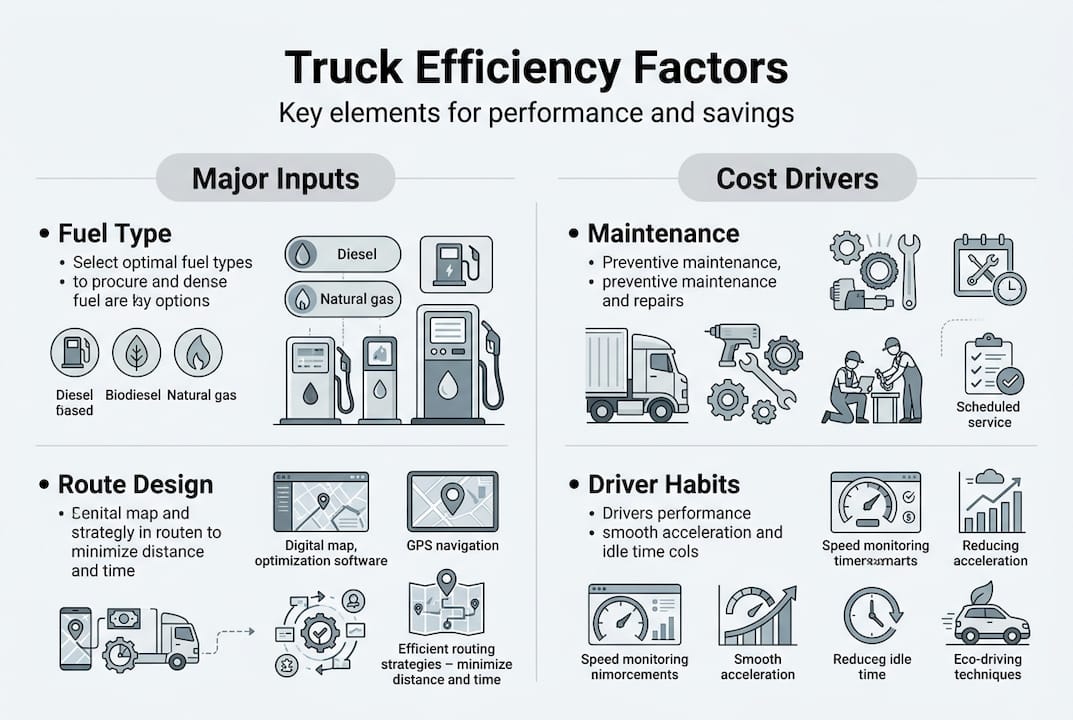
Here are the top non-engine factors that affect your fleet’s real-world efficiency:
- Driver behavior: Aggressive acceleration and hard braking can cut fuel economy by 15–30 percent
- Aerodynamics: Poorly spec’d trailers and open cargo doors at highway speeds create massive drag
- Accessory loads: HVAC systems, liftgates, and refrigeration units pull significant power from the drivetrain
- Maintenance gaps: Under-inflated tires, dirty air filters, and worn brakes all reduce efficiency quietly
- Route planning: Inefficient routing adds unnecessary miles and idle time
Telematics is where many Massachusetts fleets are finding their fastest efficiency gains. Telematics tools enable route optimization, aerodynamic tracking, and predictive maintenance for 5–10% efficiency gains without buying a single new truck. That’s real money recovered from your existing fleet.
Pro Tip: Pull your telematics data monthly and look for patterns. A single driver consistently idling 45 minutes per shift or a route with repeated stop-and-start segments can cost more than you’d expect. Sometimes a routing change or a coaching conversation improves mpg more than a new vehicle purchase would.
Good fleet management advice always starts with understanding what your current trucks are actually doing before spending money on replacements. Pairing that with a solid approach to reducing downtime and preventive maintenance keeps your efficiency gains from eroding over time.
Making your fleet more efficient: Practical strategies
You’ve seen what affects truck efficiency. Now here’s how to turn that knowledge into measurable gains for your fleet.
Start with a structured approach rather than making random changes. The most effective fleet managers treat efficiency improvement as a process, not a one-time fix. Benchmarking diesel, hybrid, and BEV trucks against your actual duty cycles is the foundation of any serious improvement plan.
Here’s a step-by-step plan to get started:
- Audit your existing fleet: Document each truck’s actual mpg, maintenance history, route type, and payload utilization. You can’t improve what you don’t measure.
- Analyze duty cycles: Match each vehicle to the routes it runs. Are you using a long-haul diesel for urban stop-and-go? That mismatch alone could be costing you significantly.
- Deploy telematics: Install or activate telematics on every truck. Use the data to identify idle time, speeding, harsh braking, and inefficient routing. Review your truck fuel management tips to build a monitoring routine.
- Train your drivers: Driver behavior is one of the highest-impact levers you have. Regular coaching on smooth acceleration, proper following distance, and idle reduction pays off fast.
Beyond the audit, here are best practices that deliver rapid efficiency wins:
- Schedule preventive maintenance on a fixed calendar, not just when something breaks. Follow a solid maintenance schedule guide to stay ahead of problems.
- Check tire pressure weekly. Under-inflation is one of the most common and most avoidable efficiency losses.
- Use load planning software to maximize payload per trip and reduce empty miles.
- Review fuel card data monthly to catch unusual consumption patterns early.
Getting buy-in from drivers and dispatchers matters as much as the technology. When your team understands why efficiency matters and sees their own performance data, they become partners in improvement rather than resistors to change.
A smarter approach: Why real-world conditions matter more than spec sheets
Bringing all these insights together, here’s what we’ve learned from both industry research and boots-on-the-ground experience in Massachusetts and across New England.
Spec sheets are written for ideal conditions. New England is not ideal conditions. Hills, cold winters, coastal humidity, and the mix of urban and rural routes that most Massachusetts fleets deal with daily create a very different environment than a flat interstate in the Southwest. A truck that looks great on paper can underperform significantly once it’s navigating Route 9 in February with a full load.
The NACFE research is clear: no single powertrain wins across all conditions. The best-performing fleets in 2026 are the ones that match vehicle to duty cycle with discipline, use data to make decisions, and resist the temptation to chase a single efficiency metric.
We’ve seen fleet managers get burned by buying the newest technology before the infrastructure existed to support it, and we’ve seen others squeeze years of additional value out of well-maintained existing trucks simply by matching them to the right routes. Sometimes the best investment isn’t a newer truck. It’s a smarter assignment of the trucks you already have. Exploring the right utility trailer choices for each application is part of that same discipline.
A mixed fleet strategy, combining diesel reliability with hybrid or electric options where infrastructure supports it, is the most practical path forward for most operations in this region.
Next steps: Find your efficient truck solution
Ready to put efficiency insights into practice? Apple Truck and Trailer has been helping Massachusetts fleet operators find the right equipment since 1986, and we understand the specific demands of New England routes and operations.
Whether you’re looking at buying a used commercial truck that fits your duty cycle, exploring the full range of truck and trailer sales in our current inventory, or considering truck leasing options to preserve capital while upgrading your fleet, our team can help you find the right match. We don’t just sell trucks. We help you make a decision that holds up in the real world, not just on a spec sheet. Reach out today for a personalized consultation.
Frequently asked questions
What truck powertrain is most efficient for Massachusetts fleets in 2026?
There’s no single most efficient powertrain. Matching truck type to your duty cycle, routes, and local refueling infrastructure consistently delivers the best results for regional fleets.
How do telematics help improve truck efficiency?
Telematics systems track routes, driver behavior, and maintenance needs, delivering 5–10% fuel savings or more without requiring new equipment purchases.
What range can electric trucks cover in a typical workday?
Modern battery-electric Class 8 trucks achieve 350 to 500-plus miles daily, though real-world range depends on battery size, terrain, and load.
Which non-electric truck offers the highest fuel economy in 2026?
The Ford Maverick Hybrid at 39 mpg combined leads all non-electric trucks in EPA ratings, making it a strong option for light-duty fleet applications.
Recommended
- Fleet Management Advice: Maximizing Efficiency and Savings – Apple Truck & Trailer
- Truck Fleet Fuel Management: Reducing Costs and Waste – Apple Truck & Trailer
- Benefits of Preventive Maintenance for Truck Fleets – Apple Truck & Trailer
- Truck Parking Solutions: Maximizing Fleet Efficiency – Apple Truck & Trailer