
TL;DR:
- Monthly box truck rentals offer flexible, short-term access without long-term liabilities.
- They are ideal for businesses with variable demand, providing predictable costs and easy exit options.
- Proper assessment of cargo needs and demand patterns can reveal significant cost savings over leasing.
Many Massachusetts businesses assume that leasing is automatically the smarter, cheaper option when they need a box truck for more than a week or two. That assumption costs companies real money. Monthly box truck rental has evolved into a serious alternative that delivers flexibility, predictable costs, and zero long-term liability. Whether you’re managing seasonal delivery surges, covering a gap in your fleet, or scaling operations across New England, understanding the monthly rental model could fundamentally change how you think about your transportation budget.
Table of Contents
- How does monthly box truck rental work?
- Monthly rental vs leasing: What’s the real difference?
- Key factors when choosing the right box truck rental
- Maximizing value: Tips for saving with monthly rentals
- Our take: What most businesses miss about monthly box truck rental
- Ready to simplify your fleet? Rent or lease today
- Frequently asked questions
Key Takeaways
| Point | Details |
|---|---|
| Flexible contracts | Monthly box truck rentals let you adapt quickly to business shifts without long-term commitments. |
| Know your numbers | Compare total rental and leasing costs, including insurance and extra fees, to make the smartest choice. |
| Factor in downtime | Scheduling and proper utilization help reduce waste and boost your return on a rental. |
| Consider seasonal needs | Monthly rentals can help cover spikes or slow periods in Massachusetts logistics operations. |
How does monthly box truck rental work?
A monthly box truck rental is a short-term agreement, typically 30 days and renewable, that gives your business access to a commercial box truck without committing to a multi-year lease. You pay a flat monthly rate, drive the truck within your contracted mileage allowance, and return it when your need is done. That’s the core structure.
What makes monthly rental different from daily or weekly options is the rate structure and the relationship it builds between you and the provider. Daily rentals are expensive per unit because they’re priced for emergency or one-off use. Weekly rentals are better but still carry a premium. Monthly agreements, on the other hand, reward commitment with lower per-day costs while keeping the exit door open.
Here’s what a typical monthly box truck rental contract covers:
- Mileage cap: Most contracts set a monthly mileage limit, often between 1,500 and 3,000 miles, with overage charges per mile beyond that.
- Insurance requirements: Basic liability coverage is usually included or required. Some providers bundle it; others require you to show proof of your own commercial auto policy.
- Maintenance responsibility: Unlike a full lease, monthly rentals typically keep maintenance on the provider’s side for mechanical issues. Minor upkeep like fuel and tires may fall on the renter.
- Duration flexibility: You can often extend month to month or return the truck with 15 to 30 days’ notice, depending on the agreement.
- Add-on services: Roadside assistance, GPS tracking, and even seasonal fleet swap options are available from full-service providers.
When does monthly rental make the most sense? When your business has a defined window of need that stretches beyond two weeks but doesn’t justify a multi-year lease. Think of a retail distributor ramping up for the holiday season, a moving company handling a busy spring quarter, or a contractor completing a six-week commercial build-out. The short-term rental guide lays out a clear picture of when this model outperforms other options, including the pros and cons of monthly rental versus leasing for companies moving goods.
Pro Tip: Always ask your provider about oversized and seasonal fleet options before you sign. Some providers in Massachusetts can swap you into a larger truck if your freight volume changes mid-contract. That kind of built-in adaptability is worth more than a slightly lower base rate.
Learning how to lease a box truck first will help you understand the contrast clearly. Once you see what a lease actually commits you to, the monthly rental option looks even more strategic for uncertain demand periods.
Monthly rental vs leasing: What’s the real difference?
This is where most businesses get confused, and where the wrong choice can cost thousands. Monthly rental and leasing both give you access to a truck without buying it outright, but they operate under completely different financial and operational logic.
Here’s a direct comparison to put the differences in sharp focus:
| Factor | Monthly Rental | Long-Term Lease |
|---|---|---|
| Commitment | 30 days, renewable | Typically 12 to 60 months |
| Monthly cost | Higher per month | Lower per month |
| Maintenance | Usually on provider | Often on lessee |
| Fleet flexibility | High (swap or return) | Low (locked in) |
| Best for | Variable or seasonal demand | Steady, predictable volume |
| Exit cost | None or minimal notice fee | Can include early termination penalties |
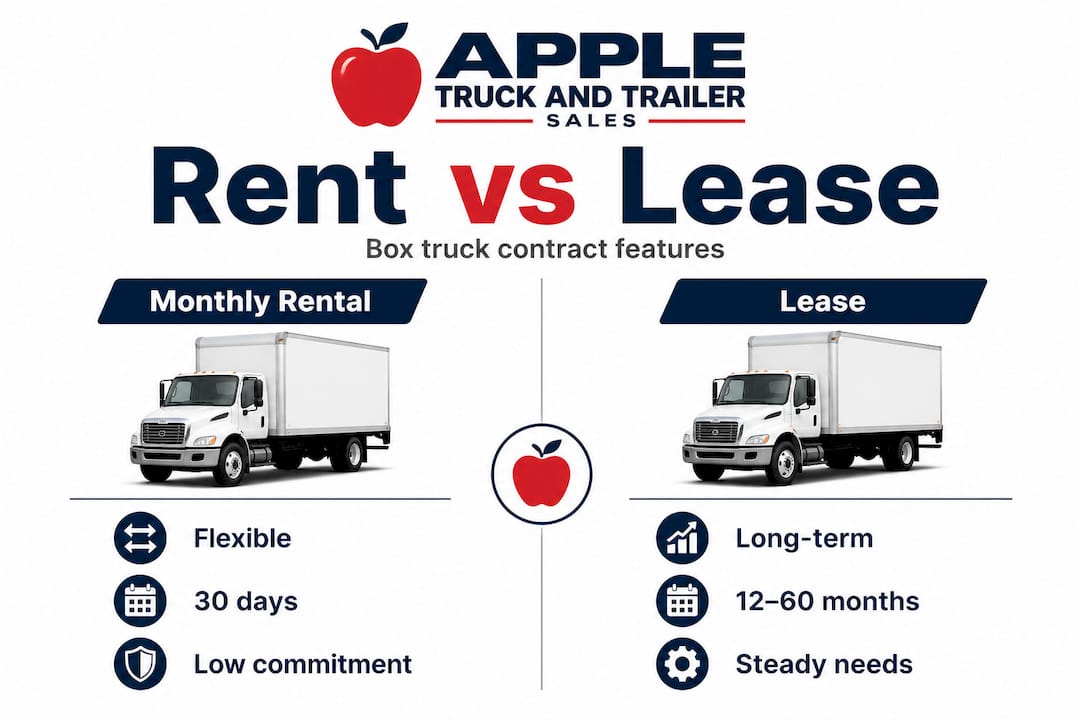
The box truck lease costs for a standard 26-foot unit typically run lower monthly than a rental agreement, but that lower number comes with strings attached. Lease agreements can span two to five years, and exiting early often triggers penalties that wipe out any savings you banked in lower monthly payments.
Here’s a useful way to think about it in numbered steps:
- Calculate your certain need period. If you need a truck for fewer than six months, monthly rental almost always wins on total cost when you factor in lease penalties.
- Assess your demand variability. Businesses with unpredictable freight volumes benefit from the flexibility to return a rental without penalty.
- Add up hidden lease costs. Maintenance obligations, insurance requirements, and early termination fees can push truck leasing pros and cons into negative territory faster than expected.
- Consider your cash flow. Leases sometimes require larger upfront deposits. Monthly rentals tend to have lower entry costs.
- Look at regional market conditions. In Massachusetts and southern New England, seasonal demand swings are real. A rental structure lets you match capacity to actual business cycles rather than paying for a truck sitting in your lot in February.
The benefits of truck leasing are genuine for businesses with steady, documented freight needs over 24 to 60 months. But for everyone else, the flexibility of monthly rental is a practical and financially sound choice.
Pro Tip: Pull your last three months of delivery data before you decide. If your freight volume varies by more than 25% from month to month, monthly rental likely fits your operation better than a rigid lease structure.
Key factors when choosing the right box truck rental
Choosing the right box truck is not just about picking the largest one available. The wrong truck wastes fuel, increases liability risk, and can create operational headaches that outweigh the convenience of having a vehicle at all.
Here are the core factors every Massachusetts business should evaluate:
- Cargo size and payload: Box trucks typically come in 12-foot, 16-foot, 20-foot, and 26-foot configurations. Match the truck’s payload rating to your average load, not your maximum load.
- Fuel efficiency: Diesel versus gas matters when you’re running routes through Greater Boston, Worcester, or along the I-95 corridor. Diesel units typically cost more to rent but deliver better mileage on highway routes.
- Loading requirements: Does your freight require a liftgate? Many rental providers offer liftgate-equipped units, but you need to request this at booking.
- Insurance and liability: Understand exactly what the rental provider’s coverage includes and where your business liability begins. This matters especially for high-value cargo or pharmaceutical and food deliveries.
- Regional coverage and support: Breakdowns happen. Choose a provider that offers roadside assistance across Massachusetts, Rhode Island, Connecticut, and New Hampshire if your routes cross state lines.
- Cab comfort and driver safety: For daily or multi-shift use, cab features like climate control, backup cameras, and GPS hookups reduce driver fatigue and accident risk.
The box truck vs flatbed comparison is a good starting point for businesses that aren’t sure which truck type fits their freight profile. For enclosed, weather-sensitive goods, box trucks are almost always the right call. For oversized or bulk materials, a flatbed may be more practical, and understanding that distinction early saves time in the selection process.
Here’s a quick reference for common Massachusetts business scenarios:
| Business type | Ideal box truck size | Key feature needed |
|---|---|---|
| Local moving company | 20 to 26 foot | Liftgate, cargo straps |
| Restaurant supply distributor | 16 to 20 foot | Refrigeration, route efficiency |
| E-commerce last-mile delivery | 12 to 16 foot | High door clearance, urban maneuverability |
| Construction materials hauler | 20 to 26 foot | High payload, flatbed may also suit |
| Medical or pharma delivery | 16 to 20 foot | Climate control, insurance add-ons |
Strong fleet management tips suggest reviewing your cargo specs in detail with your rental provider before finalizing any agreement. A five-minute conversation upfront prevents a very expensive mismatch down the road.

Pro Tip: Always review the insurance liability section of any rental contract before you sign. Know specifically what happens if the truck is damaged in a minor accident on a Boston side street versus a highway incident. The coverage terms are often very different.
Maximizing value: Tips for saving with monthly rentals
Getting a monthly box truck rental on your fleet is step one. Getting the most out of it is where most businesses leave money on the table. Thoughtful scheduling, negotiation, and service bundling can turn a good rental into a genuinely cost-effective logistics solution.
Here’s how to do it right:
- Negotiate seasonal terms. If your business is busiest from October through January, ask your provider for a seasonal rate structure. Many full-service providers in New England will work with you on pricing if you commit to returning in the next busy cycle.
- Bundle insurance and roadside assistance. Purchasing these services separately through a third party almost always costs more. Ask your rental provider what packages they offer. Bundled coverage simplifies your billing and often costs 10 to 20 percent less.
- Set up a mileage tracking system. Overage charges are one of the most common surprise costs in monthly truck rental. Use a simple spreadsheet or a fleet app to track daily miles and flag when you’re approaching your cap.
- Schedule around your freight peaks. Don’t run a rental truck at 40% capacity for three weeks just to cover one or two heavy-load days. Plan your rental window to align tightly with your actual high-volume period.
- Establish a rotation with your provider. If you regularly need a truck for seasonal or quarterly spikes, talk to your provider about a rotation agreement. You get priority access; they get predictable revenue. Both sides win.
“Proper scheduling and utilization can cut waste by 15% seasonally, making monthly rentals a smarter choice than adding permanent fleet capacity.”
This kind of operational discipline is exactly what separates businesses that profit from their rental arrangements from those that just break even. Solid fleet management advice emphasizes that guidance for transportation managers on using monthly box truck rentals in fleet operations should always include utilization rate tracking. If your truck sits idle more than three days a week, you’re almost certainly renting more capacity than you need.
Our take: What most businesses miss about monthly box truck rental
Here’s what we’ve seen after decades of working with fleet operators, logistics managers, and small business owners across Massachusetts and southern New England. Most companies undervalue flexibility because they can’t put a dollar amount on it. They see the monthly rental rate, compare it to a lower lease payment, and choose the lease because the math looks obvious. It isn’t.
What they’re not calculating is the cost of being locked in. A long-term lease signed in a stable year becomes a serious problem in a down quarter. You’re still paying for a truck even when freight volume drops 30 percent. Monthly rental eliminates that risk entirely. You’re buying optionality, and optionality has real financial value even when you can’t see it on a spreadsheet.
The regional reality in Massachusetts makes this even more pronounced. Construction cycles, tourism-driven retail, seasonal agriculture, and New England weather all create demand volatility that doesn’t exist in more stable logistics markets. The short-term truck rental model was genuinely built for this kind of environment, where evaluating the pros and cons of monthly rental versus leasing for companies moving goods is not a generic exercise but a regionally specific decision.
Our strongest recommendation: model your last three months of logistics cycles honestly. Look at the days you actually needed a truck, the loads you moved, and the total mileage. If those numbers fit within a monthly rental structure, you would likely have paid less under a rental than a lease when you account for flexibility. Most businesses are genuinely surprised by what that analysis shows.
The advanced leasing guide is still worth reading, because understanding what a lease fully requires is the best way to appreciate why monthly rental is often the smarter starting point. Don’t skip to a lease just because it sounds like a professional choice. Make the decision based on your actual numbers.
Ready to simplify your fleet? Rent or lease today
Monthly box truck rental gives Massachusetts businesses real flexibility, controlled costs, and the freedom to scale up or down without penalty. Whether you need one truck for a busy quarter or want to test a new delivery route before committing to permanent capacity, monthly rental is a practical, low-risk solution that fits how regional logistics actually works.
At Apple Truck and Trailer, we’ve been helping businesses across Massachusetts, Rhode Island, Connecticut, and New Hampshire manage their truck and trailer needs since 1986. From truck leasing in Massachusetts to rental solutions and a full inventory of used commercial trucks, we offer the equipment and expertise to match your business to the right solution. Contact us today for a no-obligation quote and let’s build the right arrangement for your operation.
Frequently asked questions
How much does it cost to rent a box truck monthly in Massachusetts?
Monthly box truck rental rates in Massachusetts generally range from $1,200 to $2,000 per month depending on truck size, mileage allowance, and included services. Additional charges like insurance add-ons or overage miles can adjust the total.
Are there mileage limits on monthly box truck rentals?
Yes, most monthly rental contracts include a mileage cap, typically between 1,500 and 3,000 miles per month, with per-mile overage fees. Always review the mileage terms carefully before signing so you can plan your routes accordingly.
Is insurance included with monthly truck rentals?
Basic liability insurance is typically included or required as part of the rental agreement, but coverage limits vary significantly by provider. Confirm the exact terms and ask about supplemental coverage options for high-value or specialized cargo.
Can I switch trucks during my monthly rental period?
Some providers allow vehicle swaps if your business needs change, but this varies by rental agreement and is not guaranteed. Always ask your provider about swap flexibility before signing any monthly rental contract.
Recommended
- How Much Does It Cost To Lease A Box Truck: Buyer’s Guide for Best Deals in 2024 – Apple Truck & Trailer
- How to Lease a Box Truck: Your Powerful Guide with Tips and Tricks – Apple Truck & Trailer
- Short-Term Truck Rental: Smarter Logistics Choices – Apple Truck & Trailer
- Box Truck vs Flatbed: Choosing the Right Truck for Your Needs – Apple Truck & Trailer